

A five-dimensional model has successfully predicted the asymmetric fission of mercury isotopes, offering new insights into nuclear fission processes beyond the well-studied elements uranium and plutonium.
A five-dimensional (5D) Langevin model developed by an international team of researchers, including scientists from Science Tokyo, has accurately reproduced complex fission fragment distributions and kinetic energies in medium-mass mercury isotopes (180Hg and 190Hg). The model successfully captures the unusual “double-humped” mass distribution seen in mercury-180 and reveals how nuclear shell effects influence fission dynamics, even at higher excitation energies than previously assumed. This work deepens our understanding of nuclear fission in the sub-lead region.
Nuclear fission, the process in which an atomic nucleus splits into smaller parts, is a key phenomenon in nuclear physics. While the fission of heavy elements like uranium and plutonium has been extensively studied, lighter nuclei such as mercury (Hg) behave in ways that are not well explained by existing models.
Experiments have shown that 180Hg undergoes an unusual type of asymmetric fission, producing fragments of very different sizes. These results challenge current theories and point to the importance of understanding how nuclear structure affects fission in elements with atomic numbers below 82.
A collaborative five-dimensional solution
To better understand the unusual fission behavior of mercury isotopes, an international research team led by Associate Professor Chikako Ishizuka from the Institute of Zero-Carbon Energy at the Institute of Science Tokyo (Science Tokyo), Japan, developed a five-dimensional (5D) Langevin model. Their study, published online in Physical Review C on May 20, 2025, provides accurate predictions of fragment distributions and total kinetic energy (TKE), and was selected as an Editor’s Suggestion by the journal.
The study was a collaborative effort and included Dr. F. A. Ivanyuk from the Institute for Nuclear Research Ukraine; Professor C. Schmitt from the University of Strasbourg, France; and Researcher Satoshi Chiba from NAT Co., Ltd., Japan, as co-authors.
Unlike static models, the Langevin model follows the changing shape of the nucleus in real time, from its initial equilibrium state to the point of scission, where it splits into smaller fission fragments. “Describing the fission of actinides like uranium is not enough to understand the full picture,” says Ishizuka. “We need consistent models that work for other nuclei too, especially lighter ones like Hg that behave differently.”
Realistic simulation of fission fragment distributions
The team successfully modeled the fission of two Hg isotopes: 180Hg produced from the collision of 36Ar and 144Sm, and 190Hg from 36Ar and 154Sm. For both, they calculated the distribution of fission fragment masses and their TKEs. The model was designed to simulate nuclear fission more realistically by considering both the macroscopic, large-scale, liquid-drop-like motion and microscopic shell structure effects.
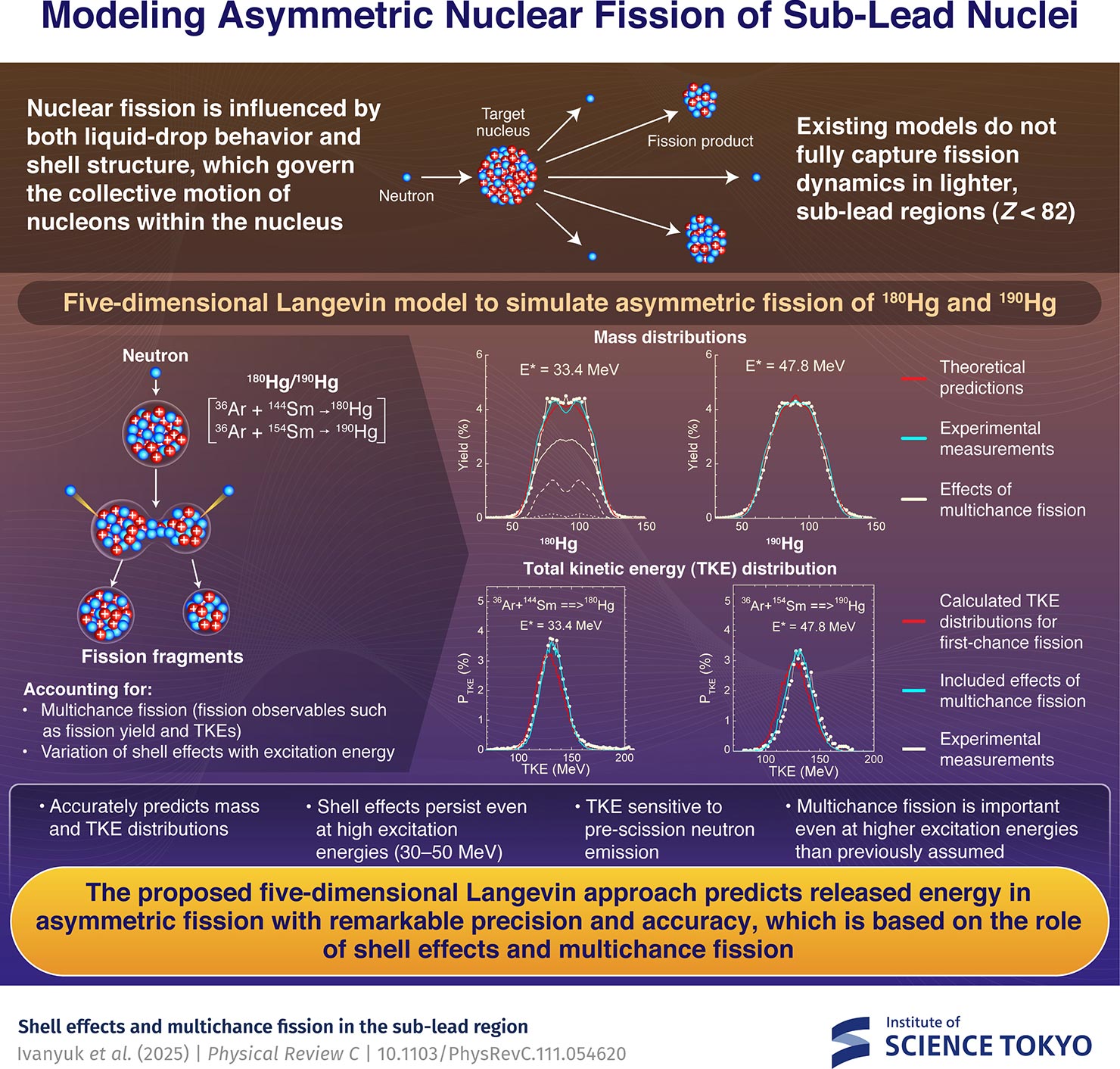
A key improvement was the use of a “soft wall” at the boundaries of the deformation space, which accurately simulates how the shape of the nucleus evolves during fission. The model also accounted for how shell effects change with increasing excitation energy, an aspect that previous models often oversimplified.
Validating predictions with experimental data
The simulation results showed strong agreement with experimental data for both the mass number distributions and the TKE of fission fragments. In the case of 180Hg, the model reproduced the unusual double-humped mass pattern seen in experiments. A key finding of the study is that shell effects persist even at higher excitation energies of 40–50 MeV, where they were previously thought to vanish.
The model also accounted for multichance fission, a process where the nucleus emits neutrons before it undergoes fission. They found that while this process has only a minor effect on fragment mass distributions at low excitation energies, it significantly impacts the TKE, making it a valuable indicator for studying multichance fission.
Overall, these findings provide new insights into the fission process with important implications for fundamental research. “The calculations presented in this work confirm that our 5D Langevin approach is a reliable tool for the theoretical predictions of the fission process observables,” concludes Ishizuka.
Reference: “Shell effects and multichance fission in the sub-lead region” by F. A. Ivanyuk, C. Schmitt, C. Ishizuka and S. Chiba, 20 May 2025, Physical Review C.
DOI: 10.1103/PhysRevC.111.054620
Funding: Japan Society for the Promotion of Science
Never miss a breakthrough: Join the SciTechDaily newsletter.
Follow us on Google and Google News.
1 Comment
A five-dimensional model has successfully predicted the asymmetric fission of mercury isotopes, offering new insights into nuclear fission processes beyond the well-studied elements uranium and plutonium. Their study, published online in Physical Review C on May 20, 2025, provides accurate predictions of fragment distributions and total kinetic energy (TKE), and was selected as an Editor’s Suggestion by the journal.
Please ask researchers to think deeply:
1. Why is the result you observed asymmetric?
2. Will your observation behavior and the environment in which the object you are observing affect your observation results?
My SciTechDaily comments are often blocked.
My theory is suppressed by so-called official publications of physics and science. Few one interaction with me – this fool. Whether it is foolish or honest, researchers only need to answer one question to the public and the so-called peer-reviewed publications:
Two sets of cobalt-60 rotating in opposite directions, if they exhibit asymmetry, are they two objects that are mirror images of each other?
YES or NO.
Ask the researchers:
1. What can scientific researches and observations change?
3. How should we understand the results observed in scientific research and describe and utilize them?