
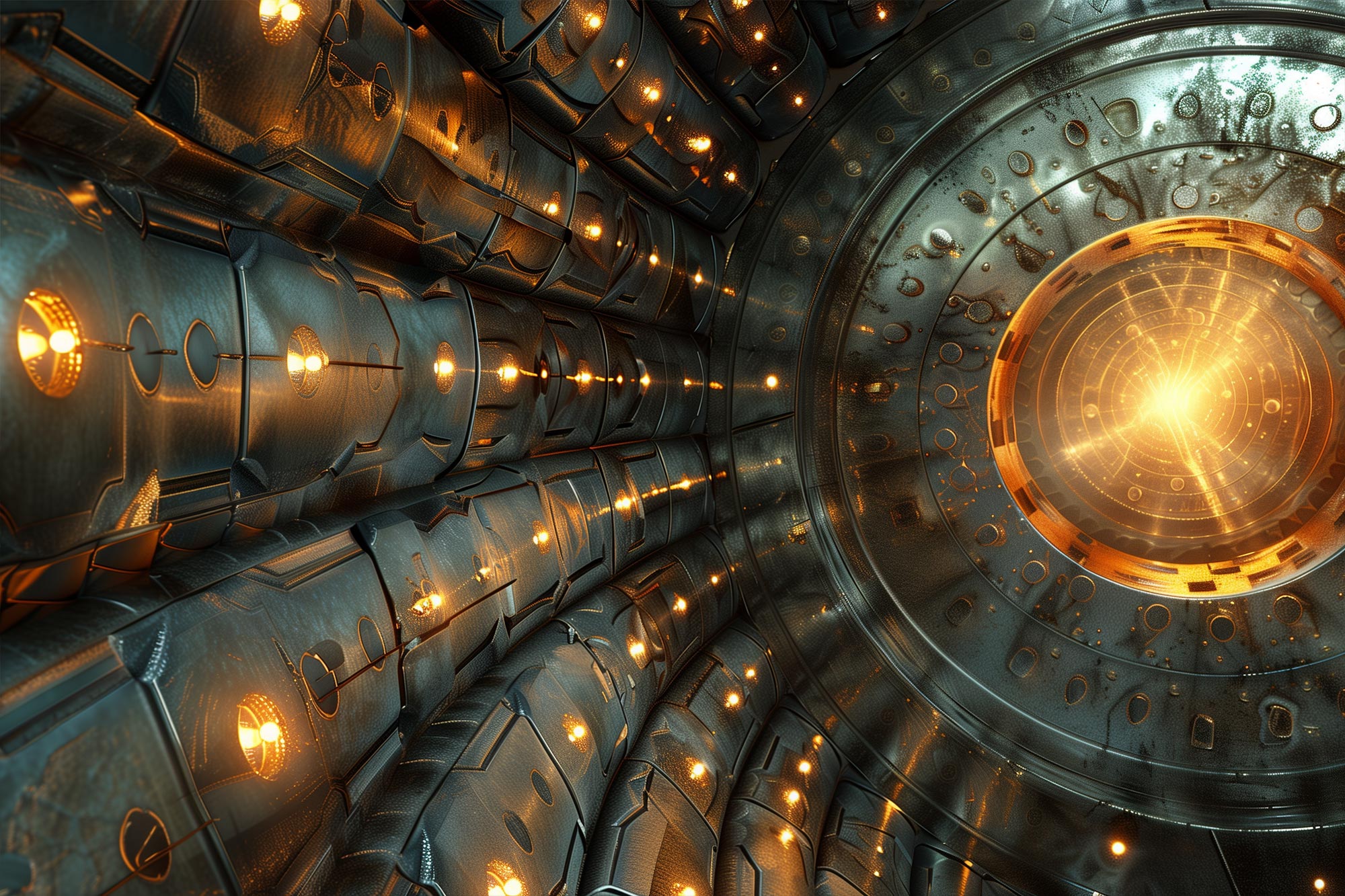
Researchers have developed a new detector that analyzes antineutrinos emitted by nuclear reactors to monitor their activities from great distances.
This technology, which utilizes the phenomena of Cherenkov radiation, could revolutionize how we ensure reactors are not producing material for nuclear weapons, despite challenges from other environmental antineutrinos.
Nuclear Fission and Antimatter Monitoring
Nuclear fission reactors provide a major energy source worldwide, with global power capacity projected to nearly double by 2050. However, it remains challenging to determine if a reactor is also producing material for nuclear weapons. Capturing and analyzing antimatter particles, specifically antineutrinos, offers a potential solution by allowing scientists to remotely monitor reactor activities from hundreds of miles away.
In a study published in AIP Advances, researchers from the University of Sheffield and the University of Hawaii introduced a new detector that can sense and analyze antineutrinos emitted by nuclear reactors. Designed by Wilson and colleagues, this detector can assess antineutrino energy profiles from a distance, offering a way to remotely monitor reactor activity.

“In this paper, we test a detector design that could be used to measure the energy of particle emission of nuclear fission reactors at large distances,” said author Stephen Wilson. “This information could tell us not only whether a reactor exists and about its operational cycle, but also how far away the reactor is.”
The Role of Neutrinos and Antineutrinos
Neutrinos are chargeless elementary particles that have a mass of nearly zero, and antineutrinos are their antimatter counterpart, most often created during nuclear reactions. Capturing these antiparticles and analyzing their energy levels provides information on anything from operational cycle to specific isotopes in spent fuel.
The group’s detector design exploits Cherenkov radiation, a phenomenon in which radiation is emitted when charged particles moving faster than light pass through a particular medium, akin to sonic booms when crossing the sound barrier. This is also responsible for nuclear reactors’ eerie blue glow and has been used to detect neutrinos in astrophysics laboratories.
Challenges and Future Directions in Antineutrino Detection
The researchers proposed to assemble their device in northeast England and detect antineutrinos from reactors from all over the U.K. as well as in northern France.
One issue, however, is that antineutrinos from the upper atmosphere and space can muddle the signal, especially as very distant reactors yield exceeding small signals — sometimes on the order of a single antineutrino per day.
To account for this, the group proposed to place their detector in a mine more than 1 kilometer underground.
“Discriminating between these particles is also a significant analysis challenge, and being able to measure an energy spectrum can take an impractically long time,” Wilson said. “In many ways, what surprised me most is that this is not actually impossible.”
Wilson hopes the detector stimulates more discussion in how to use antineutrinos to monitor reactors, including measuring the antineutrino spectrum of spent nuclear fuel or developing smaller detectors for use closer to reactors.
Reference: “Remote reactor ranging via antineutrino oscillations” by S. T. Wilson, J. Armitage, C. Cotsford, N. Holland, J. G. Learned and M. Malek, 1 October 2024, AIP Advances.
DOI: 10.1063/5.0220877
Never miss a breakthrough: Join the SciTechDaily newsletter.
Follow us on Google and Google News.
1 Comment
The universe is not algebra, formulas, or fractions. The universe is the superposition, deflection, and entanglement of geometric shapes, is the interaction and balance of topological vortices and their fractal structures. The imagined particles are no different from the imagined God.