
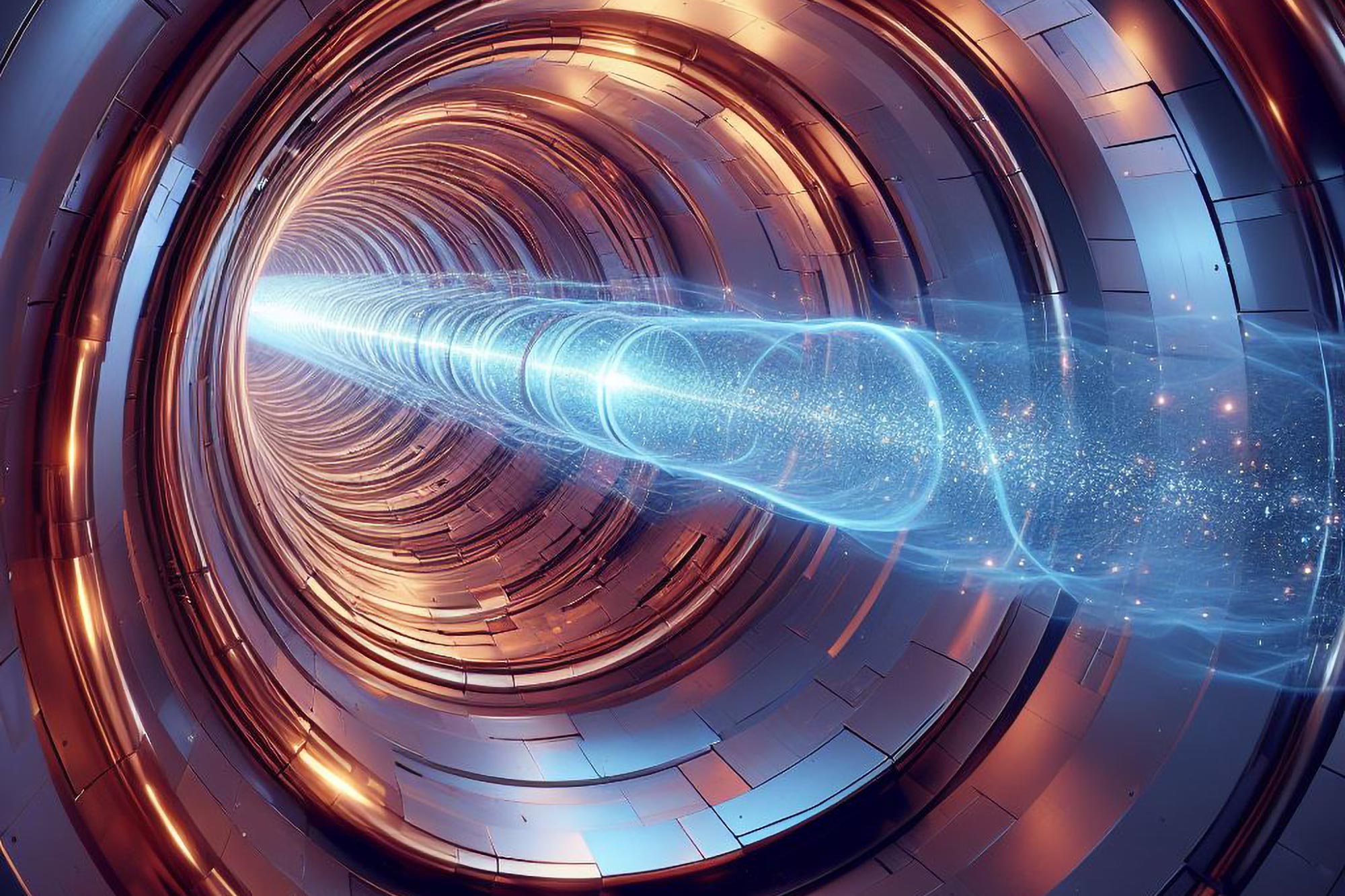
At the Facility for Rare Isotope Beams, a major advancement has been achieved with the successful acceleration of a high-power uranium beam, achieving an unprecedented 10.4 kilowatts of continuous beam power.
This achievement not only highlights the difficulty in handling uranium but underscores its importance in generating a diverse range of isotopes for scientific study. The high-power beam led to the discovery of three new isotopes within the first eight hours of its operation, marking a significant breakthrough in nuclear science and expanding our understanding of the nuclear landscape.
Breakthrough in Isotope Research
Scientists and engineers at the Facility for Rare Isotope Beams (FRIB) have achieved a significant milestone in isotope research by accelerating a high-power beam of uranium ions to deliver a record-setting 10.4 kilowatts of continuous beam power to a target. Uranium, known as the most challenging element to accelerate, plays a crucial role in scientific research. According to the National Academy of Sciences and the Nuclear Science Advisory Committee, more than half of the top 17 priority scientific programs that utilize rare isotope beams depend on a primary beam of uranium. This is due to uranium’s ability to produce a diverse array of isotopes through fragmentation or fission.
The successful acceleration of a uranium beam to unprecedented power levels marks a pivotal moment for FRIB. This breakthrough not only paves the way for new research avenues with rare isotopes but also, within the first eight hours of operation, enabled the identification of three previously unknown isotopes: gallium-88, arsenic-93, and selenium-96. Achieving this required the stable operation of all accelerator components at optimal accelerating gradients. This milestone lays the groundwork for the generation of the heaviest ion beams for creating rare isotopes. It also expands our scientific exploration into previously untapped areas of the nuclear landscape.

Pioneering Acceleration Techniques and New Isotope Discovery
The accelerator facility at FRIB produced the highest-power accelerated continuous wave uranium beam ever seen, leading to the separation and identification of three previously unknown isotopes. This achievement was possible thanks to the successful operation of FRIB, including a new superconducting linear accelerator composed of 324 resonators in 46 cryomodules, a newly developed liquid-lithium stripper, and novel technologies such as uranium production in the Electron Cyclotron Resonance (ECR) ion source, the unique heavy-ion Radio-Frequency Quadrupole (RFQ), the high-power target and beam dump.
Researchers developed new techniques to set up the simultaneous acceleration of three charge states of uranium after stripping with liquid-lithium film. This approach achieved the record-high power for uranium. The three previously unobserved isotopes — gallium-88, arsenic-83, and selenium-96—were produced in a 1.2 mm graphite target, separated, and identified for the first time in the Advanced Rare Isotope Separator at FRIB. This work was performed in collaboration with scientists from the United States, Japan, and South Korea.
References:
“Acceleration of uranium beam to record power of 10.4 kW and observation of new isotopes at Facility for Rare Isotope Beams” by 17 June 2024, Physical Review Accelerators and Beams.
DOI: 10.1103/PhysRevAccelBeams.27.060101
“FRIB Transition to User Operations, Power Ramp Up, and Upgrade Perspectives” by J. Wei, H. Ao, B. Arend, S. Beher, G. Bollen, N.K. Bultman, F. Casagrande, W. Chang, Y. Choi, S. Cogan, C. Compton, M. Cortesi, J.C. Curtin, K.D. Davidson, X.J. Du, K. Elliott, B. Ewert, A. Facco, A. Fila, K. Fukushima, V. Ganni, A. Ganshyn, T.N. Ginter, T. Glasmacher, J.-W. Guo, Y. Hao, W. Hartung, N.M. Hasan, M. Hausmann, K. Holland, H.-C. Hseuh, M. Ikegami, D.D. Jager, S. Jones, N. Joseph, T. Kanemura, S.H. Kim, C. Knowles, T. Konomi, B.R. Kortum, E. Kwan, T. Lange, M. Larmann, T.L. Larter, K. Laturkar, R.E. Laxdal, J. LeTourneau, Z. Li, S.M. Lidia, G. Machicoane, C. Magsig, P.E. Manwiller, F. Marti, T. Maruta, E.S. Metzgar, S.J. Miller, Y. Momozaki, D.G. Morris, M. Mugerian, I.N. Nesterenko, C. Nguyen, P.N. Ostroumov, M.S. Patil, A.S. Plastun, L. Popielarski, M. Portillo, J. Priller, X. Rao, M.A. Reaume, K. Saito, B.M. Sherrill, M.K. Smith, J. Song, M. Steiner, A. Stolz, O. Tarasov, B.P. Tousignant, R. Walker, X. Wang, J.D. Wenstrom, G. West, K. Witgen, M. Wright, T. Xu, Y. Yamazaki, T. Zhang, Q. Zhao, S. Zhao, K. Hosoyama, P. Hurh, M.P. Kelly, Y. Momozaki, R.E. Laxdal, S.O. Prestemon and M. Wiseman, 19 July 2023, Journals of Accelerator Conferences Website (JACoW).
DOI: 10.18429/JACoW-SRF2023-MOIAA01
This material is based on work supported by the Department of Energy Office of Science, Office of Nuclear Physics, the National Science Foundation, and the Institute for Basic Science in South Korea.
Never miss a breakthrough: Join the SciTechDaily newsletter.
Follow us on Google and Google News.
4 Comments
Organizing Memo 2. 241019014
Scientists and engineers at the Rare Isotope Beam Facility (FRIB) have achieved an important milestone in isotope studies by accelerating the high-power beam of uranium ions to deliver a record 10.4 kilowatts of continuous beam power to the target.
This led to the discovery of a new isotope. Optimized machines were mobilized for this. This was possible thanks to the successful operation of FRIB, including a new superconducting linear accelerator comprising 324 resonators in 46 cryo modules, a newly developed liquid lithium stripper, uranium production in an electron cyclotron resonance (ECR) ion source, and new techniques such as unique heavy ion radio frequency quadrupole (RFQ), high power target and beam dump.
Of course, the scientists who operate them need a clear brain of scientific knowledge. It is analysis and insight.
Source 1. Edit
The success of accelerating the uranium beam to unprecedented power levels marks a significant moment for FRIB. The breakthrough not only pioneered a new research path using rare isotopes, but was also able to identify three previously unknown isotopes, gallium-88, arsenic-93, and selenium-96, within eight hours of starting operations. To achieve this, all of the accelerator components had to be operated stably at optimal acceleration gradients. This milestone laid the groundwork for the creation of the heaviest ion beam for the creation of rare isotopes. It also extends scientific inquiry to previously underutilized areas in the nuclear field.
1.
The role of the uranium beam can be applied by qpeoms to the msbase target. Of course, it is hypothetical, but it could be implemented with hundreds of complex simple devices. Hmm.
qpeoms.beam is a quantum field. It can mobilize millions of photons, neutrinos, gravitons, and mesons at once to increase the resolution to the limit more than a uranium beam. This way, more surprising isotopes change from msbase to msoss. This is the dark matter. Huh. In dark matter, isotopes are scattered almost infinitely. This is because of the amount of msoss.zerosum.magic scalar. Huh.
Perhaps, the MSoss dark matter can also have the characteristics of electronic crystals such as black phosphorus. Electronic crystals discovered by the Korean team, introduced in Nature, are a phenomenon in which electrons are locally arranged in a certain order and can be related to the force that binds electrons. It is hoped that the discovery can be used to explain the principles of high-temperature superconductors.
Source 2.
Professor Kim Geun-soo of the Department of Physics at Yonsei University told the international journal Nature, “We have discovered the world’s first piece of electronic crystal that has the characteristics of liquid and solid at the same time. Electronic crystals refer to a state in which electrons cannot move due to the formation of regular arrangements. Electrons, together with the nucleus, form atoms, the smallest unit of matter. Electrons are negatively charged particles that meet elements that have lost electrons to form compounds, and when electrons move freely, current is generated.
The researchers analyzed the doped black phosphorus with the ALS, a radiation accelerator operated by Lawrence Berkeley National Laboratory. A radiation accelerator is a device that emits strong light by accelerating electrons at a speed close to light. The light produced by the radiation accelerator hits the black phosphorus and then bounces with specific energy and angles, and by analyzing this, the state of electrons can be accurately measured.
Professor Kim said, “If the electrons present in black phosphorus are completely regularly arranged, they can be viewed as solid, and if they are completely irregular, they can be viewed as gases,” adding, “This black phosphorus has both irregular characteristics while forming electron crystals in which electrons are partially and regularly arranged.”
ㅡㅡㅡㅡㅡㅡㅡㅡㅡㅡㅡㅡㅡ
Source 1.
https://scitechdaily.com/unleashing-atomic-power-record-breaking-10-4kw-uranium-beam-reveals-new-isotopes/
Nuclear Liberation: Record 10.4 kW uranium beam reveals new isotope
Source 2.
https://m.moneys.co.kr/article/2024101709232851117#_PA
[Specialty Stock] Mobis Strong On News Of Solving World’s First High-Temperature Superconductor Challenges Using Radiant Accelerator by Korean Researchers
When physics is passionate about studying imaginary particles and things, it is no longer much different from theology. They are passionate about God particles and Devil particles, and have always been immersed in supreme glory.
Particles are just appearances. The material basis of spacetime motion is the ideal fluid properties of space.
Why is an article published in October 2024 on work done in July 2023 ?