
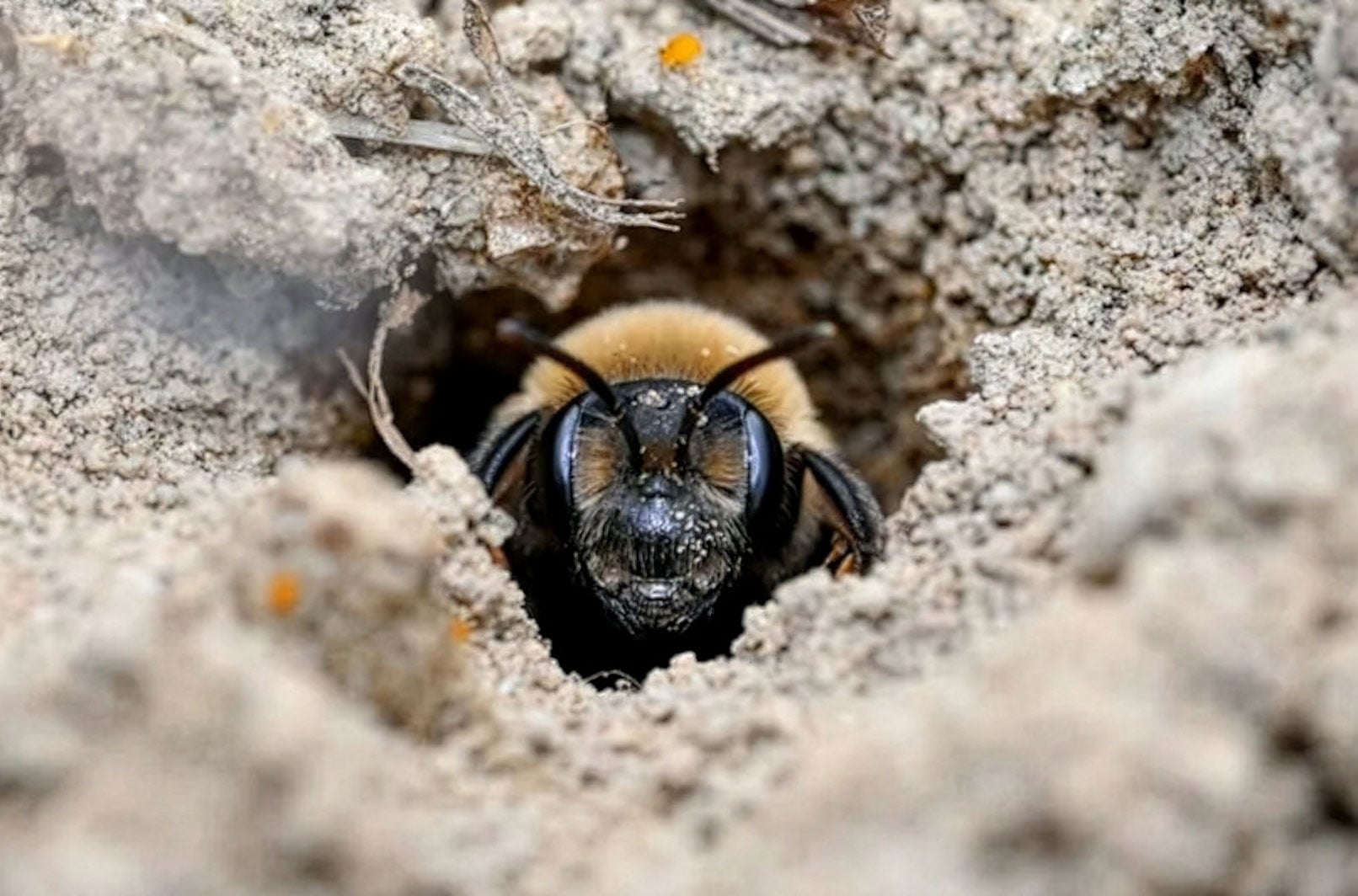
A cemetery hosts millions of vital pollinator bees, showing their ecological importance and the need to preserve their habitats.
To cut costs, Rachel Fordyce used to park for free at Ithaca’s East Hill Plaza and walk through East Lawn Cemetery to her job as a technician in an entomology lab at Cornell University. One day in the spring of 2022, she arrived carrying a jar filled with bees.
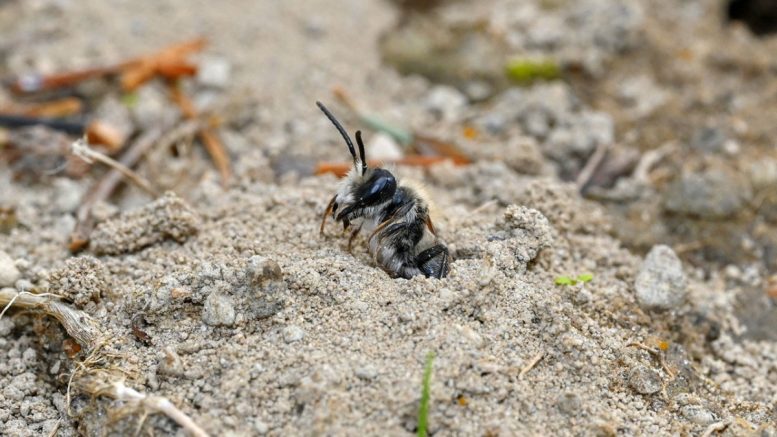
“These are all over the cemetery,” she told her boss, Bryan Danforth, professor of entomology in the College of Agriculture and Life Sciences. The insects were identified as Andrena regularis (also known as the “regular mining bee”), a wild, solitary, ground-nesting species that plays a key role in pollination.
That chance encounter uncovered something remarkable. Researchers found that the Ithaca cemetery hosts one of the largest and oldest-known aggregations of ground-nesting bees, with an estimated 5.5 million individuals. That is comparable to more than 200 honeybee hives packed into a 1.5-acre area and exceeds three times the population of Manhattan.
Scientific Significance and Research Insights
“I’m sure there are other large bee aggregations that exist around the world that we just haven’t identified, but in terms of what is in the literature, this is one of the largest,” said Steve Hoge ’24, first author of a new study published April 13 in the journal Apidologie. The research explores the biology of these often overlooked but economically valuable bees, using the cemetery population as a case study. Hoge carried out the work as an undergraduate in Danforth’s lab.
The study introduces a new approach for documenting bee biology, highlights the importance of wild bees for pollinating high-value crops such as apples, one of New York’s most important agricultural products, and underscores the role of cemeteries as reservoirs of biodiversity.
“The research elevates the value of solitary ground-nesting bees and shows just how abundant these bees are, how important they are as crop pollinators, and that we need to be aware of these nest sites and preserve them,” Danforth said.
Cemeteries as Biodiversity Hotspots
Records show that A. regularis has been collected in East Lawn Cemetery since the early 1900s, and the cemetery itself dates back to 1878.
The finding supports the idea that cemeteries can serve as important habitats for wildlife. Older burial grounds, especially in urban areas, often provide refuge for a wide range of species. Keven Morse, the cemetery’s superintendent, said he has seen deer, nesting geese, hawks, foxes, and coyotes on the property, along with the bees, which he noted have never stung him.
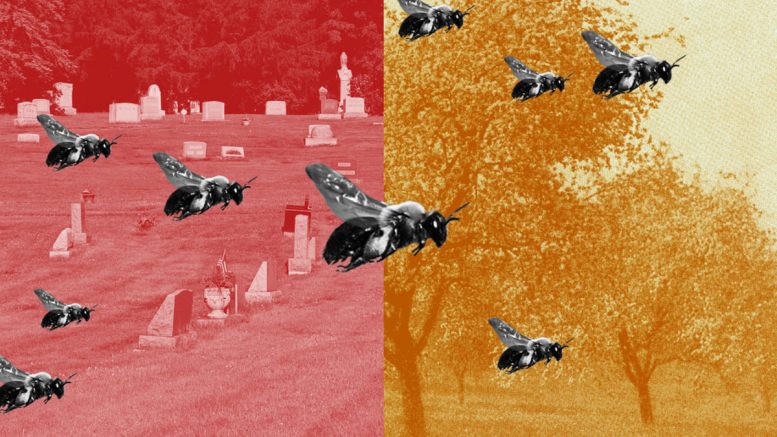
“I just felt bad having to mow in certain areas,” he said. “There’s probably three or four sections where they really migrate heavy, there’s a lot of them.”
Danforth explained that the calm environment, absence of pesticides, and minimal soil disturbance make cemeteries ideal for bee populations.
Biology and Behavior of Ground-Nesting Bees
Even though about 75% of bee species are solitary ground nesters, they remain poorly studied. “It’s the most common lifestyle for bees,” Danforth said. When Hoge began his research, he found that the most detailed scientific description of A. regularis dated back to 1978, leaving much of its biology unexplored.
Female bees of this species dig underground nests, where they create brood cells stocked with pollen and nectar. Eggs develop into larvae and eventually mature into adults below the surface.
“This species overwinters as adults, which is relatively rare, and that’s part of the reason why they come up out of the ground so early in the spring, timed to the apple bloom,” as well as other fruit trees and early blooming wildflowers, said Hoge, now a research assistant at Brigham and Women’s Hospital at Harvard with plans to attend medical school. In New York, these bees typically emerge in April, when midday temperatures reach about 70 degrees Fahrenheit (21 degrees Celsius).
Environmental Factors Supporting Bee Populations
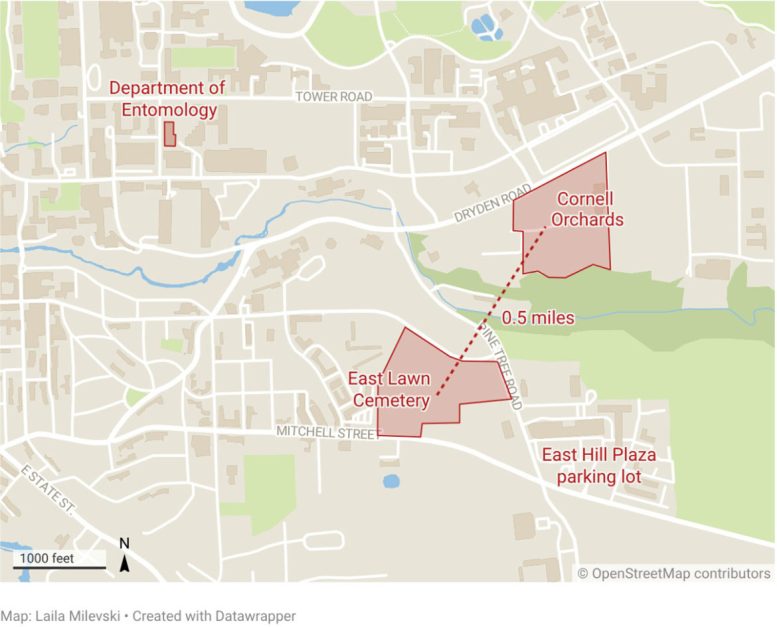
Nearby Cornell Orchards, located about one-third of a mile away, provides abundant early spring flowers. Combined with the area’s sandy soil, which the bees prefer, this likely helps sustain the large population, Danforth said.
To study the bees, researchers used emergence traps, small mesh enclosures placed over less than a square meter of ground. These traps funnel insects into a container as they emerge.
“You capture a whole community of animals coming out of the ground with this approach,” Danforth said.
Population Estimates and Ecological Dynamics
Between March 30 and May 16, 2023, the team set up 10 traps and collected 3,251 insects representing 16 species, including bees, flies, and beetles. A. regularis was the dominant species.
By measuring how many bees appeared in each trap, researchers estimated population density per square meter and scaled that figure to the cemetery’s total area of about 6,000 square meters. Their calculations placed the population between 3 million and 8 million bees, with an average of 5.5 million.
The data showed that males emerge first during warm periods in April, followed by females a few days later. “The males come out first and wait for the females so that they have the best opportunities to mate and pass on their genes,” Hoge said, confirming that A. regularis follows a pattern noted in other early spring bee species.
Parasitism, Citizen Science, and Conservation
The traps also revealed brood parasitism by nomad, or “cuckoo,” bees (Nomada imbricata). These bees emerge later and lay their eggs in the nests of A. regularis. Their larvae kill the host larvae and consume the stored pollen.
To expand knowledge of these insects, Danforth and his colleagues have launched a global citizen science project that encourages people to report sightings of ground-nesting bees and their colonies.
“These populations are huge, and they need protection,” Danforth said. “If we don’t preserve nest sites, and someone paves over them, we could lose in an instant 5.5 million bees that are important pollinators.”
Reference: “Emergence dynamics and host-parasite associations in a large aggregation of Andrena regularis (Hymenoptera: Apoidea: Andrenidae)” by Steven T. Hoge, Jordan G. Kueneman, Rachel Fordyce, Cassidy Dobler, Katherine Odanaka and Bryan N. Danforth, 13 April 2026, Apidologie.
DOI: 10.1007/s13592-026-01256-6
Never miss a breakthrough: Join the SciTechDaily newsletter.
Follow us on Google and Google News.
3 Comments
What are they eating down there?
Stored pollen. Did you not read the article?
For Profit Chemical Companies, Like Dow Chemical, Monsanto, and Bayer, have harmed earth’s atmosphere, and in turn, our pollinating bees. Their numbers are way down now, because of airborne chemical pollution emissions. Other pollinators we need, like butterflies and hummingbirds are also being decimated. And all because some corporation wants more profit? Some weed killers cause cancer. Come on folks, let’s take a stand for our failing environment, and conserve wild bees. On this earth day, 2026. Won’t you help? Plant pollinator friendly flowers, to help increase their population!