
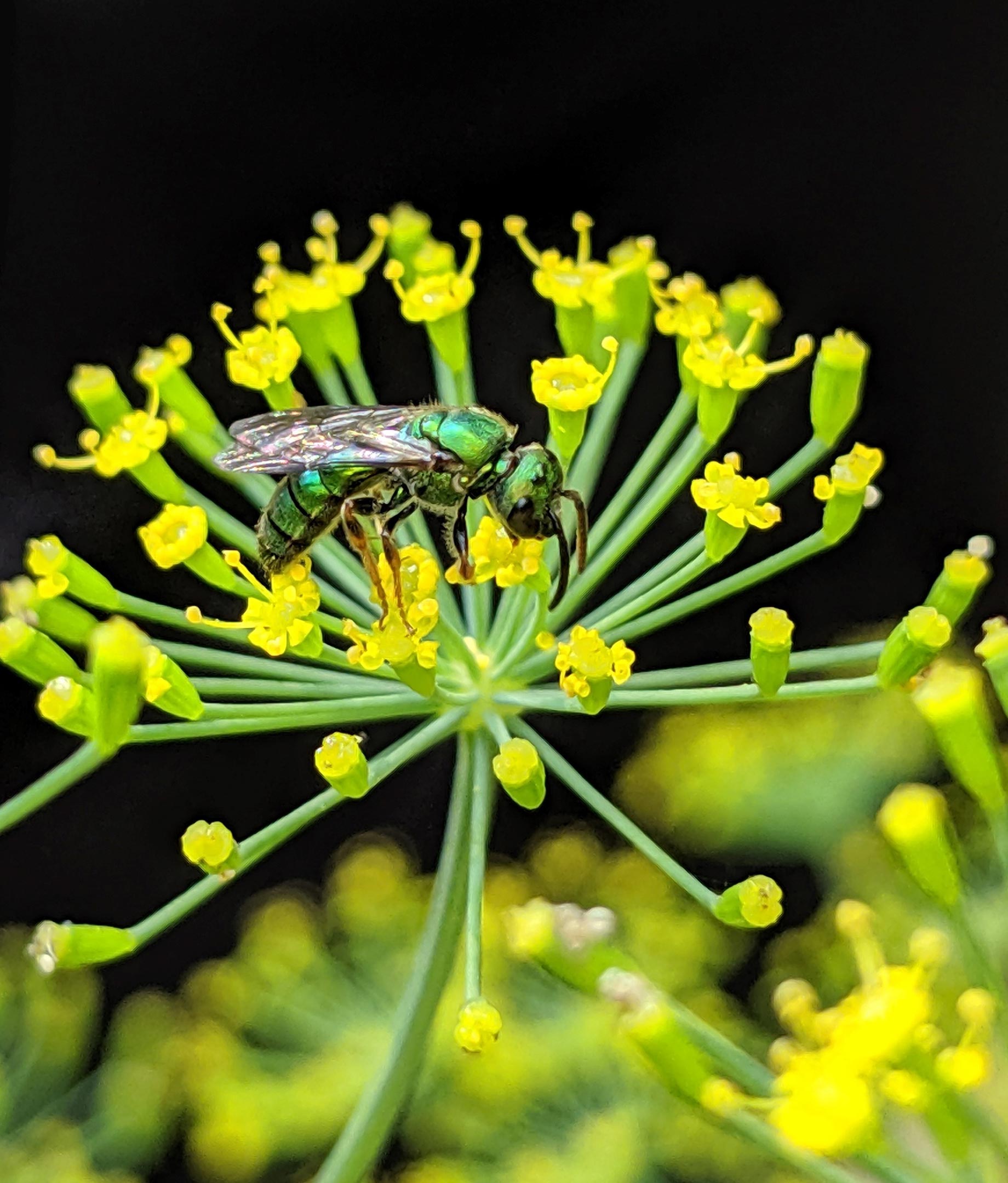
Climate Change Is the Top Threat to Wild Bees
Wild bees are more affected by climate change than by disturbances to their habitats, according to a team of researchers led by Penn State. The findings suggest that addressing land-use issues alone will not be sufficient to protecting these important pollinators.
“Our study found that the most critical factor influencing wild bee abundance and species diversity was the weather, particularly temperature and precipitation,” said Christina Grozinger, Distinguished Professor of Entomology and director of the Center for Pollinator Research, Penn State. “In the Northeastern United States, past trends and future predictions show a changing climate with warmer winters, more intense precipitation in winter and spring, and longer growing seasons with higher maximum temperatures. In almost all of our analyses, these conditions were associated with lower abundance of wild bees, suggesting that climate change poses a significant threat to wild bee communities.”
According to Melanie Kammerer, graduate student in entomology, Penn State, few studies have considered the effects of both climate and land use on wild bees.
“We thought this was an oversight because, like many organisms, bees are experiencing habitat loss and climate change simultaneously,” she said. “By looking at both factors in the same study, we were able to compare the relative importance of these two stressors.”
To conduct their study, the researchers analyzed a 14-year United States Geological Survey data set of wild bee occurrences from more than 1,000 locations in Maryland, Delaware and Washington, D.C., specifically examining how different bee species and communities respond to land-use and climate factors.
“To really understand the effects of weather and climate, particularly as weather patterns become more variable with climate change, we need to use these very large, long-term data sets,” said Grozinger. “We hope that our study, and others like it, will help encourage the collection and integration of these data sets for future research.”
Landscape Quality Less Important Than Weather
Using land cover maps and spatial models, the team described the landscape surrounding each of the sampling locations, including the habitat size and available floral and nesting resources. The team’s results appear today (January 12, 2021) in Global Change Biology. Finally, the researchers compiled a large suite of climate variables and used machine-learning models to identify the most important variables and to quantify their effects on wild bees.
“We found that temperature and precipitation patterns are very important drivers of wild bee communities in our study, more important than the amount of suitable habitat or floral and nesting resources in the landscape,” said Kammerer.
Interestingly, added Grozinger, different bee species were most affected by different weather conditions. For example, she said, areas with more rain had fewer spring bees.
“We think the rain limits the ability of spring bees to collect food for their offspring,” said Grozinger. “Similarly, a very hot summer, which might reduce flowering plants, was associated with fewer summer bees the next year.”
Winter Warming Linked to Bee Mortality
In addition, warm winters led to reduced numbers of some bee species.
“This result coincides with studies showing that, with earlier spring onset, overwintering adults had higher pre-emergence weight loss and mortality and shorter life span post-emergence,” Grozinger said.
Kammerer noted that these weather changes will likely worsen in the coming years.
“In the future, warm winters and long, hot summers are predicted to occur more frequently, which we expect will be a serious challenge to wild-bee populations,” she said. “We are just beginning to understand the many ways that climate influences bees, but in order to conserve these essential pollinators, we need to figure out when, where and how changing climate disrupts bee life cycles, and we need to move from considering single stressors to quantifying multiple, potentially interacting pressures on wild-bee communities.”
According to the researchers, the study is part of their larger Beescape project, which allows individuals — including growers, conservationists and gardeners — to explore the landscape quality at their site and potentially make adjustments to improve conditions for bees. Given their new findings, the researchers plan to expand Beescape to include weather and climate conditions.
Reference: “Wild bees as winners and losers: Relative impacts of landscape composition, quality, and climate” by Melanie Kammerer, Sarah C. Goslee, Margaret R. Douglas, John F. Tooker and Christina M. Grozinger, 12 January 2021, Global Change Biology.
DOI: 10.1111/gcb.15485
Other authors on the paper include Sarah Goslee, ecologist, United States Department of Agriculture Agricultural Research Service; Margaret Douglas, assistant professor of environmental studies, Dickinson College; and John Tooker, professor of entomology, Penn State.
The U.S. Department of Agriculture National Institute for Food and Agriculture, the Foundation for Food and Agriculture Research and the College of Agricultural Sciences and Intercollege Graduate Degree Program in Ecology at Penn State supported this research.
Never miss a breakthrough: Join the SciTechDaily newsletter.
Follow us on Google and Google News.
1 Comment
“Our study found that the most critical factor influencing wild bee abundance and species diversity was the weather, particularly temperature and precipitation,”
They apparently have established a correlation [Unspecified! What are the r-squared values for these variables?] with weather and bee survival. That is not particularly surprising. However, they need to be reminded that correlation does not necessarily establish causation.
“To really understand the effects of weather and climate, particularly as weather patterns become more variable with climate change, we need to use these very large, long-term data sets,”
It is an assumption that weather patterns will become more variable. However, it is debatable! In general, weather is driven by temperature and pressure conditions. It is commonly accepted that the Arctic is warming faster than any other regions on Earth. That means that the temperature difference between the Arctic and northern mid-latitudes is decreasing, probably resulting in reduced variability.
The concern about the impact of global warming on bee survival is based on an unexamined assumption! And, there is not good evidence that heat waves are increasing.
https://wattsupwiththat.com/2019/09/06/the-gestalt-of-heat-waves/