
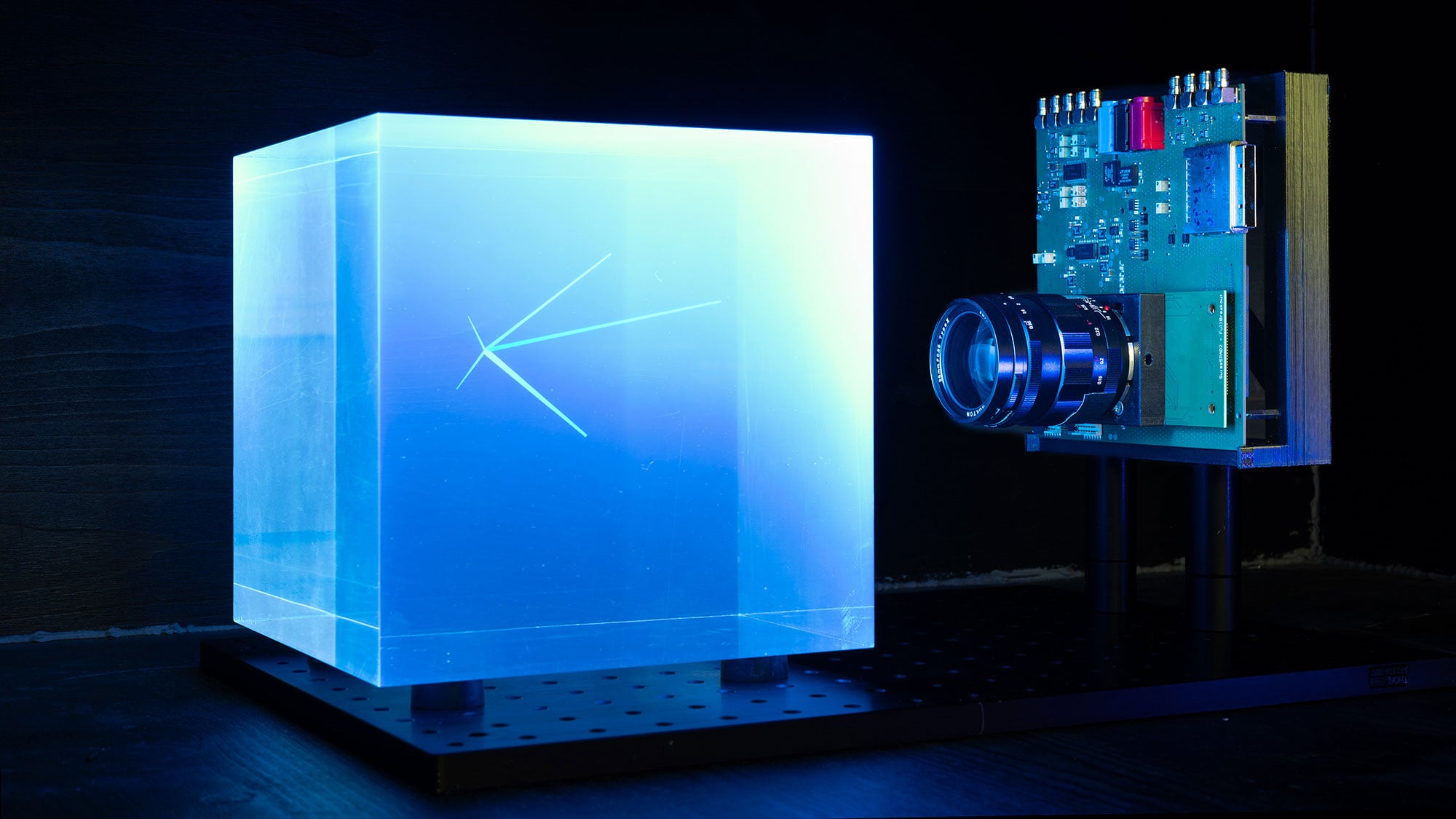
Physicists are rethinking how to detect elusive particles like neutrinos by combining existing technologies in unconventional ways.
Progress in physics often comes from unexpected combinations of familiar ideas. That is increasingly true in the hunt for elusive particles like neutrinos and potential dark matter candidates, where detection is limited not just by theory but by the size, cost, and precision of instruments. As detectors grow larger to improve sensitivity, traditional designs that rely on finely segmented materials become harder to scale, pushing researchers to explore fundamentally different approaches.
Most particle physics experiments depend on three-dimensional (3D) tracking of particles moving through dense materials. In scintillators, this is typically done by dividing the material into many small active elements. Each unit emits visible light when struck by a charged particle. That light is then collected by optical fibers and sent to photon detectors such as photomultiplier tubes or silicon photomultipliers.
Large experiments highlight both the power and the limits of this approach. In Japan’s T2K neutrino oscillation experiment, one detector contains about two tons (around 4,400 pounds) of active material built from roughly two million small cubes and 60,000 fibers. At CERN and the Paul Scherrer Institute, experiments such as LHCb and Mu3e achieve submillimeter precision using millions of thin scintillating fibers. However, this level of segmentation becomes difficult to scale as detector volumes grow, creating a potential bottleneck.
A team from ETH Zurich and EPFL is proposing a different strategy. Researchers, including PhD student Till Dieminger, senior scientist Dr Saúl Alonso-Monsalve, Professor Davide Sgalaberna, and collaborators from EPFL’s Advanced Quantum Architecture Lab led by Professor Edoardo Charbon, have developed and tested a prototype detector that can capture ultrafast, high-resolution 3D images of particle interactions in large, unsegmented scintillator volumes. Their results, along with detailed simulations, were recently published in Nature Communications.

Known tools with new eyes
The new approach draws inspiration from plenoptic, or light field, cameras. These devices record not only the intensity of light but also its direction, allowing depth information to be reconstructed. This is achieved using a micro lens array (MLA) placed between the main lens and the sensor. Each tiny lens captures a slightly different view, enabling reconstruction of the full light field.
When combined with single-photon avalanche diode (SPAD) sensors, this technique can track particles in 3D even when very few photons are detected. Despite this potential, light field imaging had not previously been applied to particle tracking.
As part of the Swiss National Science Foundation-funded PLATON project, the ETH Zurich and EPFL team built a working prototype based on this concept. The system combines an MLA with a SPAD sensor known as SwissSPAD2, developed at EPFL. The MLA was designed and integrated by Raytrix GmbH. A key feature of SwissSPAD2 is gated photon detection, which records signals within specific time windows. This helps separate real photon signals from background noise.
PLATON to the test
The team evaluated the prototype’s performance in laboratory conditions, measuring spatial resolution across light levels ranging from several hundred photons down to just five detected photons. They also tested its ability to reconstruct electron tracks in a plastic scintillator using a strontium-90 source. In all cases, experimental results closely matched simulations.
These initial tests have already guided plans for improvements. The researchers are developing a new SPAD sensor with higher detection efficiency and the ability to assign precise time stamps to individual photons at subnanosecond resolution. They are also refining the camera design to expand its field of view and improve light collection. Simulations suggest these upgrades will further enhance spatial resolution.
Simulated scenarios
Additional simulations explore how an upgraded PLATON system could perform in neutrino detection. These studies incorporate advanced image processing using a neural network based on a Transformer architecture, similar to those used in large language models. This network can identify patterns and correlations among detected photons.
Results indicate that the system could achieve spatial resolution better than 1 millimeter (about 0.04 inches) in an unsegmented volume of (10x10x10)cm3. It could also identify neutrino interactions involving low-momentum protons with high accuracy.
For larger detectors, the team modeled a one cubic meter (about 35 cubic feet) system using a simplified photon source. Even in this case, simulations suggest resolution of a few millimeters, comparable to the current state-of-the-art scintillator detectors. With further improvements, the researchers expect submillimeter performance in volumes larger than 1m3.
Future plans
The potential applications extend beyond particle physics. The team believes their plenoptic-based system could improve imaging in other fields as well.
Dieminger, Alonso-Monsalve, and Sgalaberna have already filed three patents related to PLATON for use in positron emission tomography (PET). These cover both the scanner design and the image processing methods, including the neural network. Particle physics has a strong track record of generating technologies with broad impact, from the World Wide Web to proton therapy. PLATON could become another example of this trend.
Reference: “An ultrafast plenoptic-camera system for high-resolution 3D particle tracking in unsegmented scintillators” by Till Dieminger, Saúl Alonso-Monsalve, Christoph Alt, Claudio Bruschini, Noemi Bührer, Edoardo Charbon, Kodai Kaneyasu, Tim Weber, Matthew Franks and Davide Sgalaberna, 21 March 2026, Nature Communications.
DOI: 10.1038/s41467-026-70918-x
Never miss a breakthrough: Join the SciTechDaily newsletter.
Follow us on Google and Google News.