
A new study suggests that pulsar timing arrays could help reveal how the Universe’s first supermassive black holes formed.
A faint background of extremely low-frequency gravitational waves, detected by monitoring networks of pulsars, may preserve clues from events that began more than 13 billion years ago. Among them could be the processes that produced some of the Universe’s earliest supermassive black holes.
Sohan Ghodla and Cosmin Ilie of Colgate University explored that possibility in a study published as a Letter in Physical Review D. Their goal was to determine whether supermassive black holes that originated in the early Universe could eventually account for a substantial share of the gravitational wave background now detected by Pulsar Timing Arrays, or PTAs.
The analysis connects two observations separated by billions of years: unexpectedly massive black holes seen when the Universe was young and gravitational waves later generated by pairs of supermassive black holes.
One possible origin stood out. The researchers found that early black hole seeds left behind by hypothetical supermassive Dark Stars could potentially provide a dominant contribution to the PTA signal observed today. “Pulsar timing arrays are usually thought of as probes of supermassive black-hole binaries in the relatively recent Universe,” said Ilie. “What our work shows is that the signal may also contain information about how the ancestors of those black holes formed at cosmic dawn. In that sense, gravitational waves observed today could provide a new window onto the birth of the first supermassive black holes.”
Pulsars may probe ancient black hole origins
Pulsar Timing Arrays rely on pulsars, rapidly spinning neutron stars whose radio signals arrive with extraordinary regularity, as precise clocks spread across the sky. Gravitational waves passing between them and Earth can produce tiny changes in the arrival times of those pulses. By observing many pulsars over years, collaborations around the world have found evidence for a stochastic gravitational-wave background at nanohertz frequencies.
The leading astrophysical explanation is a widespread population of supermassive black hole binaries gradually moving toward merger. Systems containing more than roughly a billion times the mass of the Sun are especially important at PTA frequencies. Their enormous size, however, raises a deeper question: how were the original black hole seeds created? Observations from facilities including the James Webb Space Telescope and Chandra have revealed surprisingly massive black holes very early in cosmic history, increasing interest in mechanisms that could produce large seeds quickly.
Ghodla and Ilie, therefore, examined whether those ancient seeds could survive, grow alongside their galaxies, eventually pair with other black holes, and produce the gravitational wave background detected billions of years afterward.
They studied two possible formation routes for early black holes: direct collapse black holes and black holes produced when supermassive Dark Stars collapse.
Dark Stars are hypothetical primordial stars powered mainly by heating associated with dark matter rather than conventional nuclear fusion. Under the WIMP dark matter scenario examined in the study, these objects could remain relatively cool and extended while continuing to accumulate matter, potentially growing to a million Suns or more before collapsing into massive black holes.
Dark Star remnants could dominate the signal
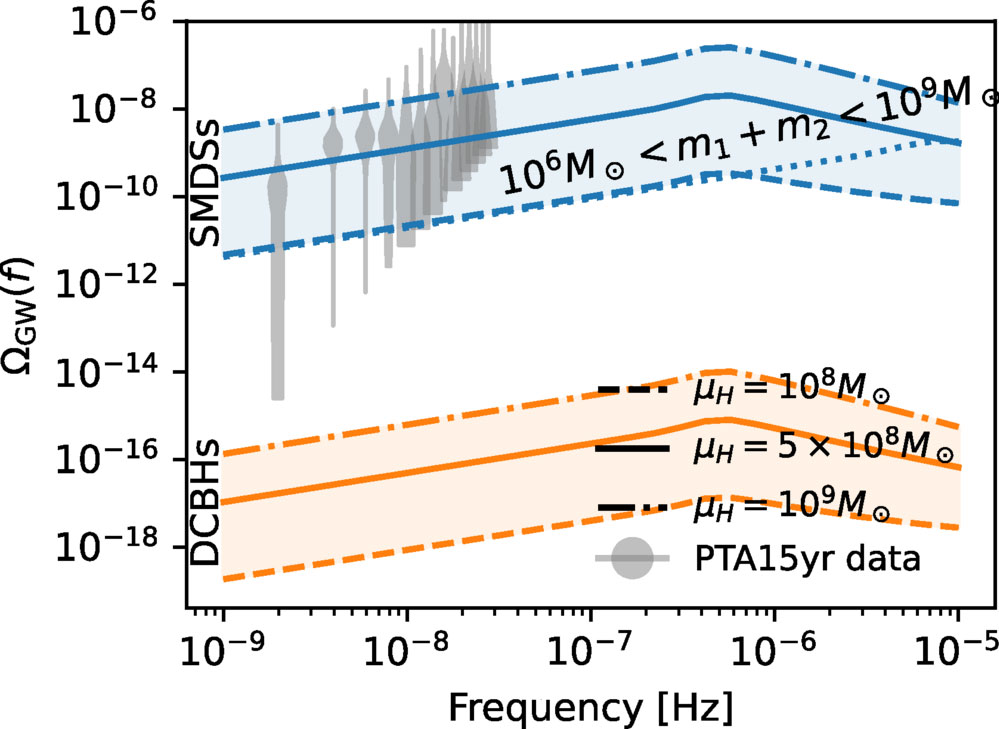
Ghodla and Ilie modeled how black holes originating from these seeds would evolve across cosmic history, including the halos surrounding them, their expected merger rates, and the gravitational wave background those mergers would generate. Their calculations indicate that if remnants of supermassive Dark Stars had a number density of about 10-3 Mpc-3, their descendants could contribute a major, and potentially dominant, portion of the PTA signal.
The direct collapse black hole population included in the analysis is expected to be much less common, with characteristic densities near 10-6 Mpc-3. As a result, it contributes far less to the predicted gravitational wave background.
Today’s waves can constrain ancient seeds
An important implication is that existing PTA observations can already place an upper limit on how common the earliest seeds of supermassive black holes could have been. “Produce too many of these massive seeds and you end up over-producing the PTA-detected signal. Produce too few, and you need other sources to efficiently assemble these supermassive black holes later in the life of the universe to match PTA observations,” said Ghodla.
Within the models tested, seed densities of roughly 10-2 to 10-1 Mpc-3 would begin producing more gravitational wave background than observations allow. The exact constraint depends strongly on the masses of the dark matter halos where those seeds originated. In this way, PTA measurements could potentially constrain populations that existed at redshifts greater than 10, even though the mergers producing the gravitational waves occur much later. The calculations also support an earlier finding that binaries with total black hole masses roughly above 109 solar masses dominate the predicted PTA signal, while systems with smaller masses contribute substantially less.
The findings create an observational link among dark matter physics, the earliest luminous objects, the origins of supermassive black holes, and gravitational wave astronomy.
“Dark Stars were originally proposed as objects that might be seen directly at cosmic dawn,” Ilie said. “This work points to a completely different way of testing their possible role in cosmic history. Their descendants could leave a gravitational-wave imprint that persists all the way to the present-day Universe.”
As PTA measurements improve, combining them with tighter constraints on distant black holes and their host galaxies could help researchers distinguish between competing explanations for how the Universe’s first supermassive black holes formed.
Reference: “Reconstructing PTA measurements via early seeding of supermassive black holes” by Sohan Ghodla and Cosmin Ilie, 17 August 2026, Physical Review D.
DOI: 10.1103/hvfd-8fkr
Never miss a breakthrough: Join the SciTechDaily newsletter.
Follow us on Google and Google News.