

Physicists used advanced quantum technologies to test predictions from a decades-old theory.
At the point where matter changes from one phase to another, very different materials can suddenly begin following the same mathematical rules. Water approaching a boil and a magnet losing its magnetism are familiar examples of phase transitions.
“Physicists call this trait universality—the messy, microscopic details wash out and only a few essential features survive,” explains Jason Alicea, William K. Davis Professor of Theoretical Physics. Physicists describe much of this universal behavior using a mathematical framework known as conformal field theory.
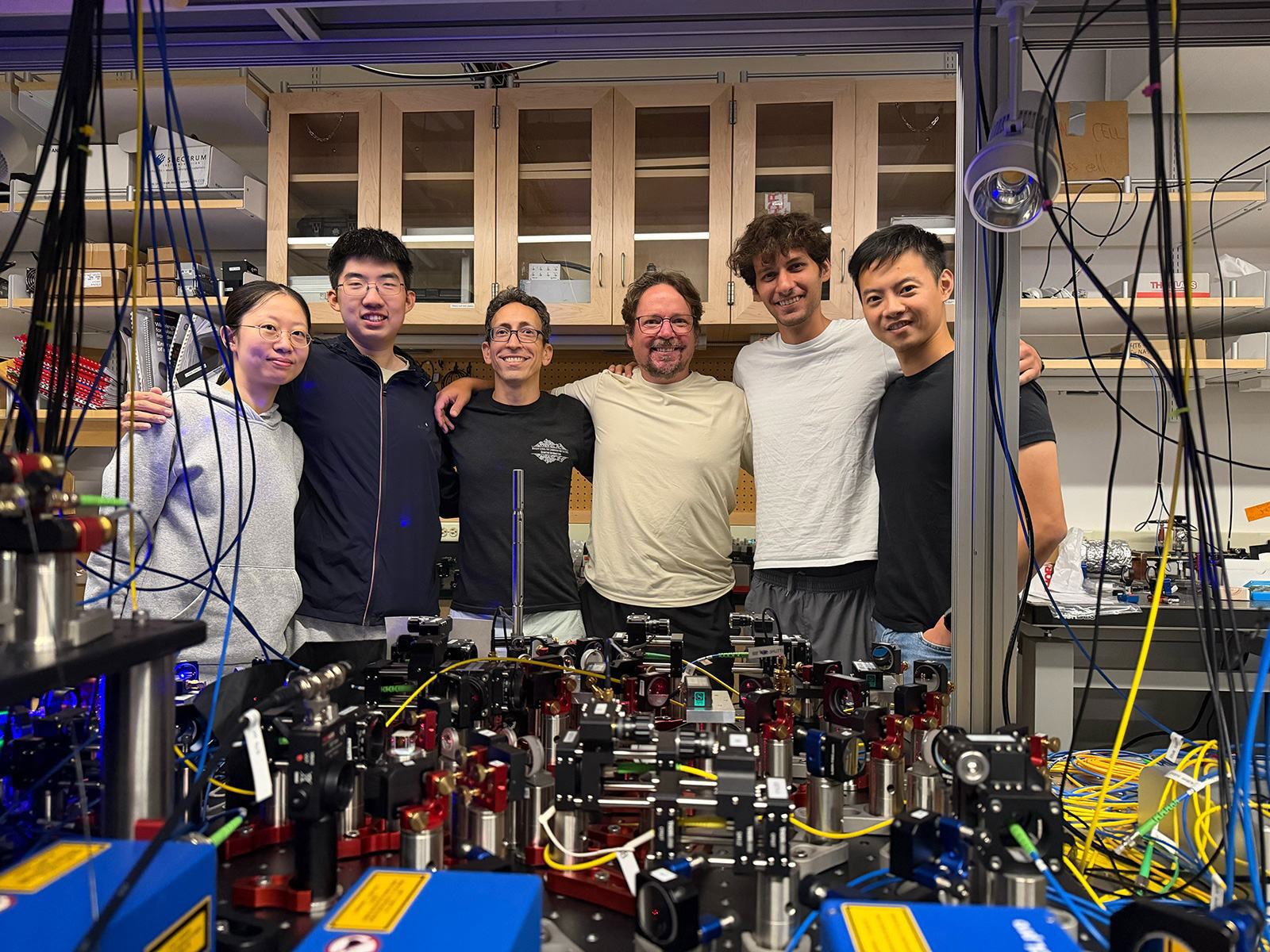
In work reported in the journal Nature, the experimental group of Caltech professor of physics Manuel Endres and Alicea’s theory group joined researchers at Université Paris-Saclay and the Technical University of Munich to experimentally investigate two different conformal field theories with quantum simulators, specialized systems related to quantum computers that are designed for particular tasks.
Using technology developed for these simulators, the researchers directly measured energy levels in synthetic quantum matter predicted by the Ising and tricritical Ising conformal field theories for the first time. (Ising refers to Ernst Ising, a physicist who, in the 1920s, solved an early model of magnetism.) Both theories describe universal behavior that appears when a quantum system, with properties such as entanglement and superposition, reaches a critical point between two states, with one more ordered than the other.
Unlike an everyday transition such as water becoming steam, this change is produced entirely by quantum effects rather than temperature, although it occurs near absolute zero. At this critical point, lasers can excite the system into a sequence of distinct energies resembling the rungs of a ladder. “The energy levels predicted by these theories are important because they encode profound information about the theories themselves,” Alicea says.
Quantum simulators put old predictions to the test
For roughly 40 years, physicists have used conformal field theories to predict the precise ratios separating these energy levels. Until now, however, those spacings had never been measured experimentally.
“Our new tools borrow from quantum computing platforms,” says Xiangkai Sun, a co-lead author of the new study and a graduate student working in the Endres lab. “Over the past 10 years, people have been learning to control these systems, and now we are at the point where we can use them to do fundamental physics research.”
The researchers built their quantum system using technology that the Endres lab also employs for quantum computers: arrays of neutral atoms held in place by laser beams called optical tweezers. A related neutral atom system in the lab recently trapped 6,100 atoms in a single array. Although optical tweezer arrays were developed largely for quantum computing, the researchers used the same technology here to investigate a fundamental problem in physics.
Atomic chains revealed the predicted spectrum
The experiment began by arranging strontium atoms in a line with optical tweezers. Additional lasers pushed the atoms into high-energy Rydberg states, causing neighboring atoms to interact strongly. Those interactions made the entire chain behave collectively instead of as separate particles. The researchers then adjusted the lasers until the system reached the critical point predicted by theory.
To measure its energy levels, they developed a method called many-body modulation spectroscopy. The researchers gently drove the whole atomic chain by varying the lasers at selected frequencies and recorded how strongly the atoms responded. By scanning across frequencies and identifying peaks in the response, they reconstructed the energy ladder. The idea resembles rubbing a wet finger around a wine glass: the glass resonates when driven at the right frequency but responds little at the wrong one.
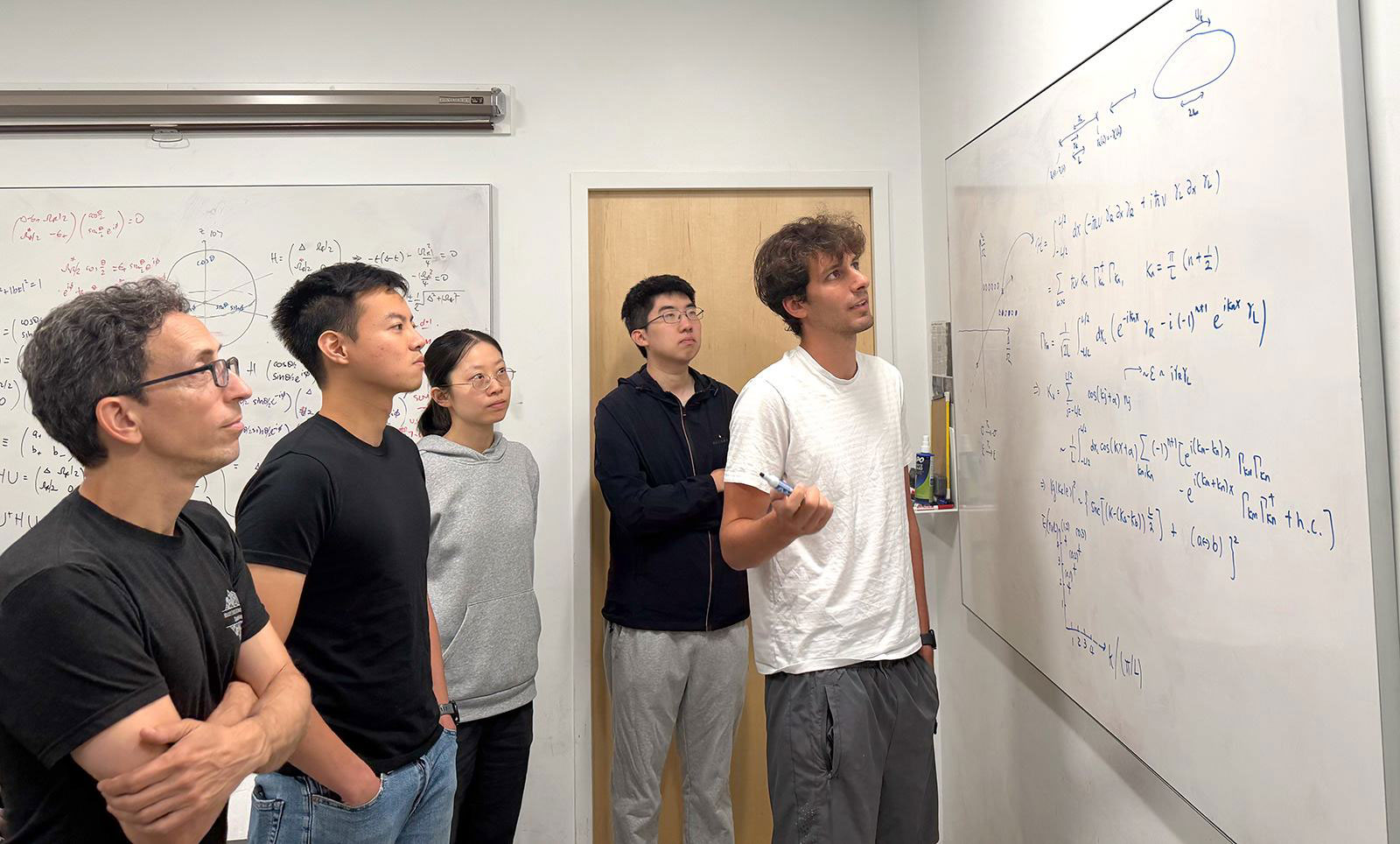
“We repeated the experiment on chains of up to 35 atoms, and the rungs came out as predicted by the Ising conformal field theory: the spectra collapsed onto a single universal curve once rescaled for size,” Sun says. “We then tuned to the tricritical point and measured the lowest levels of its distinct spectrum, which came out in the different ratios theory predicts.”
Symmetry exposed a second energy pattern
Because the researchers could control each atom separately, they were able to perform measurements that would be much harder in conventional materials. Sorting the excitations by their symmetry exposed a second family of energy levels that had been hidden in the initial measurement. Changing the atoms at the two ends of the chain also rearranged the energy ladder, producing different patterns predicted by the tricritical Ising theory.
“Even though we believed these theories to be true, it’s important to have an experimental realization, something you can poke and prod,” Alicea says. “To see those predictions borne out is a beautiful thing.”
Larger systems could probe unknown physics
The researchers next plan to expand the approach from one-dimensional chains of atoms to larger systems arranged in grids. “In two dimensions, the conformal field theories are not as well understood, so this is an exciting opportunity,” Sun says.
“What excites me is that the technique doesn’t require knowing the answer in advance. Here we could check our measurements against exact predictions,” Endres says. “The next step is to point this at systems where nobody knows the response of the system quantitatively—including regimes that classical computers can’t reach.”
Reference: “Observation of conformal field theory spectra in a quantum simulator” by Xiangkai Sun (孙向恺), Yuan Le (乐媛), Stephen Naus, Richard Bing-Shiun Tsai, Lewis R. B. Picard, Sara Murciano, Michael Knap, Jason Alicea and Manuel Endres, 19 August 2026, Nature.
DOI: 10.1038/s41586-026-10904-x
Funded by the US Department of Energy, including its Quantum Systems Accelerator and its Quantum Science Center; the National Science Foundation, including the Institute for Quantum Information and Matter at Caltech (IQIM); the Army Research Office; the Defense Advanced Research Projects Agency; the Air Force Office of Scientific Research; the Gordon and Betty Moore Foundation; and the Deutsche Forschungsgemeinschaft.
Never miss a breakthrough: Join the SciTechDaily newsletter.
Follow us on Google and Google News.