
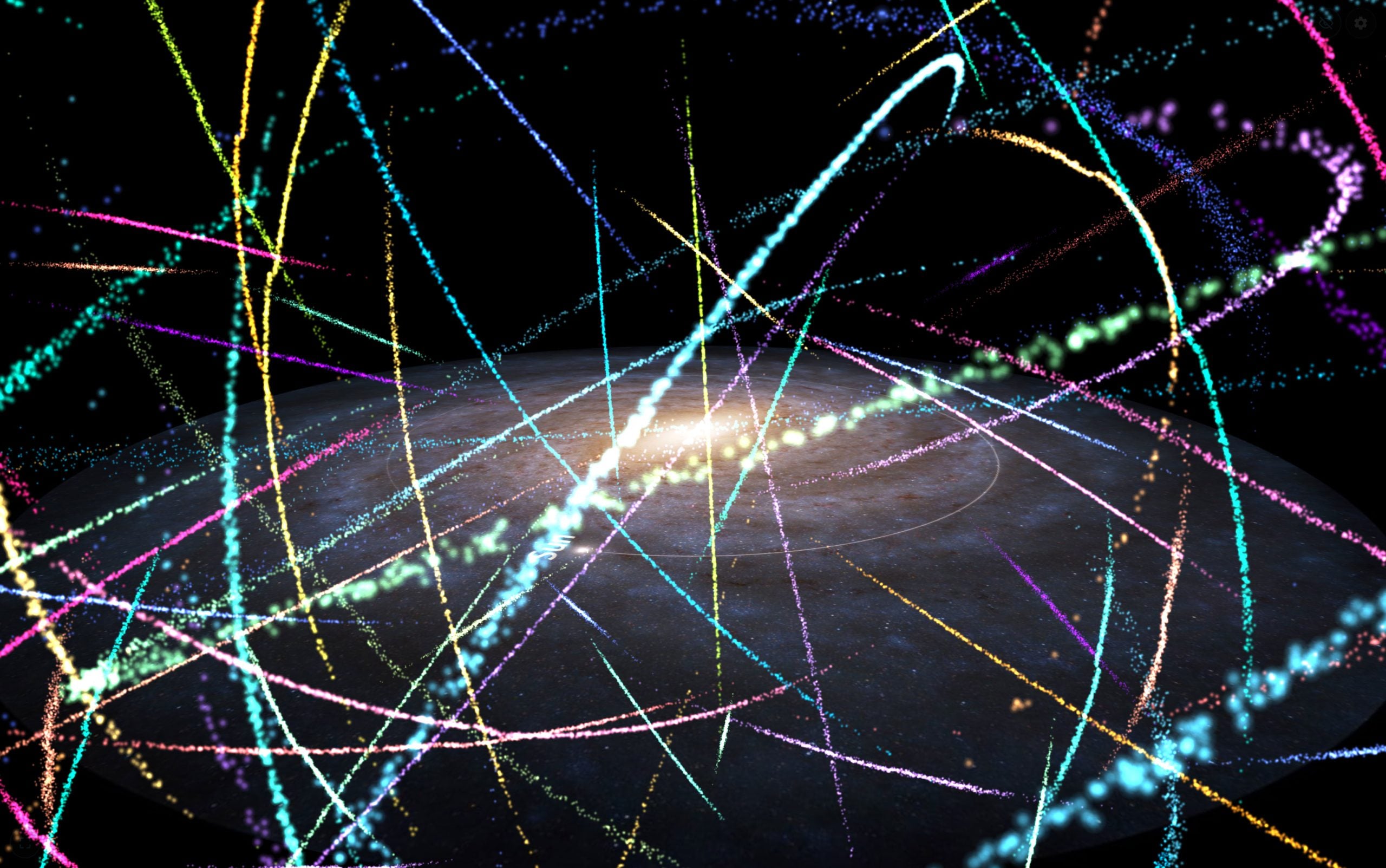
Galaxies can create many of the same stellar stream distortions that astronomers have looked to as possible signs of dark matter.
Astronomers have long hoped that gaps, bends, and other distortions in long bands of stars around the Milky Way could reveal the hidden influence of dark matter. But new simulations suggest many of those features can arise from the galaxy itself, even without the small dark matter clumps thought to produce them.
University of Washington researchers modeled roughly 15,000 of these bands, known as stellar streams, across four Milky Way-sized galaxies. The simulations omitted small dark matter clumps called subhalos. After five billion simulated years, irregularities appeared in nearly every stream, and only 70 remained perfectly smooth.
“In our simulations, the host galaxies alone caused the same kinds of irregularities that we observe in real stellar streams,” said lead author Arpit Arora, a UW postdoctoral scholar in astronomy. “Now that we can predict what the host galaxy does on its own, we can start isolating the part that dark matter is responsible for.”
The study was published in The Astrophysical Journal.
Galaxies alone can disrupt stellar streams
The distortions arose from the structure of the galaxies themselves. Stars were distributed somewhat unevenly across each simulated disk, creating regions of greater and lesser density similar to those in a real galaxy. As stellar streams passed through denser areas, the uneven gravitational landscape bent and tore at them.
Arora had expected the galaxies to produce some irregularities, but not nearly so many.
“We found that almost all of the streams had some sort of structural variation,” Arora said. “So this idea that streams are naturally thin and smooth wasn’t really necessarily true.”
The simulations produced wiggles, kinks, spurs, branches, gaps, and clumps. Some streams were completely torn apart by the gravitational froth of their host galaxies. Those orbiting closer to the galactic core encountered dense, clumpy regions more often and developed more irregularities.
Stream irregularities may have another source
The result complicates efforts to use stellar streams to investigate dark matter, a theorized substance that does not interact with light or normal matter except through gravity.
“Dark matter makes up most of the mass in the universe and forms the scaffolding that galaxies grow on, but we still don’t know what it is,” said co-author Nora Shipp, a UW assistant professor of astronomy. “The Milky Way is one of the best laboratories we have for figuring that out, and stellar streams are one of the sharpest tools inside it.”
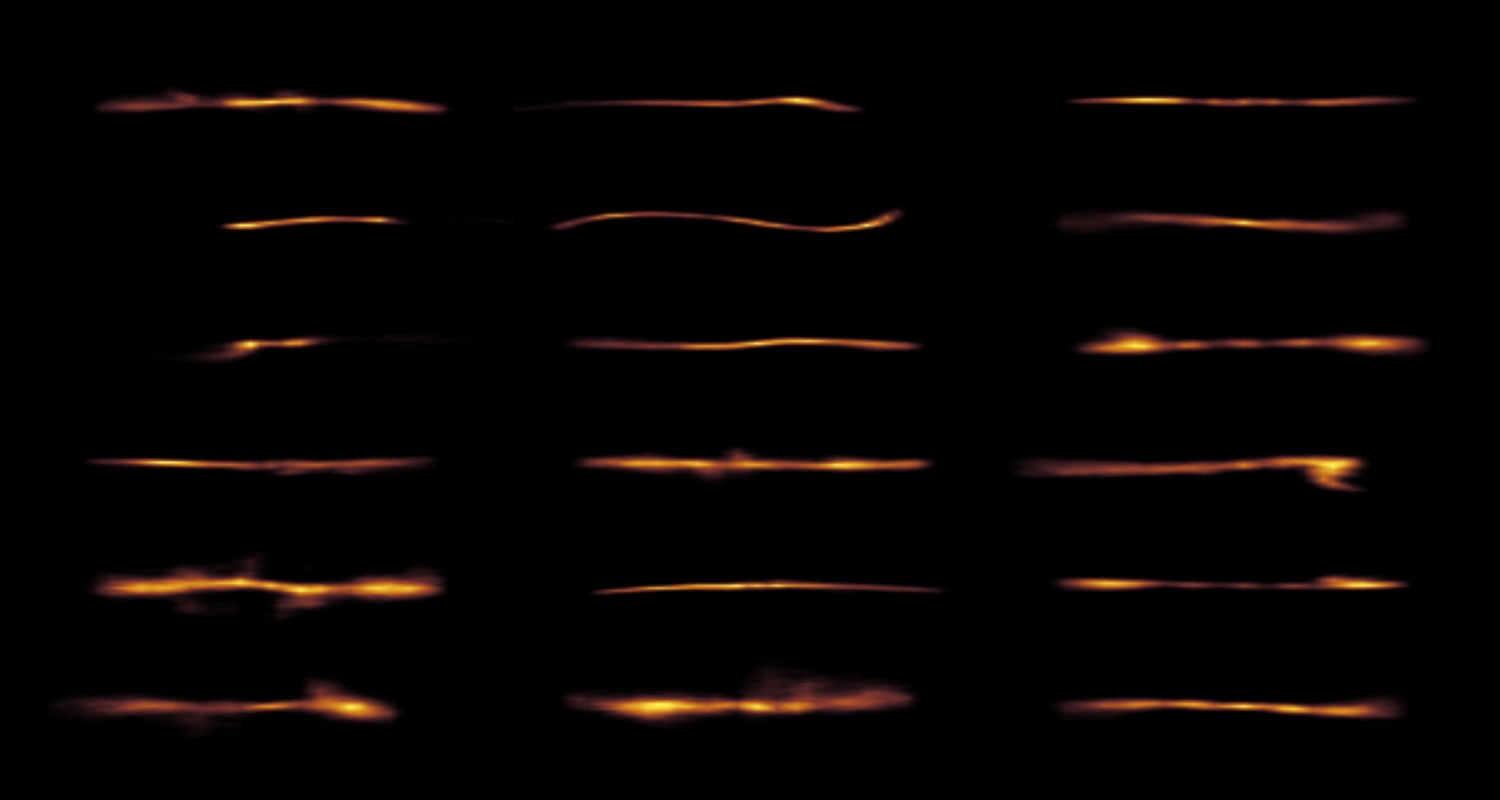
Most stars in the Milky Way lie in a relatively flat plane, while stellar streams follow different paths around the galaxy. A stream forms when a group of stars crashes into a galaxy and becomes trapped by its gravity. As the stars orbit, the galaxy stretches the cluster into a long, thin filament. Most galaxies host stellar streams, though those around the Milky Way are the most visible to astronomers.
Many stellar streams in our galaxy contain gaps and kinks. Astronomers have proposed that some of these features could result from encounters with dark matter subhalos. If so, their distortions could provide information about the composition of dark matter. The new simulations show that astronomers must first account for similar features produced by the host galaxy itself.
Dark matter fingerprints remain to be isolated
Arora now plans to add dark matter clumps to future simulations and test whether they create patterns that can be distinguished from those caused by the galaxy alone.
New observations could help make that distinction. The Simonyi Survey Telescope at the NSF-DOE Vera C. Rubin Observatory is expected to discover many more stellar streams in the Milky Way. Those observations could help astronomers classify stream features and search for signatures that can be more confidently linked to dark matter.
“Sadly there’s no magic wand to reveal the structure of dark matter,” said James Davenport, a research assistant professor of astronomy at the UW. “Streams are complex systems, but they’re still the most interesting way to study the dark matter close to home.”
Reference: “No Stream Left Unscathed: The Imprint of a Host Galaxy” by Arpit Arora, Peter S. Ferguson, Jacob Nibauer, Nora Shipp, Videep Reddy, Eugene Vasiliev, Jack Kohm, Laurella C. Marin, Adrian M. Price-Whelan, Denis Erkal, Sarah Pearson, Andrew Wetzel, Jeremy Bailin and Robert Feldmann, 27 August 2026, The Astrophysical Journal.
DOI: 10.3847/1538-4357/ae89af
This research was funded by the Gordon and Betty Moore Foundation.
Never miss a breakthrough: Join the SciTechDaily newsletter.
Follow us on Google and Google News.