
Close Menu
    Facebook X (Twitter) Instagram
    SciTechDaily
    • Biology
    • Chemistry
    • Earth
    • Health
    • Physics
    • Science
    • Space
    • Technology
    Facebook X (Twitter) Pinterest YouTube RSS
    SciTechDaily
    Home»Space»Dark Matter Dynamics: Exploring the Strange Milky Way Satellite, Crater 2
    Space

    Dark Matter Dynamics: Exploring the Strange Milky Way Satellite, Crater 2

    By Iqbal Pittalwala, University of California - RiversideJuly 6, 2024No Comments4 Mins Read
    Facebook Twitter Pinterest Telegram LinkedIn WhatsApp Email Reddit
    Share
    Facebook Twitter LinkedIn Pinterest Telegram Email Reddit
    Satellite Galaxy Art Concept
    Identified in 2016, Crater 2 stands out among satellite galaxies due to its enormous size and extremely low brightness, hinting at unusual dark matter dynamics. The prevailing CDM model struggles to account for such features. (Artist’s concept.) Credit: SciTechDaily.com

    Crater 2, a large, dim satellite galaxy, exhibits properties that challenge traditional cold dark matter theories. The SIDM theory provides a better explanation, suggesting dark matter interactions that reduce density and increase galaxy size, matching observations.

    Crater 2, located approximately 380,000 light years from Earth, is one of the largest satellite galaxies of the Milky Way. Extremely cold and with slow-moving stars, Crater 2 has low surface brightness. How this galaxy originated remains unclear.

    Challenges in Understanding Crater 2

    “Since its discovery in 2016, there have been many attempts to reproduce Crater 2’s unusual properties, but it has proved very challenging,” said Hai-Bo Yu, a professor of physics and astronomy at the University of California, Riverside, whose team now offers an explanation for Crater 2’s origin in a paper published recently in The Astrophysical Journal Letters.

    A satellite galaxy is a smaller galaxy that orbits a larger host galaxy. Dark matter makes up 85% of the universe’s matter, and it can form a spherical structure under the influence of gravity called a dark matter halo. Invisible, the halo permeates and surrounds a galaxy like Crater 2. The fact that Crater 2 is extremely cold indicates its halo has a low density.
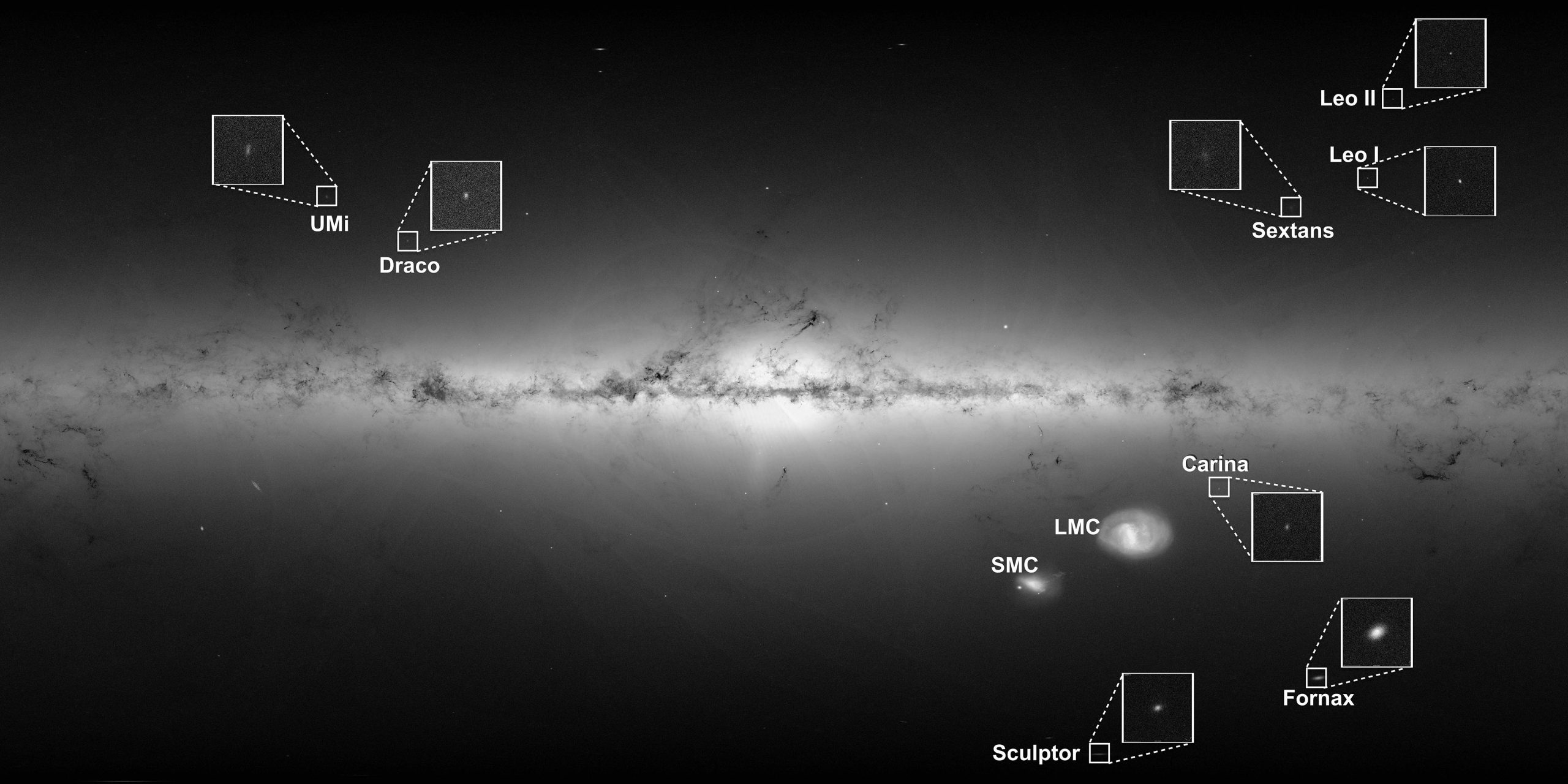
    Dwarf Galaxies Around Milky Way
    Our galaxy, the Milky Way, is surrounded by about fifty dwarf galaxies. Most of these galaxies are only identifiable through telescopes and have been named after the constellation in which they appear on the sky (for example, Draco, Sculptor, or Leo). However, the two most obvious dwarf galaxies are called the Large Magellanic Cloud (LMC) and the Small Magellanic Cloud (SMC), and these are easily visible to the unaided eye. Credit: ESA/Gaia/DPAC

    Yu explained that Crater 2 evolved in the tidal field of the Milky Way and experienced tidal interactions with the host galaxy, similar to how Earth’s oceans experience tidal forces due to the gravity of the Moon. In theory, the tidal interactions can reduce the density of the dark matter halo.

    However, the latest measurements of the orbit of Crater 2 around the Milky Way suggest the strength of the tidal interactions is too weak to lower the satellite galaxy’s dark matter density to be consistent with its measurements — if dark matter is made of cold, collisionless particles, as expected from the prevailing cold dark matter theory, or CDM.

    “Another puzzle is how Crater 2 could have a large size, as the tidal interactions would reduce the size when the satellite galaxy evolves in the tidal field of the Milky Way,” Yu said.

    Proposing a New Theory: SIDM

    Yu and his team invoke a different theory to explain Crater 2’s properties and origin. Called self-interacting dark matter, or SIDM, it can compellingly explain diverse dark matter distributions. It proposes that dark matter particles self-interact through a dark force, strongly colliding with one another close to the center of a galaxy.

    “Our work shows that SIDM can explain the unusual properties of Crater 2,” Yu said. “The key mechanism is that dark matter self-interactions thermalize the halo of Crater 2 and produce a shallow density core, that is, the dark matter density is flattened at small radii. In contrast, in a CDM halo, the density would increase sharply toward the center of the galaxy.”

    According to Yu, in SIDM, a relatively small strength of tidal interactions, consistent with what can be expected from measurements of Crater 2’s orbit, is sufficient to lower Crater 2’s dark matter density, consistent with observations.

    “Importantly, the galaxy size also expands in a SIDM halo, which explains Crater 2’s large size,” Yu said. “Dark matter particles are just more loosely bound in a cored SIDM halo than in a ‘cuspy’ CDM halo. Our work shows that SIDM is better than CDM at explaining how Crater 2 originated.”

    Reference: “Self-interacting Dark Matter Interpretation of Crater II” by Xingyu Zhang, Hai-Bo Yu, Daneng Yang and Haipeng An, 10 June 2024, The Astrophysical Journal Letters.
    DOI: 10.3847/2041-8213/ad50cd

    Yu was joined in the study by Daneng Yang of UCR, and Xingyu Zhang and Haipeng An of Tsinghua University in China.

    Yu’s research was supported by the John Templeton Foundation and the U.S. Department of Energy.

    Never miss a breakthrough: Join the SciTechDaily newsletter.
    Follow us on Google and Google News.

    Astronomy Astrophysics Dark Matter Milky Way Popular
    Share. Facebook Twitter Pinterest LinkedIn Email Reddit

    Related Articles

    The Center of Our Galaxy May Not Be a Black Hole

    A Strange Glow in the Milky Way May Be Our First Glimpse of Dark Matter

    Ancient Dwarf Galaxy Shredded in a Collision With the Milky Way May Help in Search for Dark Matter

    Strangely Massive Black Hole Discovered in Milky Way Satellite Galaxy

    Dark Matter “Counterweight” Is Slowing the Spin of the Milky Way’s Galactic Bar

    New All-Sky Map of Milky Way’s Outer Reaches Released – Could Offer a New Test of Dark Matter Theories

    Milky Way’s Dark Side Revealed by Measurements of Pulsar Acceleration

    Milky Way Is Being Twisted and Deformed With Extreme Violence by the Gravitational Force of the LMC’s Dark Matter Halo

    Link Between Dark Matter Halos and Galaxy Formation Revealed With Help From the Milky Way’s Satellites

    Leave A Reply Cancel Reply

    • Facebook
    • Twitter
    • Pinterest
    • YouTube

    Don't Miss a Discovery

    Subscribe for the Latest in Science & Tech!

    Trending News

    Scientists Discover How Coffee Impacts Memory, Mood, and Gut Health

    Why Did the Neanderthals Disappear? Scientists Reveal Humans Had a Hidden Advantage

    Physicists Propose Strange Experiment Where Time Goes Quantum

    Magnesium Magic: New Drug Melts Fat Even on a High-Fat, High-Sugar Diet

    Weight-Loss Drugs Like Ozempic May Come With an Unexpected Cost

    Mezcal “Worm” in a Bottle Mystery: DNA Testing Reveals a Surprise

    New Research Reveals That Your Morning Coffee Activates an Ancient Longevity Switch

    This Is What Makes You Irresistible to Mosquitoes

    Follow SciTechDaily
    • Facebook
    • Twitter
    • YouTube
    • Pinterest
    • Newsletter
    • RSS
    SciTech News
    • Biology News
    • Chemistry News
    • Earth News
    • Health News
    • Physics News
    • Science News
    • Space News
    • Technology News
    Recent Posts
    • Alaska’s Sky Explodes With Swirling Clouds and a Hidden Polar Storm
    • Warming Oceans Could Trigger a Dangerous Methane Surge
    • Harvard Scientists Reveal Secret Structure Behind How You Smell
    • Scientists Just Discovered the Hidden Trick That Keeps Your Cells Alive
    • This Simple Movement Could Be Secretly Cleaning Your Brain
    Copyright © 1998 - 2026 SciTechDaily. All Rights Reserved.
    • Science News
    • About
    • Contact
    • Editorial Board
    • Privacy Policy
    • Terms of Use

    Type above and press Enter to search. Press Esc to cancel.