
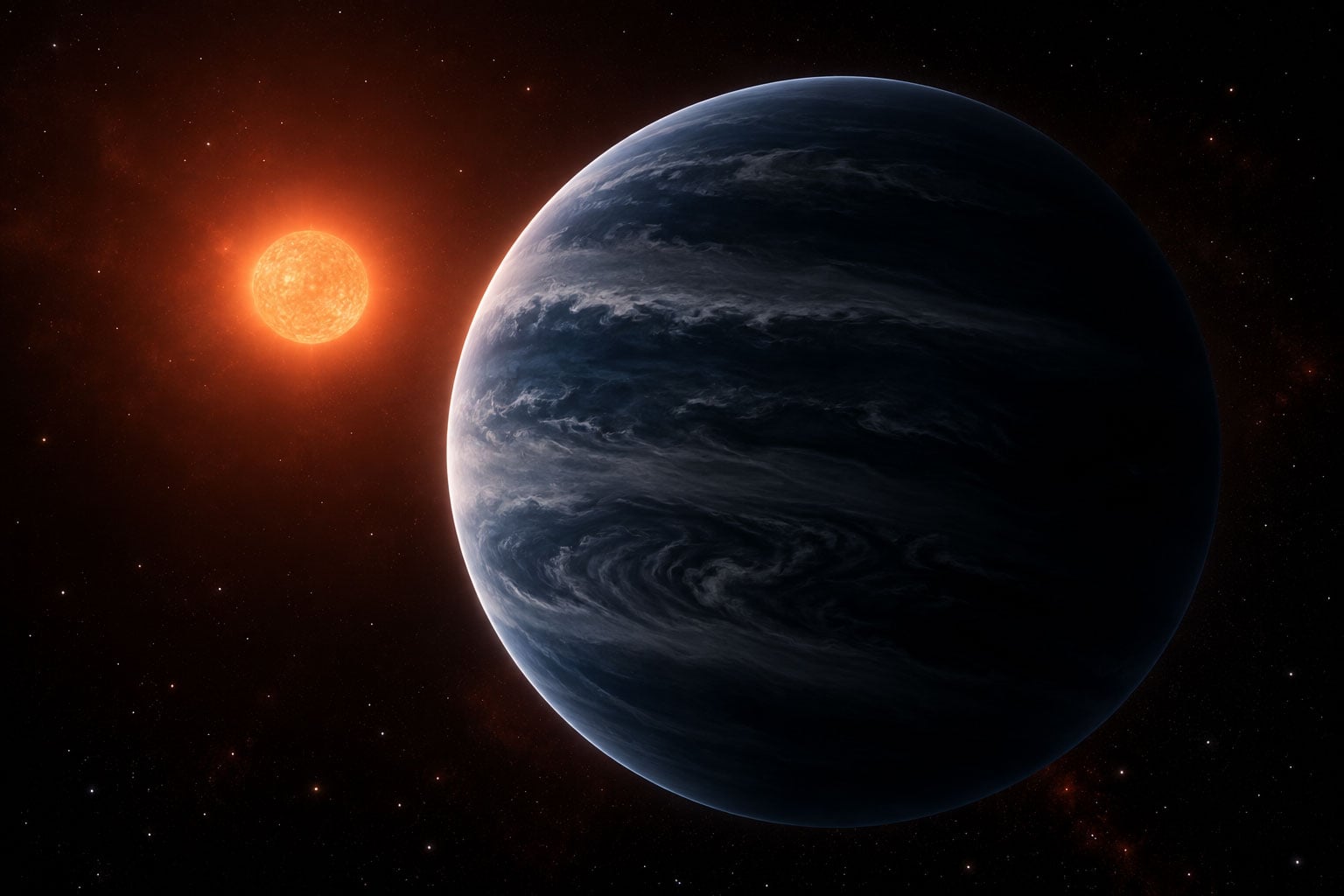
Researchers at Queen Mary University of London helped identify a planet’s backward orbit, which could offer clues to how planetary systems form and evolve.
When a star and its planets form from the same spinning disk of gas and dust, the planets are expected to orbit in the direction the star rotates. Astronomers have now discovered that GJ 3090 b, a Neptune-sized planet, travels around its star in the opposite direction.
Its host is an M dwarf, one of the small, cool stars that make up the majority of stars in our galaxy. GJ 3090 b is the first known planet to follow a backward, or retrograde, orbit around this type of star, raising questions about how it acquired such an unusual path.
An international team used high-resolution observations from the NIRPS near-infrared spectrograph, an instrument that separates light into its component wavelengths, to measure the orbit’s orientation in three dimensions. They calculated an orbital obliquity of approximately 136 degrees. This angle between the star’s spin axis and the planet’s orbital axis confirmed that the planet is orbiting backward.
“This is a remarkable planetary system because the planet is not simply tilted relative to its star — it is orbiting in the opposite direction. That immediately raises the question of how such an unusual orbit could have formed,” said Dr. Andrew Winter, a lead author of the study from Queen Mary University of London.
A backward orbit inherited at birth?
The research, published in Astronomy & Astrophysics Letters, considers whether GJ 3090 b inherited its unusual orbit from material the star acquired early in the system’s history.
Assistant Professor Vincent Bourrier of the University of Geneva said, “The idea that a planetary system could be rebuilt from a second, differently oriented disk is particularly exciting. It suggests that the environment around a young star can play a much bigger role in determining the architecture of its planets than we might have expected.”
In that scenario, the star acquired another disk of gas and dust from its surroundings, tilted relative to its original disk. Planets forming from the newly acquired material could have inherited its orientation. GJ 3090 b’s backward orbit would then preserve evidence of its beginnings, without requiring a later violent encounter to explain its path.
No sign of a massive companion
Gravitational interactions offer another way to turn a planet’s orbit around. A sufficiently massive outer planet or a companion star can disturb an orbit, tilting it dramatically over time. Such interactions are often invoked to explain retrograde planets, so the researchers searched the GJ 3090 system for a widely separated companion star or an outer planet massive enough to readily explain the extreme tilt.
PhD student Yann Carteret of the University of Geneva said, “We looked for the kind of massive companion that could have forced the planet into such an extreme orbit, but we don’t find evidence for one. That suggests we may need to think differently about how this system acquired its unusual architecture.”
GJ 3090 b is also the smallest planet around an M dwarf for which astronomers have measured a three-dimensional orbital obliquity. The measurement demonstrates how near-infrared observations can help researchers investigate planetary orbits around these common stars.
Further observations will be needed to test whether the system could have formed from a second, misaligned disk and to establish whether other planetary systems have similarly extreme orbital arrangements.
Reference: “Upside down: GJ 3090 b the first retrograde exoplanet around an M dwarf detected with NIRPS” by Yann Carteret, Vincent Bourrier, Léna Parc, Andrew Winter, Romain Allart, Izan de Castro Leão, François Bouchy, Vera M. Passegger, Charles Cadieux, Pierrot Lamontagne, Étienne Artigau, Frédérique Baron, Susana C. C. Barros, Björn Benneke, Xavier Bonfils, Marta Bryan, Bruno L. Canto Martins, Ryan Cloutier, Eduardo Cristo, Jonathan Gagné, Neil J. Cook, Nicolas B. Cowan, Jose Renan De Medeiros, Xavier Delfosse, René Doyon, Xavier Dumusque, David Ehrenreich, Jonay I. González Hernández, David Lafrenière, Christophe Lovis, Lison Malo, Claudio Melo, Lucile Mignon, Christoph Mordasini, Francesco Pepe, Rafael Rebolo, Jason Rowe, Nuno C. Santos, Damien Ségransan, Alejandro Suárez Mascareño, Stéphane Udry, Diana Valencia, Gregg Wade, Khaled Al Moulla, Rillck Guilherme de Souza Barros de Amorim, Lisa Dang, Emily Deibert, Dasaev O. Fontinele, Thierry Forveille, Yolanda G. C. Frensch, Roseane de Lima Gomes, Dany Mounzer, Stefan Pelletier, Riley Rosener, Bennett Neil Skinner, Avidaan Srivastava, Atanas K. Stefanov, Valentina Vaulato, Joost P. Wardenier and Drew Weisserman, 21 September 2026, Astronomy & Astrophysics.
DOI: 10.1051/0004-6361/202661989
Never miss a breakthrough: Join the SciTechDaily newsletter.
Follow us on Google and Google News.