
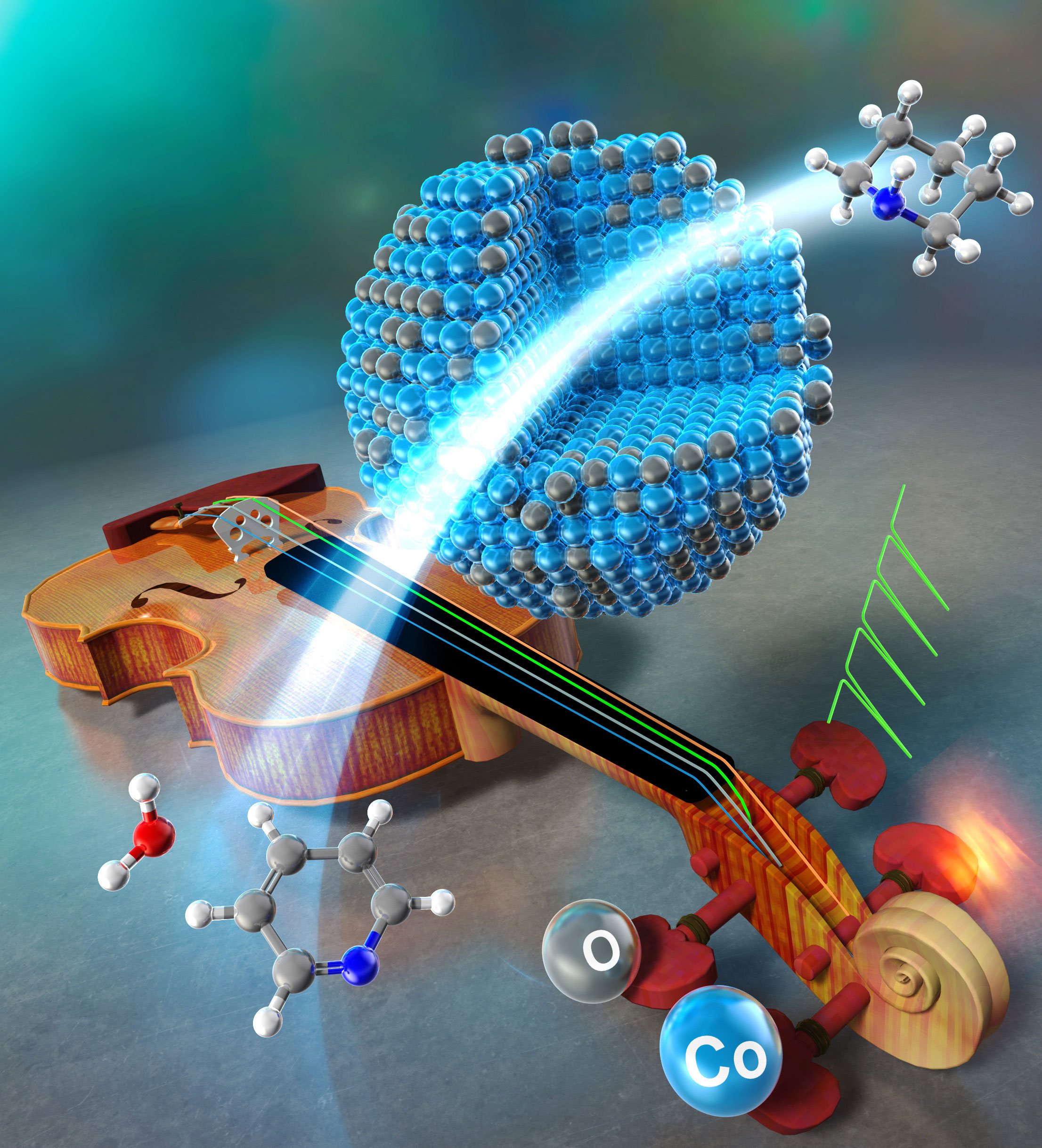
A cobalt catalyst may offer a more sustainable route to valuable chemical transformations when its oxidation state is carefully controlled.
A cobalt catalyst made from an abundant metal converted more than 99% of pyridine into the desired chemical product under ambient electrolysis conditions, according to researchers at Yokohama National University. Its performance depended not just on cobalt itself, but on maintaining the right balance between metallic cobalt and cobalt oxide during the reaction.
The catalyst also selectively hydrogenated several other nitrogen-containing compounds, including quinolines, pyrazines, nitriles and nitroarenes. The approach could help reduce reliance on scarce and expensive platinum group metals.
A catalyst with a changing chemical state
Hydrogenation adds hydrogen to molecules and is widely used in producing pharmaceuticals, plastics and other chemicals. Electrocatalytic hydrogenation can generate hydrogen equivalents from water using electricity rather than relying directly on hydrogen gas.
“A major challenge in electrocatalytic hydrogenation is replacing scarce platinum-group metals with earth-abundant catalysts without sacrificing activity or selectivity,” said Mahito Atobe, professor at Yokohama National University’s Faculty of Engineering and a corresponding author of the study.
The team focused on cobalt and examined how its oxidation state changed during electrolysis.
“We wanted to understand how the oxidation state of cobalt changes under operating conditions and whether controlling the balance between metallic cobalt and cobalt oxide could provide an effective catalyst,” said Naoki Shida, associate professor from the same Faculty and co-corresponding author.
More than 99% yield
The researchers prepared the catalyst from cobalt sulfate and calcined it at 750 °C (1,382 °F), then tested it in an anion-exchange membrane electrolyzer.
Under optimized conditions, the catalyst converted pyridine to piperidine with a yield above 99%. Piperidine is an important building block in synthetic and medicinal chemistry.
During electrolysis, cobalt shifts between metallic Co(0) and cobalt oxide, CoOx. Catalysts containing too much of either form were less effective. The best performance came from an intermediate Co(0)/CoOx ratio.
“We found that the catalytic performance of cobalt is determined not simply by its elemental composition, but by its dynamic oxidation state during electrolysis,” Atobe said.
Why the balance matters
Using in situ X-ray spectroscopy, experimental characterization and theoretical calculations, the team found that metallic cobalt and residual CoOx appear to create favorable conditions for pyridine adsorption and hydrogenation.
“Maintaining an appropriate balance between metallic Co and residual CoOx enables highly selective hydrogenation,” Atobe said.
The catalyst also suppressed unwanted hydrogenation pathways observed with rarer rhodium-based catalysts.
Maintaining the catalyst during longer reactions
Prolonged electrolysis can over-reduce cobalt, pushing the catalyst away from its optimal chemical state. To counter this, the researchers used intermittent electrolysis.
The strategy enabled gram-scale conversion of pyridine to piperidine with an 89% yield while maintaining a stable cell voltage.
The researchers now plan to apply this oxidation state control strategy to other earth-abundant transition metal catalysts and additional synthetic reactions.
“Our ultimate goal is to develop scalable electrochemical processes in which catalyst states can be actively controlled under operating conditions,” Shida said. “This could enable selective chemical manufacturing without relying on scarce precious metals.”
Reference: “Oxidation-State Control of Cobalt Electrocatalysts Enables Selective Hydrogenation of Nitrogen-Containing Aromatics” by Akizumi Yonezawa, Yugo Shimizu, Juri Harada, Ryo Kurihara, Atsuki Hirama, Yusuke Muto, Reno Fukui, Ayaka Wakasugi, Koji Harano, Kazuhide Kamiya, Shoji Iguchi, Naoki Shida and Mahito Atobe, 29 September 2026, Journal of the American Chemical Society.
DOI: 10.1021/jacs.6c12207
Funding: Japan Society for the Promotion of Science, Japan Science and Technology Agency
Never miss a breakthrough: Join the SciTechDaily newsletter.
Follow us on Google and Google News.