
The discovery could significantly reduce the production costs of fuels, chemicals, and materials.
A research team from the University of Minnesota Twin Cities College of Science and Engineering and the University of Houston’s Cullen College of Engineering has identified, and for the first time measured, the tiny fraction of an electron that enables catalytic manufacturing.
Details of the work appear in the open access journal ACS Central Science. The results clarify why precious metals such as gold, silver and platinum are so effective in catalysis and offer guidance for creating next-generation catalytic materials.
Catalysts are substances that lower the energy needed for chemical reactions. By doing so, they help manufacturers increase yield, speed, and efficiency when making other materials. These tools are central to processes used in pharmaceutical and battery production, and in petrochemical operations such as crude oil refining, helping supply keep pace with demand.
Finding catalysts that work faster and are easier to control is a primary objective across the fuels, chemicals, and materials sectors, which together represent economies worth multiple trillions of dollars. Around the world, researchers are racing to develop catalysts that can reduce costs and improve manufacturing efficiency across many industries.
Understanding How Molecules Interact with Catalysts
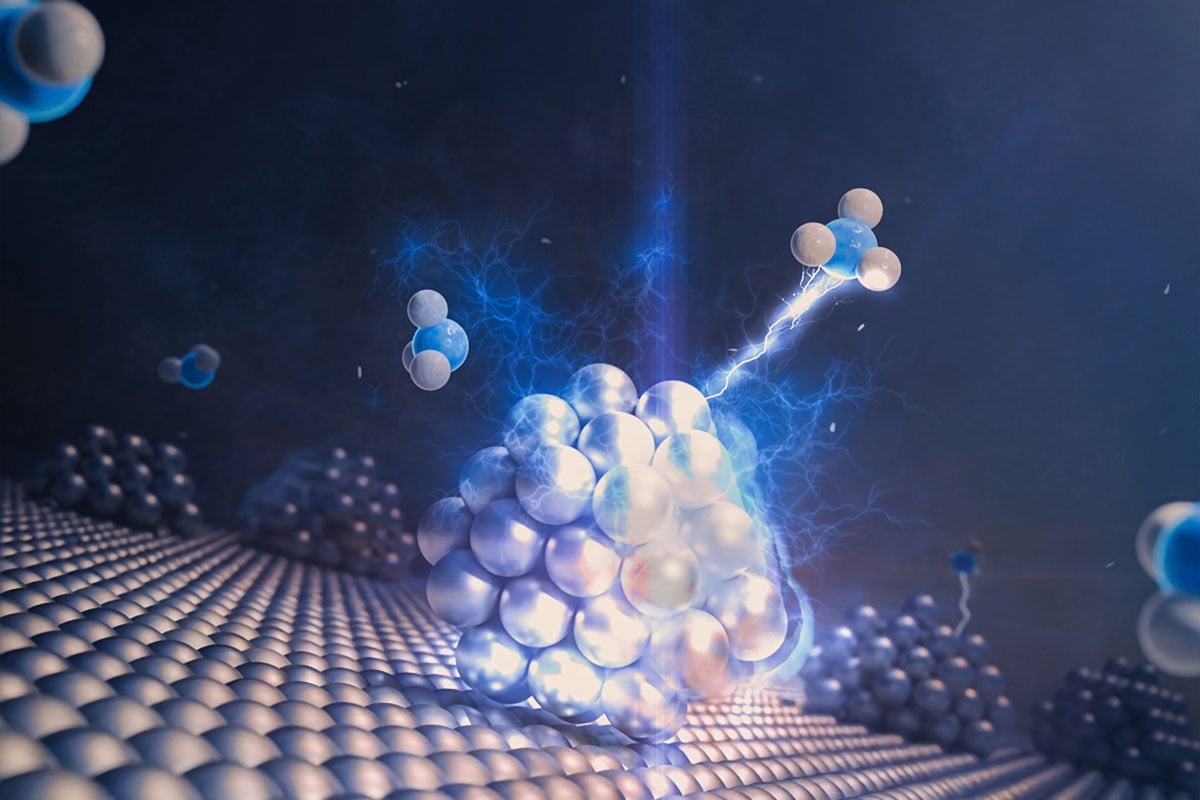
As molecules approach a catalyst surface, they share their electrons with the catalytic metal (in this case, gold, silver, or platinum), thus stabilizing the molecules in such a way that the desired reactions occur. This concept has been theorized for over a century, but direct measurements of these tiny, highly consequential percentages of an electron have never been directly observed.
Researchers at the Center for Programmable Energy Catalysis, headquartered at the University of Minnesota, have now shown that electron sharing can be directly measured by a technique of their own invention called Isopotential Electron Titration (IET).
“Measuring fractions of an electron at these incredibly small scales provides the clearest view yet of the behavior of molecules on catalysts,” said Justin Hopkins, University of Minnesota chemical engineering Ph.D. student and lead author of the research study. “Historically, catalyst engineers relied on more indirect measurements at idealized conditions to understand molecules on surfaces. Instead, this new measurement method provides a tangible description of surface bonding at catalytically-relevant conditions.”
Determining the amount of electron transfer at a catalyst surface is key to understanding its performance. Molecules that are more prone to sharing their electrons bind stronger, with increasing reactivity, providing a directly measurable quantity for catalyst activity. Precious metals exhibit the precise extent of electron sharing with reacting molecules necessary to drive catalysis, even though this exchange has not been possible to directly measure until today.
The Power of Isopotential Electron Titration (IET)
IET can now serve as a tool for experimental description of new catalyst formulations, which will enable researchers to screen for and discover ideal catalytic substances more quickly going forward.
“IET allowed us to measure the fraction of an electron that is shared with a catalyst surface at levels even less than one percent, such as the case of a hydrogen atom on platinum,” said Omar Abdelrahman, corresponding author and an associate professor in University of Houston Cullen College of Engineering’s William A. Brookshire Department of Chemical and Biomolecular Engineering. “A hydrogen atom gives up only 0.2% of an electron when binding on platinum catalysts, but it’s that small percentage which makes it possible for hydrogen to react in industrial chemical manufacturing.”
With the emergence of nanotechnologies for synthesizing catalysts combined with new tools in machine learning to explore and utilize large datasets, engineers have identified large numbers of new catalytic materials. IET now enables a third method for directly characterizing new materials at a fundamental level.
“The foundation for new catalytic technologies for industry has always been fundamental basic research,” says Paul Dauenhauer, Distinguished Professor and director of the Center for Programmable Energy Catalysis at the University of Minnesota. “This new discovery of fractional electron distribution establishes an entirely new scientific foundation for understanding catalysts that we believe will drive new energy technologies over the next several decades.”
Reference: “Isopotential Electron Titration: Hydrogen Adsorbate-Metal Charge Transfer” by Justin A. Hopkins, Benjamin J. Page, Shengguang Wang, Jesse R. Canavan, Jason A. Chalmers, Susannah L. Scott, Lars C. Grabow, James R. McKone, Paul J. Dauenhauer and Omar A. Abdelrahman, 15 September 2025, ACS Central Science.
DOI: 10.1021/acscentsci.5c00851
Funding: US Department of Energy
Never miss a breakthrough: Join the SciTechDaily newsletter.
Follow us on Google and Google News.
1 Comment
Amazing.