
Close Menu
    Facebook X (Twitter) Instagram
    SciTechDaily
    • Biology
    • Chemistry
    • Earth
    • Health
    • Physics
    • Science
    • Space
    • Technology
    Facebook X (Twitter) Pinterest YouTube RSS
    SciTechDaily
    Home»Chemistry»The New King of Propylene? Cobalt Catalyst Outperforms Precious Metals
    Chemistry

    The New King of Propylene? Cobalt Catalyst Outperforms Precious Metals

    By Dalian Institute of Chemical Physics, Chinese Academy SciencesJune 20, 2025No Comments3 Mins Read
    Facebook Twitter Pinterest Telegram LinkedIn WhatsApp Email Reddit
    Share
    Facebook Twitter LinkedIn Pinterest Telegram Email Reddit
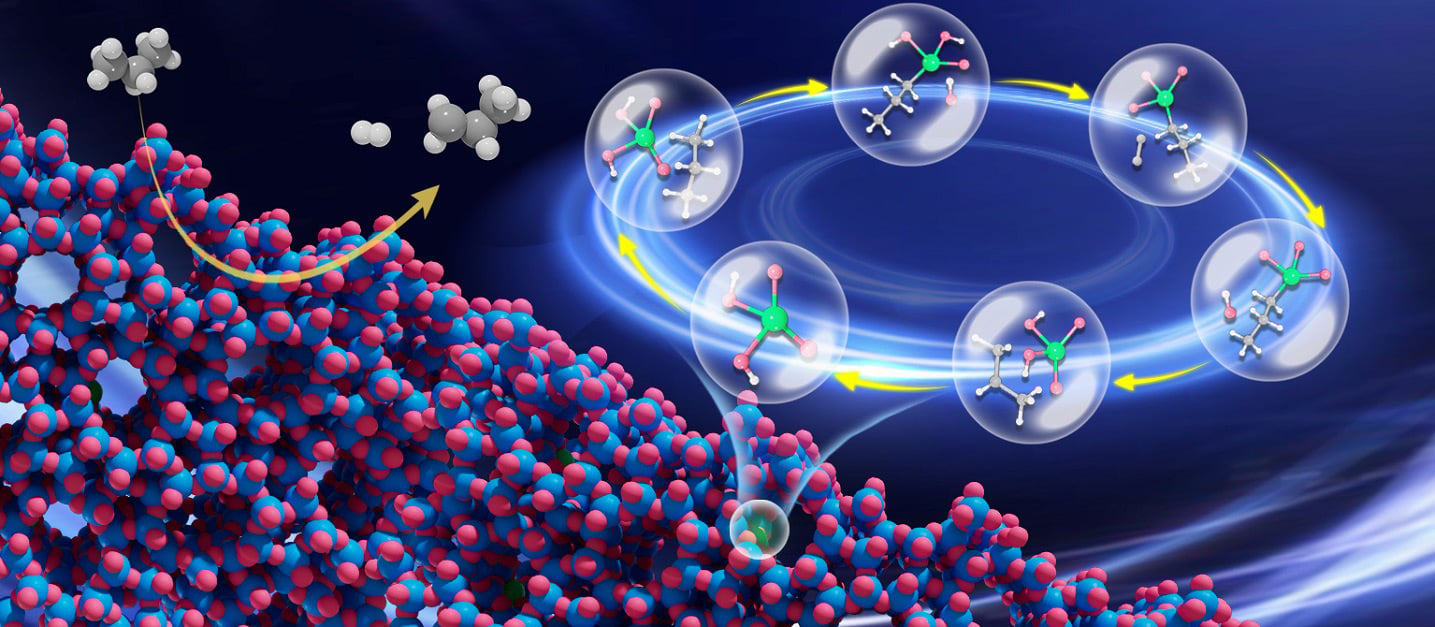
    Visualizing the Propane Dehydrogenation Cycle
    Researchers uncover mechanism behind high performance of cobaltosilicate zeolite catalyst in propane dehydrogenation. Credit: DICP

    CoS-1 is a cobalt zeolite catalyst that boosts propylene production efficiently and stably, challenging platinum-based alternatives.

    Propane dehydrogenation is an important industrial method for producing propylene without depending on oil. However, most current processes still depend heavily on precious-metal catalysts like those made with platinum. Finding efficient alternatives that use more common, earth-abundant metals has proven difficult.

    Synthesis of high-performance CoS-1 catalyst

    In a study published in Nature Catalysis, Prof. Jianping Xiao’s team at the Dalian Institute of Chemical Physics (DICP) of the Chinese Academy of Sciences, along with their collaborators, developed a high-performance cobaltosilicate zeolite catalyst called CoS-1 using a hydrothermal synthesis method. This catalyst contains only tetrahedral cobalt sites and no unstable cobalt species. It achieved a propylene productivity of 9.7 kgC3 per kg of catalyst per hour, outperforming the industrial PtSn/Al2O3 catalyst.

    The synthesis involved preparing a gel made from cobalt salts, tetraethyl orthosilicate, tetrapropylammonium hydroxide (TPAOH), urea, and water, followed by crystallization at 180 °C. After calcination to remove the organic template and three rounds of nitric acid washing at 80 °C to eliminate excess cobalt, the resulting CoS-1 catalyst retained only the stable tetrahedral cobalt sites.

    Atomic-level insights into catalyst performance

    Through density functional theory calculations and ab initio molecular dynamics simulations, researchers studied the stability of different active centers, and uncovered the mechanism behind the high performance of CoS-1 catalyst. They revealed that the flexible zeolite framework obviously lowered the dehydrogenation barriers at isolated cobalt sites due to entropic effects, resulting in a lower barrier of propane dehydrogenation than Pt3Sn alloy.

    Microkinetic simulations further showed that while CoS-1 had a lower dehydrogenation barrier, its overall reaction rate at initial conversions was slightly lower than that of Pt3Sn, due to reduced propane concentration at isolated Co sites—an effect of entropy loss during diffusion into the zeolite channels.

    The CoS-1 developed in this study exhibits excellent long-time stability. Researchers proved that this can be attributed to the non-bonding adsorption of propylene within the zeolite, which enables rapid product desorption and reducing coke formation.

    Reference: “Cobaltosilicate zeolite beyond platinum catalysts for propane dehydrogenation” by Hang Zhou, Huan Li, Liang Wang, Shengqi Chu, Lujie Liu, Lu Liu, Jizhen Qi, Zhouhong Ren, Anyu Cai, Yu Hui, Yucai Qin, Lijuan Song, Xuedi Qin, Jiaqi Shi, Jue Hou, Yongqi Ding, Jiabi Ma, Shaodan Xu, Xin Tao, Lina Li, Qi Yang, Bingwen Hu, Xi Liu, Liwei Chen, Jianping Xiao and Feng-Shou Xiao, 11 April 2025, Nature Catalysis.
    DOI: 10.1038/s41929-025-01320-x

    Never miss a breakthrough: Join the SciTechDaily newsletter.
    Follow us on Google and Google News.

    Catalysts Chemical Engineering Chinese Academy of Sciences Energy Materials Science
    Share. Facebook Twitter Pinterest LinkedIn Email Reddit

    Related Articles

    Breakthrough Catalyst Turns CO2 Into Fuel With Incredible Efficiency

    New Catalyst Turns CO2 Into Valuable Methanol With Unprecedented Efficiency

    Century-Old Mystery Solved: Scientists Measure a Fraction of an Electron, Unlocking the Secret to Catalysis

    Catalytic Hydrogenation of CO2 to Methanol: Low Temperature and High Efficiency

    Metallic Glass: One Step Closer to Solving a Major Problem of Hydrogen Energy

    Metal-Free Catalyst Discovery May Revolutionize Bio and Fossil Fuel Production

    Solar Flow Battery: Single Device Generates, Stores and Redelivers Renewable Electricity From the Sun

    More Efficient, Environmentally Friendly Ethylene Production With New Catalyst

    Atomic Layer Deposition Scaled Up to Large Surfaces With Lower Costs

    Leave A Reply Cancel Reply

    • Facebook
    • Twitter
    • Pinterest
    • YouTube

    Don't Miss a Discovery

    Subscribe for the Latest in Science & Tech!

    Trending News

    Millions Take This Joint Supplement but Scientists Found a Concerning Alzheimer’s Link

    Why Evolution Stalled for Millions of Years Before Suddenly Exploding

    New Feathered Dinosaur May Have Solved a 120-Million-Year-Old Fossil Mystery

    Ozempic and Similar Drugs Linked to Dramatic Drop in Addiction Rates

    Ancient Meteorite Reveals a Forgotten Planet That Existed 4.5 Billion Years Ago

    Scientists Reveal What Happened When 12 People Were Trapped Together in Antarctica for 10 Months

    The “Impossible” Earthquake Beneath Utah Was Real After All

    A Major Update Just Hit Cholesterol Guidelines – Here’s What Every Adult Needs To Know

    Follow SciTechDaily
    • Facebook
    • Twitter
    • YouTube
    • Pinterest
    • Newsletter
    • RSS
    SciTech News
    • Biology News
    • Chemistry News
    • Earth News
    • Health News
    • Physics News
    • Science News
    • Space News
    • Technology News
    Recent Posts
    • Your Diet Could Be Missing the Key Ingredient for Heart Protection
    • New Study Reveals Unexpected Way To Destroy Pancreatic Cancer Cells
    • Researchers Warn Widely Prescribed Blood Pressure Drugs Could Be Harming Diabetic Kidneys
    • JUNO’s First Results Bring the Neutrino Mass Mystery Into Focus
    • Astronomers Confirm Dark Energy After Shock Challenge Rocked Cosmology
    Copyright © 1998 - 2026 SciTechDaily. All Rights Reserved.
    • Science News
    • About
    • Contact
    • Editorial Board
    • Privacy Policy
    • Terms of Use

    Type above and press Enter to search. Press Esc to cancel.