

Scientists have built an “atomic cannon” to test whether exotic matter falls as Einstein’s theory predicts.
Researchers at ETH Zurich and the Paul Scherrer Institute (PSI) in Villigen have created a tightly controlled beam of muonium, an unusual atom containing an electron and an antimuon. Their advance, described in Nature Physics, clears a major obstacle to measuring how gravity affects a heavier relative of the particles that make up everyday matter.
“We have taken an important step toward carrying out an exciting experiment on this topic,” says Anna Soter, the physics professor leading the research. “We want to measure the gravitational interaction of the muon.”
Why Test Gravity With Exotic Matter?
Ordinary matter contains electrons and atomic nuclei made of protons and neutrons. Electrons and the quarks inside those protons and neutrons belong to the first generation of elementary particles. Nature also has two heavier generations, including the muon, a second-generation counterpart of the electron.
The Standard Model describes this particle family tree without explaining why it has three generations. “But we physicists do not yet understand why these additional generations exist at all in the first place,” Soter says. “And why are there three in total?”
When air resistance and other outside forces are excluded, ordinary objects fall at the same rate in the same gravitational field, regardless of their mass or composition. This universality of free fall, associated with Galileo Galilei and Isaac Newton, is central to Einstein’s theory of gravitation.
The underlying principle links gravitational mass, which determines how an object responds to gravity, with inertial mass, which determines how strongly it resists acceleration. Direct tests have so far involved ordinary matter or first-generation antimatter. Muonium offers a way to investigate whether the same relationship holds for a second-generation particle.
A Gravity Experiment Against The Clock
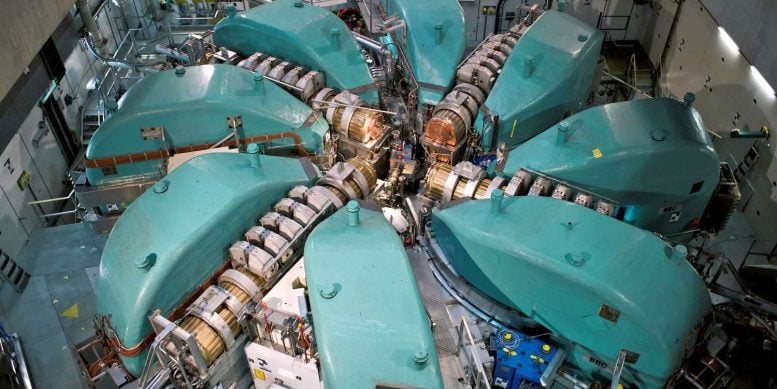
At PSI, an accelerator produces muons and their antiparticles. When a positively charged antimuon binds to a negatively charged electron, their charges cancel, forming neutral muonium. Although the atom contains an electron, most of its mass comes from the much heavier antimuon.
“The exotic muonium is very well suited to this because it is a neutral atom,” Soter explains. “After all, to make something fall, you need something neutral.” Charged particles also respond to gravity, but electromagnetic forces from stray fields can overwhelm its much weaker effect.
The researchers must nevertheless work within an extraordinarily short window: muons decay after an average of just 2.2 microseconds. Earlier muonium sources compounded that problem by releasing atoms in different directions and at widely varying speeds, making their motion difficult to measure precisely.
“We have managed to produce the muonium atoms in a ‘cold’ state, which is what makes the gravity experiment possible in the first place,” Soter says. “In this case, ‘cold’ means that the atoms propagate at similar speeds, almost parallel to one another.”
How The Atomic Cannon Works
To create that orderly beam, the team turned to superfluid helium. “In order to achieve this, we used superfluid helium that had been cooled close to absolute zero at minus 273 degrees Celsius,” says Jesse Zhang, the study’s lead author. That is approximately minus 459 degrees Fahrenheit.
“Superfluid helium is what is known as a quantum fluid, in which the individual helium atoms lose their identity and which does not tolerate any impurities within it,” Zhang explains. Antimuons entering a thin layer of this liquid slow down and can capture free electrons, forming muonium.
The resulting atoms have a positive chemical potential, meaning that remaining inside the helium is energetically unfavorable. When an atom reaches the surface, this energy becomes motion, launching it vertically out of the liquid. “So we’re using the chemical potential as an atomic cannon,” Zhang says.
The helium also lets muonium travel toward the surface at a characteristic speed without collisions that would scatter it. That is essential for atoms whose antimuons decay so quickly. “For our experiments, we also rely on PSI’s particle accelerator, which generates the world’s most intense, continuous muon beams,” Soter says. “Thanks to this high-quality source, a great many muonium atoms can be produced.”
Reading Gravity In An Atomic Wave
Producing the beam is a step toward the gravity measurement, rather than the measurement itself. The team is now developing an interferometer, an instrument that uses the atoms’ wave properties to create an interference pattern.
Earth’s gravity should shift that pattern slightly. Measuring the shift would reveal how muonium accelerates under gravity, allowing the researchers to test whether its heavy antimuon component follows the same rule as ordinary matter.
“We hope to be able to test the method for the first time with the atomic beam this year, and if all goes well, the actual gravity experiment should follow in two or three years’ time,” Soter says.
The beam could also improve laser spectroscopy, which uses light to probe atomic properties. More precise measurements of muonium could refine estimates of the muon’s mass and fundamental physical constants, another goal of the research group.
Could Muonium Reveal a Fifth Force?
An unexpected result could open a much broader investigation. If muonium falls differently from ordinary matter, physicists would need to explain why. “That would indeed be surprising, and, in addition to other theories, it could point to the existence of a fifth force,” Soter says.
Physics currently recognizes four fundamental interactions: gravity, electromagnetism, the strong interaction, and the weak interaction. A fifth force has been proposed many times, but none has been confirmed.
Soter is approaching the experiment without favoring a particular outcome. “I am completely open-minded,” she says. “I simply want to measure, for the first time, whether the equivalence between gravitational and inertial mass also applies to the second generation of particles—this alone is quite an inspiring piece of work.”
References:
“Generation of a high-intensity, superthermal muonium beam for gravity and laser spectroscopy experiments” by J. Zhang, A. Antognini, M. Bartkowiak, D. Goeldi, K. Kirch, A. Knecht, D. Taqqu, R. Waddy, F. Wauters, P. Wegmann and A. Soter, 14 September 2026, Nature Physics.
DOI: 10.1038/s41567-026-03433-x
“An intense superthermal muonium beam” by Jian Tang and Shihan Zhao, 14 September 2026, Nature Physics.
DOI: 10.1038/s41567-026-03435-9
This research is supported by the National Centre of Competence in Research Muoniverse.
Never miss a breakthrough: Join the SciTechDaily newsletter.
Follow us on Google and Google News.