
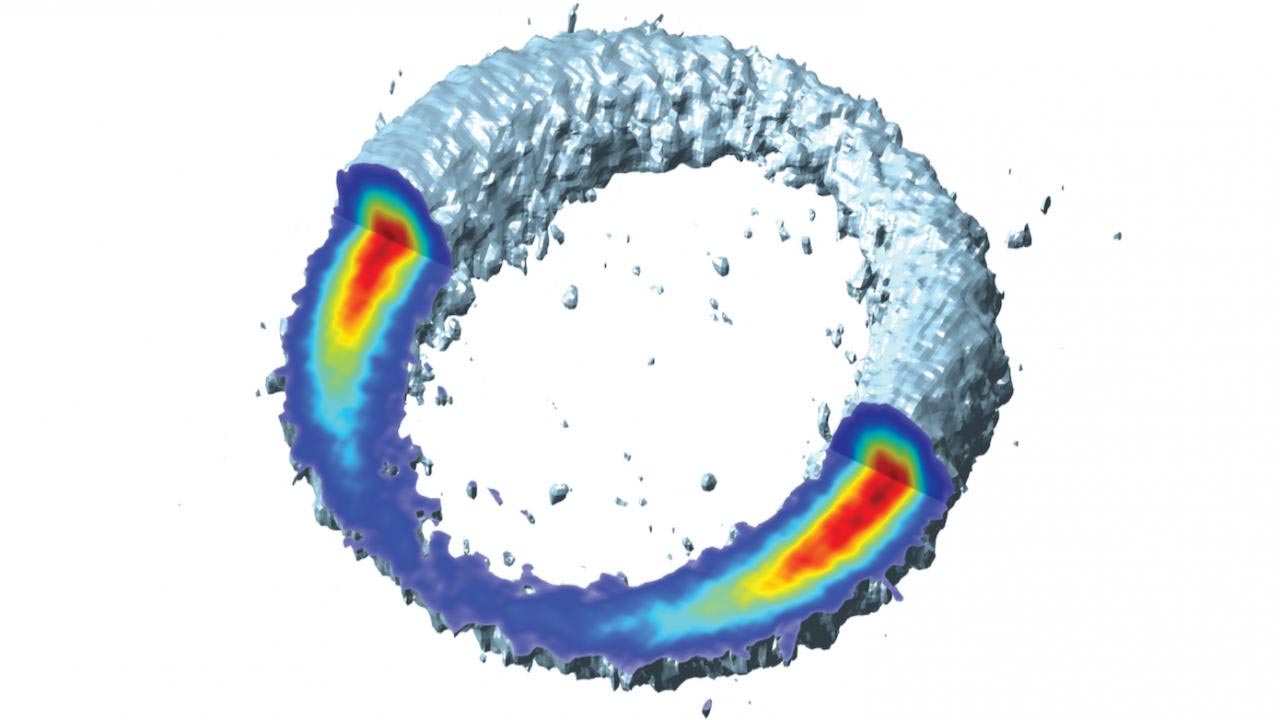
The first sub-femtosecond study of the linear photon momentum transfer during an ionization process provides unprecedented insight into the birth of photoelectrons.
The interaction between light and matter is the basis of both many fundamental phenomena and various practical technologies. Most famously, in the photoelectric effect, electrons are emitted from a material that is exposed to light of suitable energy. For long, the origin of the phenomenon remained a riddle, and only with the advent of quantum theory — and thanks to the genius of Albert Einstein — was the effect fully understood. Einstein received the 1921 Nobel Prize in Physics for his discovery of the underlying laws, and since then the effect has been harnessed in applications ranging from spectroscopy to night-vision devices. In some important cases, the key principle is the transfer not of energy but of linear momentum — or, impulse — from photons to electrons. This is the case, for instance, when laser light is used to cool microscopic and macroscopic objects, or to understand the phenomenon of radiation pressure.
Despite the fundamental importance of momentum transfer, the precise details of how light passes its impulse on to matter are still not fully understood. One reason is that the transferred impulse changes during an optical cycle on extremely fast, sub-femtosecond timescales. So far, studies revealed mainly information on time-averaged behavior, missing time-dependent aspects of the linear-momentum transfer during photoionization. This gap has now been filled by the group of Ursula Keller at the Institute for Quantum Electronics, as they report in a paper published today (December 5, 2019) in Nature Communications.
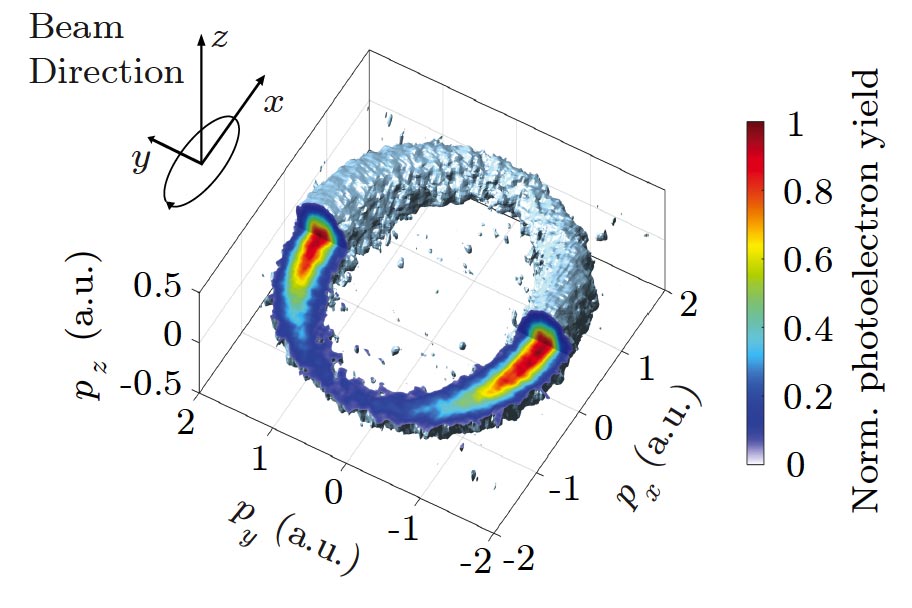
They looked at the case of high laser intensities, where multiple photons are involved in the ionization process, and investigated how much momentum is transferred in the direction of laser propagation. To achieve sufficient time resolution, they employed the so-called attoclock technique, which has been developed and refined in the Keller lab over the past decade. In this method, attosecond time resolution is achieved without having to produce attosecond laser pulses. Instead, information about the rotating laser-field vector in close to circular polarised light is used to measure time relative to the ionization event with attosecond precision. Very similar to the hand of a clock — just now this clock hand is rotating through a full circle within one optical cycle of 11.3-fs duration.
With this versatile tool at hand, the ETH physicists were able to determine how much linear momentum electrons gained depending on when the photoelectrons were ‘born.’ They found that the amount of momentum transferred in the propagation direction of the laser does indeed depend on when during the oscillation cycle of the laser the electron is ‘freed’ from the matter, in their case xenon atoms. This means that at least for the scenario they explored, the time-averaged radiation pressure picture is not applicable. Intriguingly, they can reproduce the observed behavior almost fully within a classical model, whereas many scenarios of light-matter interaction, such as Compton scattering, can only be explained within a quantum mechanical model.
The classical model had to be extended though, to take into account the interaction between the outgoing photoelectron and the residual xenon ion. This interaction, they show in their experiments, induces an additional attosecond delay in the timing of the linear momentum transfer compared to the theoretical prediction for a free electron born during the pulse. Whether such delays are a general property of photoionization or if they apply only for the sort of scenarios investigated in the present study remains open for now. What is clear, however, is that with this first study of linear momentum transfer during ionization on the natural timescale of the process, the Keller group opened up a new exciting route to explore the very fundamental nature of light-matter interactions — thus making good on a central promise of attosecond science.
Reference: “Sub-cycle time resolution of multi-photon momentum transfer in strong-field ionization” by Benjamin Willenberg, Jochen Maurer, Benedikt W. Mayer and Ursula Keller, 5 December 2019, Nature Communications.
DOI: 10.1038/s41467-019-13409-6
Never miss a breakthrough: Join the SciTechDaily newsletter.
Follow us on Google and Google News.
1 Comment
This article is worded in too complicated a fashion for many to understand. Is it saying that a laser-beam speeds up an electron to a higher energy level, and thus births a photon?