
Close Menu
    Facebook X (Twitter) Instagram
    SciTechDaily
    • Biology
    • Chemistry
    • Earth
    • Health
    • Physics
    • Science
    • Space
    • Technology
    Facebook X (Twitter) Pinterest YouTube RSS
    SciTechDaily
    Home»Physics»Chameleon Theory Could Change How Scientists Think About Gravity
    Physics

    Chameleon Theory Could Change How Scientists Think About Gravity

    By Leighton Kitson, Durham UniversityJuly 10, 2019No Comments3 Mins Read
    Facebook Twitter Pinterest Telegram LinkedIn WhatsApp Email Reddit
    Share
    Facebook Twitter LinkedIn Pinterest Telegram Email Reddit
    Chameleon Theory Could Change Our Thoughts on Gravity
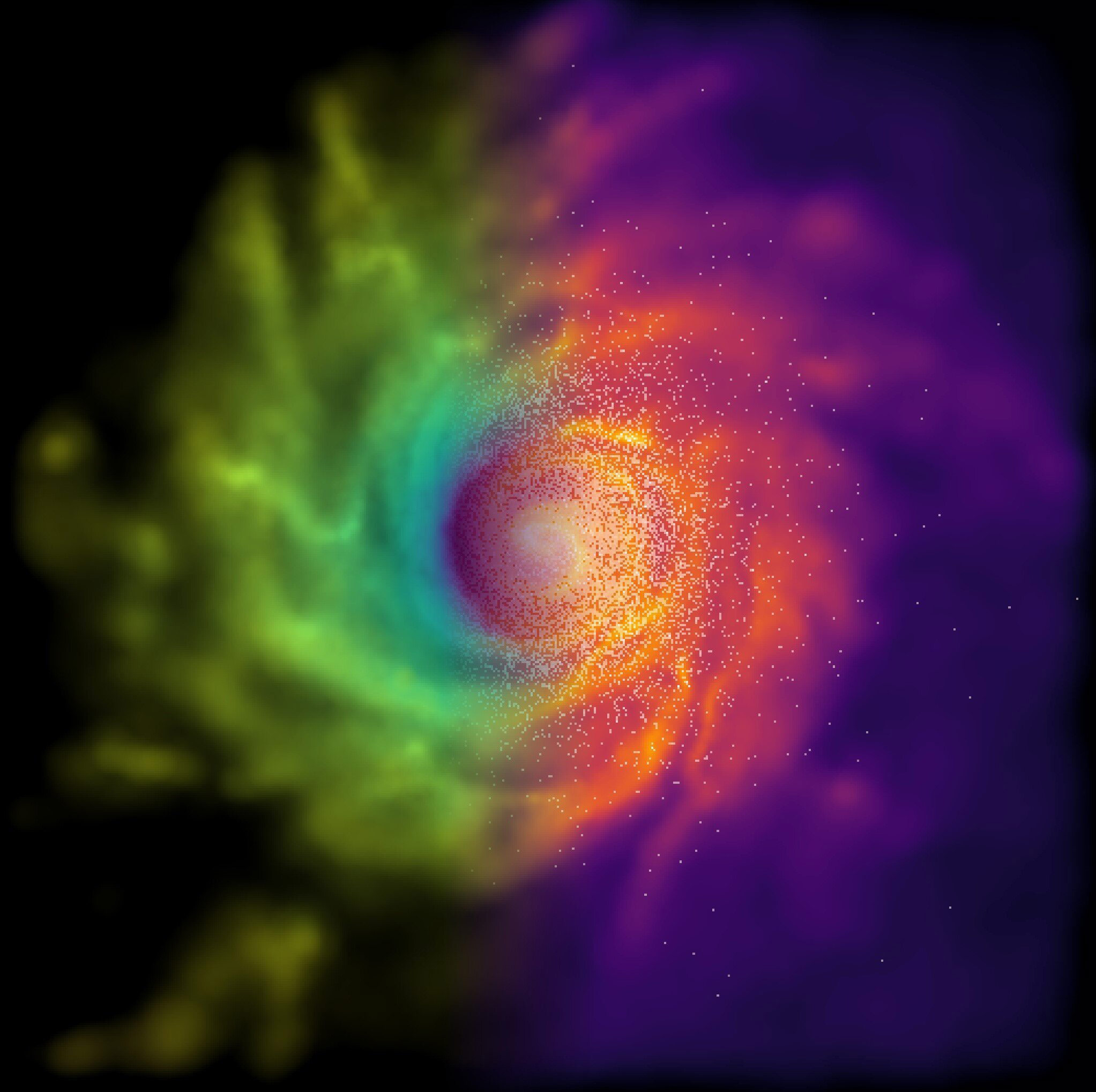
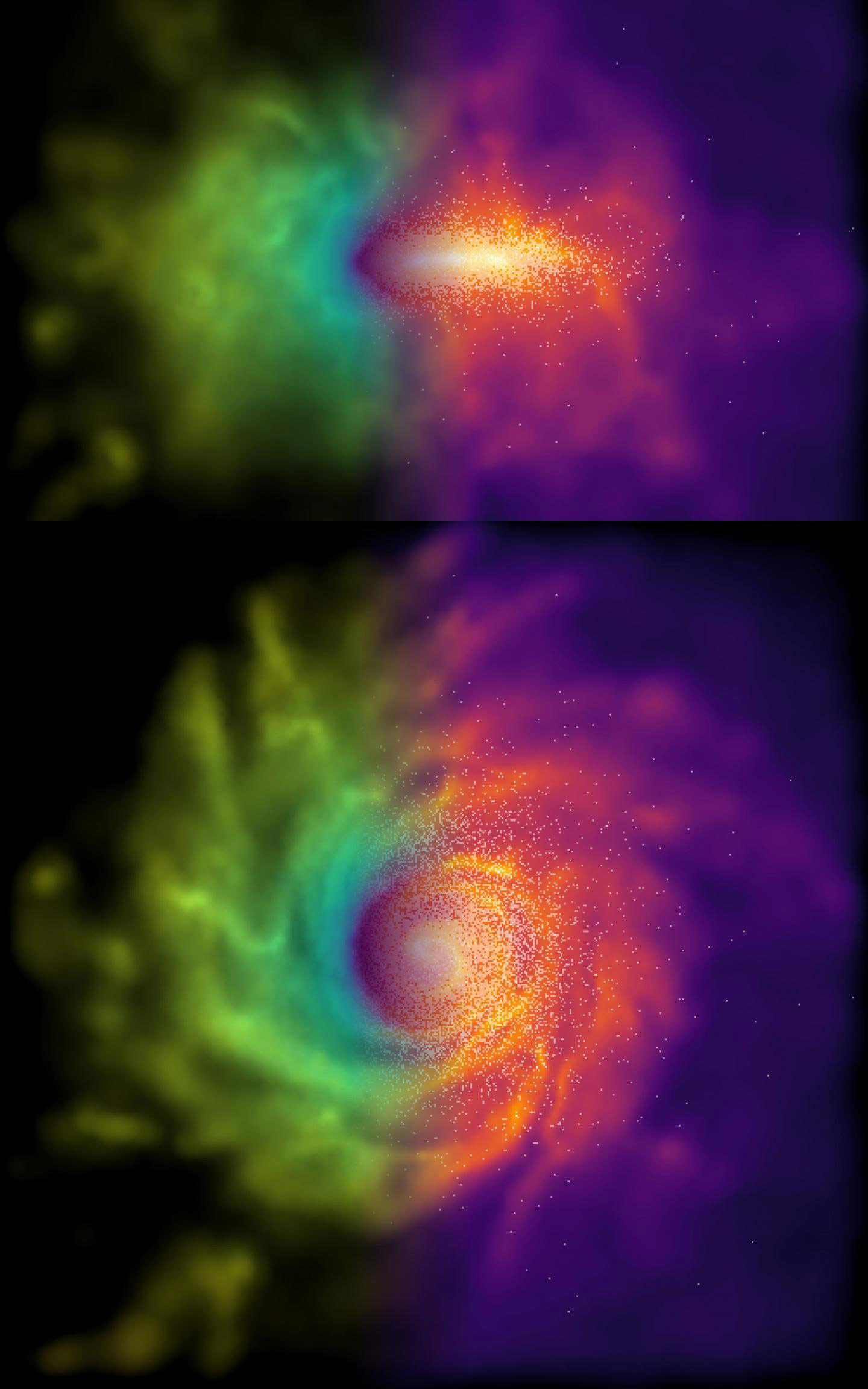
    Computer generated images showing a disk galaxy from a modified gravity simulation. Images show (right side of image, in red-blue color) the gas density within the disk of the galaxy with the stars shown as bright dots. The left side of the images show the force changes in the gas within the disk, where the dark central regions correspond to standard, General Relativity-like forces and the bright yellow regions correspond to enhanced (modified forces). Images show views of the simulated galaxy from above and the side. Christian Arnold/Baojiu Li/Durham University.

    Einstein’s theory of General Relativity is world-famous – but it might not be the only way to explain how gravity works and how galaxies form. Physicists at Durham University created huge supercomputer simulations of the universe to test an alternative theory.

    Our researchers found that f(R)-gravity – a so-called Chameleon Theory – could also explain the formation of structures in the cosmos. The simulations show that disc spiral galaxies like our Milky Way still form, even when a different law of gravity is applied.

    Scientists already know that f(R)-gravity can reproduce the success of General Relativity in demonstrating the evolution of our solar system. But our new research now shows that this theory can also be applied to galaxy formation on very large cosmological scales.

    This doesn’t mean that Einstein was wrong, though! Instead, it shows that there might be more than one way to explain gravity’s role in the evolution of the universe.
    Modified Gravity Simulation
    Images show (right side of image, in red-blue color) the gas density within the disk of the galaxy with the stars shown as bright dots. The left side of the images show the force changes in the gas within the disk, where the dark central regions correspond to standard, General Relativity-like forces and the bright yellow regions correspond to enhanced (modified forces). Images show views of the simulated galaxy from above and the side. Christian Arnold/Baojiu Li/Durham University.

    General Relativity was developed by Einstein in the early 1900s to explain the gravitational effect of large objects in space. It also has consequences for understanding the accelerating expansion of the universe, which it’s thought is driven by a mysterious substance called dark energy.

    However, models like f(R)-gravity can also explain the universe’s rapid growth and our researchers say their work could also be a small step toward identifying what dark energy is. Our astronomers and cosmologists are among the best in the world and are constantly shedding new light on the science of the universe.

    In the past year, we’ve also shown how supermassive black holes can help to measure the expansion of the early universe; how our Milky Way is on a catastrophic collision course with a neighboring galaxy; and why Uranus is tilted on its side.

    We’re also helping to build the Extremely Large Telescope – the biggest telescope in the world. Discover more about our Cosmology and Astronomy research.

    The f(R)-gravity research is published in Nature Astronomy. It was led by Dr Christian Arnold and Professor Baojiu Li in our Institute for Computational Cosmology and postgraduate student Matteo Leo in our Institute for Particle Physics Phenomenology.

    The research was funded by the European Research Council and the Science and Technology Facilities Council. Computer simulations were run on the DiRAC Data Centric System based at Durham University.

    Reference: “Realistic simulations of galaxy formation in f(R) modified gravity” by Christian Arnold, Matteo Leo and Baojiu Li, 8 July 2019, Nature Astronomy.
    DOI: 10.1038/s41550-019-0823-y

    Never miss a breakthrough: Join the SciTechDaily newsletter.
    Follow us on Google and Google News.

    Astrophysics Cosmology Durham University Einstein Gravity Particle Physics
    Share. Facebook Twitter Pinterest LinkedIn Email Reddit

    Related Articles

    The Most Elusive Number in Physics Just Got Even More Mysterious

    Hundreds of Times Colder Than Outer Space: Scientists Reach Near-Absolute Zero in Dark Matter Hunt

    Physicists Propose First-Ever Experiment To Manipulate Gravitational Waves

    Dark Matter May Not Exist: These Physicists Favor of a New Theory of Gravity

    Black Holes Have Properties That Resemble the Dynamics of Solids and Liquids

    Astrophysicists Zero In on How the Universe Responds to Gravity

    ICARUS Experiment Claims Neutrinos Aren’t Faster Than Light

    Possible Mistakes Found in Faster Than Light Neutrino Measurement

    Ultracold Neutrons Could Escape to Another Braneworld

    Leave A Reply Cancel Reply

    • Facebook
    • Twitter
    • Pinterest
    • YouTube

    Don't Miss a Discovery

    Subscribe for the Latest in Science & Tech!

    Trending News

    Scientists Warn That This Common Pet Fish Can Wreck Entire Ecosystems

    Scientists Make Breakthrough in Turning Plastic Trash Into Clean Fuel Using Sunlight

    This Popular Supplement May Interfere With Cancer Treatment, Scientists Warn

    Scientists Finally Solved One of Water’s Biggest Mysteries

    Could This New Weight-Loss Pill Disrupt the Entire Market? Here’s What You Should Know About Orforglipron

    Earth’s Crust Is Tearing Open in Africa, and It Could Form a New Ocean

    Breakthrough Bowel Cancer Trial Leaves Patients Cancer-Free for Nearly 3 Years

    Natural Compound Shows Powerful Potential Against Rheumatoid Arthritis

    Follow SciTechDaily
    • Facebook
    • Twitter
    • YouTube
    • Pinterest
    • Newsletter
    • RSS
    SciTech News
    • Biology News
    • Chemistry News
    • Earth News
    • Health News
    • Physics News
    • Science News
    • Space News
    • Technology News
    Recent Posts
    • World-First Study Reveals Human Hearts Can Regenerate After a Heart Attack
    • Why Your Dreams Feel So Real Sometimes and So Strange Other Times
    • Scientists Debunk 100-Year-Old Belief About Brain Cells, Rewriting Textbooks
    • This Simple Home Device May Boost Brain Power in Adults Over 40
    • Ancient Roman Ship Coating Reveals Secrets Hidden for 2,200 Years
    Copyright © 1998 - 2026 SciTechDaily. All Rights Reserved.
    • Science News
    • About
    • Contact
    • Editorial Board
    • Privacy Policy
    • Terms of Use

    Type above and press Enter to search. Press Esc to cancel.