
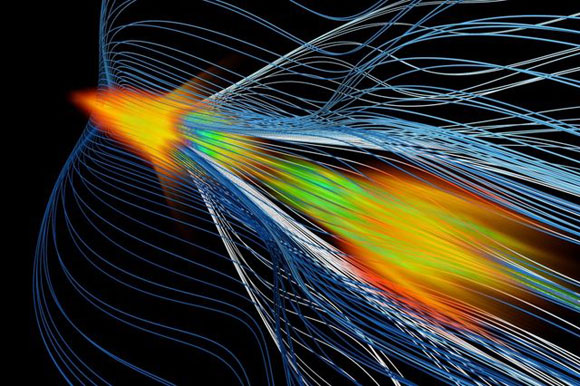
In a new study, researchers detail how a technique called plasma wakefield acceleration could enable them to build more economical particle colliders.
A study led by researchers from UCLA and the U.S. Department of Energy’s SLAC National Accelerator Laboratory has demonstrated a more efficient way to accelerate positrons, the antimatter opposites of electrons. The method may help lead to much smaller but more powerful linear electron-positron colliders — machines that could be used to understand the properties of nature’s fundamental building blocks.
The research team had previously shown that boosting the energy of charged particles by having them “surf” a wave of ionized gas, or plasma, works well when accelerating electrons. While this method by itself could lead to smaller accelerators, electrons are only half the equation for future colliders. Now the researchers have achieved another milestone by applying the technique to positrons at SLAC’s Facility for Advanced Accelerator Experimental Tests. The research was published August 26 in Nature.
Researchers study matter’s fundamental components and the forces between them by smashing highly energetic particle beams into one another. Europe’s Large Hadron Collider, for example, works by colliding protons at extremely high energies. But many scientists believe building a collider that smashes electrons and positrons together would be a major advance. This is because unlike protons, which are composed of three quarks, electrons and positrons are elementary or fundamental particles and therefore collisions between them would be far cleaner and easier to study.
This animation explains how researchers accelerate positrons with a plasma – a method that may help boost the energy and shrink the size of future linear particle colliders
Using current technology, an electron-positron collider for next-generation experiments would require accelerators tens of kilometers long. But researchers hope that a technique called plasma wakefield acceleration could enable them to build shorter, more economical accelerators.
Previous work showed that the method works efficiently for accelerating electrons: When one of FACET’s tightly focused bundles of electrons enters an ionized gas, it creates a plasma “wake” that researchers use to accelerate a trailing second electron bunch.
But plasma wakefield is much more challenging when positrons are the particles being accelerated. In fact, many scientists believed that no matter where a trailing positron bunch was placed in a wake, it would lose its compact, focused shape or even slow down.
“Our key breakthrough was to find a new regime that lets us accelerate positrons in plasmas efficiently,” said study co-author Chandrashekhar Joshi, a distinguished professor of electrical engineering at the UCLA Henry Samueli School of Engineering and Applied Science.
The team discovered that a single positron bunch can interact with the plasma in such a way that the front of it generates a wake that both accelerates and focuses its trailing end. This occurs after the positrons have traveled about 10 centimeters (about 4 inches) through the plasma.
“In this stable state, about 1 billion positrons gained 5 billion electronvolts of energy over a short distance of only 1.3 meters,” said Sebastien Corde, the study’s first author, a former SLAC researcher who is now at the Ecole Polytechnique in France. “They also did so very efficiently and uniformly, resulting in an accelerated bunch with a well-defined energy.”
Using supercomputers, team members performed simulations that were key to understanding the mechanism that enabled positron acceleration.
“We performed simulations to understand how the stable state was created,” said Warren Mori, a co-author of the study and a UCLA professor of physics and astronomy, and of electrical engineering. “Based on this understanding, we can now use simulations to look for ways of exciting suitable wakes in an improved, more controlled way. This will lead to ideas for future experiments.”
Although the researchers don’t expect plasma-based particle colliders to be built in the near future, the method could be used to upgrade existing accelerators much sooner.
“It’s conceivable to boost the performance of linear accelerators by adding a very short plasma accelerator at the end,” Corde said. “This would multiply the accelerator’s energy without making the entire structure significantly longer.”
SLAC’s Mark Hogan, co-author of the study, said, “Together with our previous achievement, the new study is a very important step toward making smaller, less expensive next-generation electron-positron colliders.”
Additional contributors included researchers from the University of Oslo and Tsinghua University in China. The research was supported by the Department of Energy, the National Science Foundation, the Research Council of Norway and the Thousand Young Talents Program of China
Reference: “Multi-gigaelectronvolt acceleration of positrons in a self-loaded plasma wakefield” by S. Corde, E. Adli, J. M. Allen, W. An, C. I. Clarke, C. E. Clayton, J. P. Delahaye, J. Frederico, S. Gessner, S. Z. Green, M. J. Hogan, C. Joshi, N. Lipkowitz, M. Litos, W. Lu, K. A. Marsh, W. B. Mori, M. Schmeltz, N. Vafaei-Najafabadi, D. Walz, V. Yakimenko and G. Yocky, 27 August 2015, Nature.
DOI: 10.1038/nature14890
Never miss a breakthrough: Join the SciTechDaily newsletter.
Follow us on Google and Google News.