
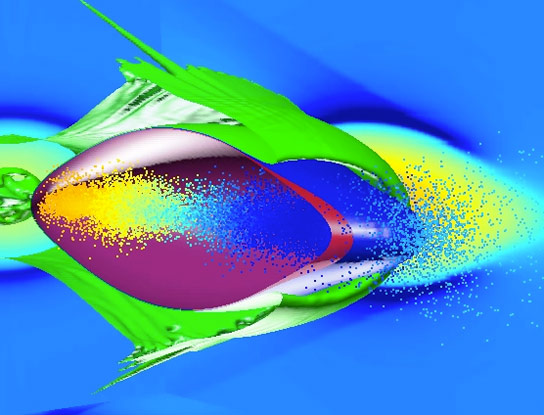
Researchers hit a milestone in demonstrating the practicality of plasma wakefield acceleration, boosting bunches of electrons to energies 400 to 500 times higher than they could reach traveling the same distance in a conventional accelerator.
Menlo Park, California — Scientists from the Department of Energy’s SLAC National Accelerator Laboratory and the University of California, Los Angeles have shown that a promising technique for accelerating electrons on waves of plasma is efficient enough to power a new generation of shorter, more economical accelerators. This could greatly expand their use in areas such as medicine, national security, industry, and high-energy physics research.
This achievement is a milestone in demonstrating the practicality of plasma wakefield acceleration, a technique in which electrons gain energy by essentially surfing on a wave of electrons within an ionized gas.
Using SLAC’s Facility for Advanced Accelerator Experimental Tests (FACET), a DOE Office of Science User Facility, the researchers boosted bunches of electrons to energies 400 to 500 times higher than they could reach traveling the same distance in a conventional accelerator. Just as important, energy was transferred to the electrons much more efficiently than in previous experiments. This crucial combination of energy and efficiency had never been reached before. The results are described in a paper published today in the journal Nature.
“Many of the practical aspects of an accelerator are determined by how quickly the particles can be accelerated,” said SLAC accelerator physicist Mike Litos, lead author of the paper. “To put these results in context, we have now shown that we could use this technique to accelerate an electron beam to the same energies achieved in the 2-mile-long (3.2-kilometer-long) SLAC linear accelerator in less than 20 feet.”
Plasma wakefields have been of interest to accelerator physicists for 35 years as one of the more promising ways to drive the smaller, cheaper accelerators of the future. The UCLA and SLAC groups have been at the forefront of research on plasma wakefield acceleration for more than a decade. In a 2007 paper, researchers announced they’d accelerated electrons in the tail end of a long electron bunch from 42 billion electronvolts to 85 billion electronvolts, causing a great deal of excitement in the scientific community. However, fewer than 1 billion of the 18 billion electrons in the pulse actually gained energy and they had a wide spread of energies, making them unsuitable for experiments.
In this experiment, researchers sent pairs of electron bunches containing 5 billion to 6 billion electrons each into a laser-generated column of plasma inside an oven of hot lithium gas. The first bunch in each pair was the drive bunch; it blasted all the free electrons away from the lithium atoms, leaving the positively charged lithium nuclei behind – a configuration known as the “blowout regime.” The blasted electrons then fell back in behind the second bunch of electrons, known as the trailing bunch, forming a “plasma wake” that propelled the trailing bunch to higher energy.
Researchers at SLAC explain how they use plasma wakefields to accelerate bunches of electrons to very high energies over only a short distance. Their experiments offer a possible path for the future of particle accelerators.
An Efficient, Viable Technology
Previous experiments had demonstrated multi-bunch acceleration, but the team at SLAC was the first to reach the high energies of the blowout regime, where maximum energy gains at maximum efficiencies can be found. Of equal importance, the accelerated electrons wound up with a relatively small energy spread.
“These results have an additional significance beyond a successful experiment,” said Mark Hogan, SLAC accelerator physicist and one of the principal investigators of the experiment. “Reaching the blowout regime with a two-bunch configuration has enabled us to increase the acceleration efficiency to a maximum of 50 percent – high enough to really show that plasma wakefield acceleration is a viable technology for future accelerators.”
The plasma source used in the experiment was developed by a team of scientists led by Chandrashekhar Joshi, director of the Neptune Facility for Advanced Accelerator Research at UCLA. He is the UCLA principal investigator for this research, a faculty member with the UCLA Henry Samueli School of Engineering and Applied Science, and a long-time collaborator with the SLAC group.
“It is gratifying to see that the UCLA-SLAC collaboration on plasma wakefield acceleration continues to solve seemingly intractable problems one by one through systematic experimental work,” Joshi said. “It is this kind of transformative research that attracts the best and the brightest students to this field, and it is imperative that they have facilities such as FACET to carry it out.”
This animation explains how electrons can be efficiently accelerated to high energy using wakes created in a plasma.
The Next Steps
There are more milestones ahead. Before plasma wakefield acceleration can be put to use, Hogan said, the trailing bunches must be shaped and spaced just right so all the electrons in a bunch receive exactly the same boost in energy, while maintaining the high overall quality of the electron beam.
“We have our work cut out for us,” Hogan said. “But you don’t get many chances to conduct research that you know in advance has the potential to be immensely rewarding, both scientifically and practically.”
Computer simulations used in the experiments were developed by Warren Mori’s group at UCLA. Additional contributors included researchers from SLAC, the University of Oslo in Norway, Tsinghua University in China, and Max Planck Institute for Physics in Germany. The research was funded by the DOE Office of Science.
Reference: “High-efficiency acceleration of an electron beam in a plasma wakefield accelerator” by M. Litos, E. Adli, W. An, C. I. Clarke, C. E. Clayton, S. Corde, J. P. Delahaye, R. J. England, A. S. Fisher, J. Frederico, S. Gessner, S. Z. Green, M. J. Hogan, C. Joshi, W. Lu, K. A. Marsh, W. B. Mori, P. Muggli, N. Vafaei-Najafabadi, D. Walz, G. White, Z. Wu, V. Yakimenko and G. Yocky, 5 November 2014, Nature.
DOI: 10.1038/nature13882
Never miss a breakthrough: Join the SciTechDaily newsletter.
Follow us on Google and Google News.
1 Comment
It is a great achievement to accelerate electrons to 400-500 times more energy using plasma fields than conventional particle accelerators. Let us hope that technology will be out of laboratory soon and will be used for practical applications.