
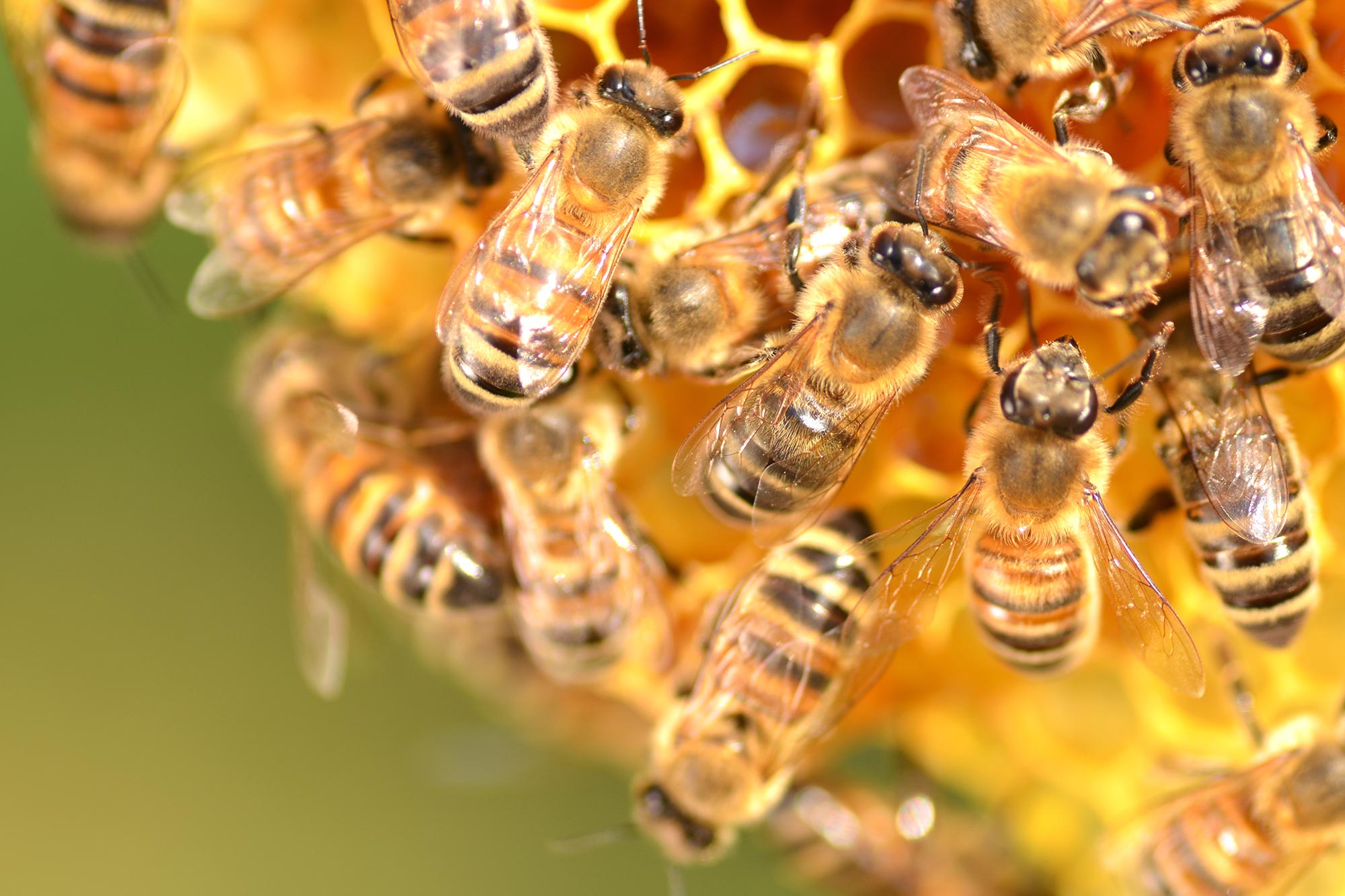
A new study challenges traditional ideas about honey bee colonies.
A honey bee colony may be more than a society of thousands of insects. A new study proposes that the entire colony functions as a single living organism, with its own development, reproductive cycle, and biological lifespan. This perspective could challenge some of the most common practices in modern beekeeping.
Researchers Hannes Bonhoff of Lund University and Heikki Helanterä, a professor of evolutionary biology and genomics at the University of Oulu in Finland, argue that a queen and her colony together constitute a superorganism. Rather than treating the queen, 200 to 300 drones, and tens of thousands of workers as separate individuals, their framework considers the colony an animal whose members function much like specialized cells in a body.
A Honey Bee Colony That Grows, Ages, and Dies
“We have analyzed what it means for a bee colony to be a single organism, which opens up new insights into the fascinating life of the honey bee,” says Bonhoff.
Under this interpretation, a colony develops through stages comparable to those of a mammal, progressing from an embryo and fetus to a juvenile and adult. Bonhoff argues that colonies also undergo biological aging and eventually die after several years. The comparison treats the colony’s development as a whole, rather than focusing on the much shorter lifespans of its individual bees.
The superorganism concept is not new, but the researchers apply it to the colony’s life cycle, including how it reproduces and cares for its offspring. This approach raises questions about whether certain behaviors traditionally understood as collective insect activity might instead be viewed as functions of a larger biological individual.
Swarming May Be a Form of Parental Care
Honey bee colonies reproduce through swarming, when the established queen leaves the hive with roughly half the colony to find a new nesting site. A new queen remains in the original hive, where she becomes the reproductive center of the next colony generation.
In the researchers’ framework, this process resembles an animal producing offspring and providing extensive parental care. The developing colony inherits an established nest, food resources, shelter, and the support of experienced workers.
“When this superorganism reproduces, the offspring are cared for with great dedication by the parent, in some cases even at the cost of the parent’s life,” says Bonhoff.
The departing queen and her swarm face the risks of finding and establishing a new home, while the next generation develops in familiar surroundings. Established workers can also provide valuable foraging information through the honey bee dance language, which communicates the locations of food sources.
“Parental care therefore goes so far that the offspring inherits the mother’s nest, whilst she herself risks her life by swarming away to settle elsewhere,” says Bonhoff.
What This Could Mean for Modern Beekeeping
The proposed framework could have practical implications for managing honey bee populations. Beekeepers commonly replace queens and prevent swarming to maintain productive colonies. However, the researchers suggest that interfering with these natural processes may disrupt the colony’s reproductive and developmental cycle.
The study also raises questions about controlling Varroa mites, parasitic arachnids that threaten honey bee populations worldwide. Understanding the colony as an organism with distinct life stages could influence how beekeepers approach parasite management, although the proposed perspective does not itself establish a more effective treatment.
“Modern beekeeping methods are based on the idea of keeping the colony young and healthy indefinitely. Our study shows that such interventions fundamentally conflict with the natural reproductive strategy and the ability to cope with parasites,” says Bonhoff.
The research originated in Bonhoff’s master’s thesis at Lund University, supervised by Helanterä and Niklas Wahlberg, a professor of systematic biology at Lund. Wahlberg believes the work contributes to understanding how biological individuality can extend beyond a single insect.
“The concept itself has been around for a long time, but this is the first time it has been applied in a genuine biological context. It’s fascinating to think that, just as individual cells make up an organism, individual bees with different roles make up the superorganism,” concludes Wahlberg.
Reference: “On the life history of the honey bee superorganism” by Hannes A. Bonhoff and Heikki Helanterä, 3 August 2026, Insectes Sociaux.
DOI: 10.1007/s00040-026-01124-7
Never miss a breakthrough: Join the SciTechDaily newsletter.
Follow us on Google and Google News.