
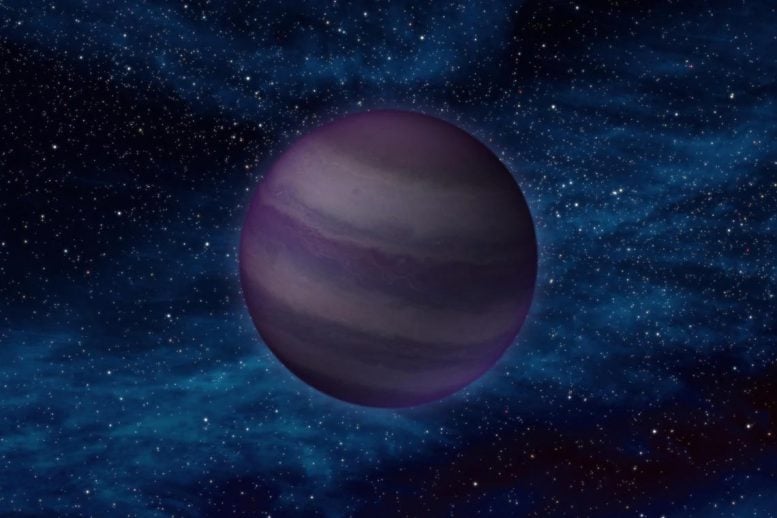
A world with no sunrise still has changing skies, and Webb has caught its water clouds thickening and thinning just 7.5 light-years away.
Astronomers have tracked weather on WISE 0855, the coldest known brown dwarf, using the James Webb Space Telescope. A team led by Brittany Miles of the University of Arizona’s Steward Observatory watched the Jupiter-sized object for 11 hours, recording a spectrum of its light every 15 minutes. Those observations allowed researchers to distinguish shifting water clouds from gases carried upward by heat deep inside the atmosphere.
The findings, published in The Astrophysical Journal, provide the most detailed time-series view yet of this frigid neighbor. They also offer the first direct confirmation that water clouds on another world change thickness over time, a familiar feature of weather on Earth.
“This is the first time we’ve been able to confirm that water clouds are becoming thinner and thicker on a nearby world,” said Miles, a postdoctoral researcher at Steward Observatory. “Before JWST, we only had photometry, which mixed up the effects of clouds, chemistry, and temperature all together. Now we can actually distinguish them.”
A Cold World Between Stars and Planets
Brown dwarfs lack enough mass to sustain the hydrogen fusion that powers stars. Instead, they gradually release heat left over from their formation. Although they are generally more massive than planets, the smallest examples make the boundary between the two categories difficult to draw.
WISE 0855 sits near that boundary. With roughly twice Jupiter’s mass and almost the same size, it resembles a giant planet traveling through space without a host star. Its temperature is about 265 Kelvin (17 degrees Fahrenheit), below Earth’s average surface temperature.
Without a nearby star supplying sunlight, heat escaping from its interior drives atmospheric convection. That gives scientists a chance to examine how a giant world’s own heat shapes its skies.
Studying those skies means interpreting light that has passed through layers of clouds and gases. Co-author Mark Marley, director and department head of the University of Arizona’s Lunar and Planetary Laboratory, compares the challenge to looking through a screen door: researchers must understand both the world beyond it and the filter altering their view.
“The photons go through the atmosphere and escape to space,” Marley said. “It’s like looking at the world through a screen door, where the screen is filtering out some of the light. We’re learning about the world on either side of the screen—but we also have to understand the screen itself.”
Webb Separates Clouds From Chemistry
As WISE 0855 rotates, atmospheric regions with different temperatures and cloud coverage come into view. The resulting changes in brightness contain clues about its weather, but brightness alone cannot reveal whether clouds, chemistry, or temperature caused a particular fluctuation.
Webb’s medium-resolution spectrograph supplied the missing detail by separating the light into wavelengths associated with individual molecules. Its sensitivity allowed the team to follow changes in specific molecular features on an object too cold and faint for earlier observatories to study this way.
The observations revealed high-altitude water clouds becoming thicker and thinner, alongside temperature changes associated with rotation. A separate, repeating wave-like signal appeared in features linked to carbon monoxide and phosphine, pointing to gases transported upward from deeper, hotter layers.
That transport resembles the circulation in a heated pot of soup, where warm liquid rises from below. On WISE 0855, convection brings chemicals into cooler atmospheric regions where their abundance differs from what local conditions alone would predict. Scientists call this disequilibrium chemistry.
Jupiter Offers A Guide To Distant Weather
Jupiter’s atmosphere shows the same kind of chemical mixing, and researchers have identified it in other brown dwarfs. What makes these observations different is the ability to follow their variations over time through individual molecules while distinguishing that activity from changes in water clouds.
“We’re seeing water clouds getting thicker and thinner, and deep gases rising and falling, and we can actually watch them change in real time,” Miles said.
Those connections could help scientists interpret the gas giant exoplanets now coming within Webb’s reach. Worlds can differ greatly in temperature, surroundings, and appearance while sharing the physical processes that move heat, form clouds, and redistribute chemicals.
“Even though brown dwarfs are not true planets, they exhibit planet-like behavior,” Miles said. “There is a spectrum of behaviors—not a hard line between brown dwarfs and planets. Jupiter and this object look distinctly different, but they have similar weather patterns. There are basic physics and chemistry that can be applied across all of these worlds.”
A Longer Look At Changing Skies
The study also connects generations of atmospheric research. Miles’s models draw on foundational work by theorists including Marley, whose own models were tested against Jupiter. That groundwork helped the team interpret patterns in Webb’s observations.
“A lot of my physical intuition on what is missing from the models is because of Mark’s mentorship and hard work,” she said. “This is a multi-year project. A lot of people contributed to make sure this could be done right.”
Miles now wants longer Webb observations to better establish WISE 0855’s rotation and investigate the three-dimensional movement of its atmosphere.
Reference: “Water Cloud and Chemical Modulations in the Coldest Brown Dwarf” by Brittany E. Miles, James Mang, Caroline V. Morley, Andrew J. I. Skemer, Melanie Rowland, Brianna Lacy, Genaro Suarez, Channon Visscher, Dániel Apai, Gordon Bjoraker, Aarynn L. Carter, Jacqueline K. Faherty, Jonathan J. Fortney, Nguyen Fuda, Thomas Geballe, Harshil Kothari, Mary Anne Limbach, Mark Marley, Allison M. McCarthy, Adam Schneider, Johanna Vos, Michael Cushing, Richard Freedman, Michael Line, Roxana Lupu, Emily Martin and Mikayla J. Wilson, September 16, 2026, arXiv.
DOI: 2609.20664
This study was supported by the Royal Society – Research Ireland University Research Fellowship, European Research Council, and the Heising-Simons Foundation.
Never miss a breakthrough: Join the SciTechDaily newsletter.
Follow us on Google and Google News.