
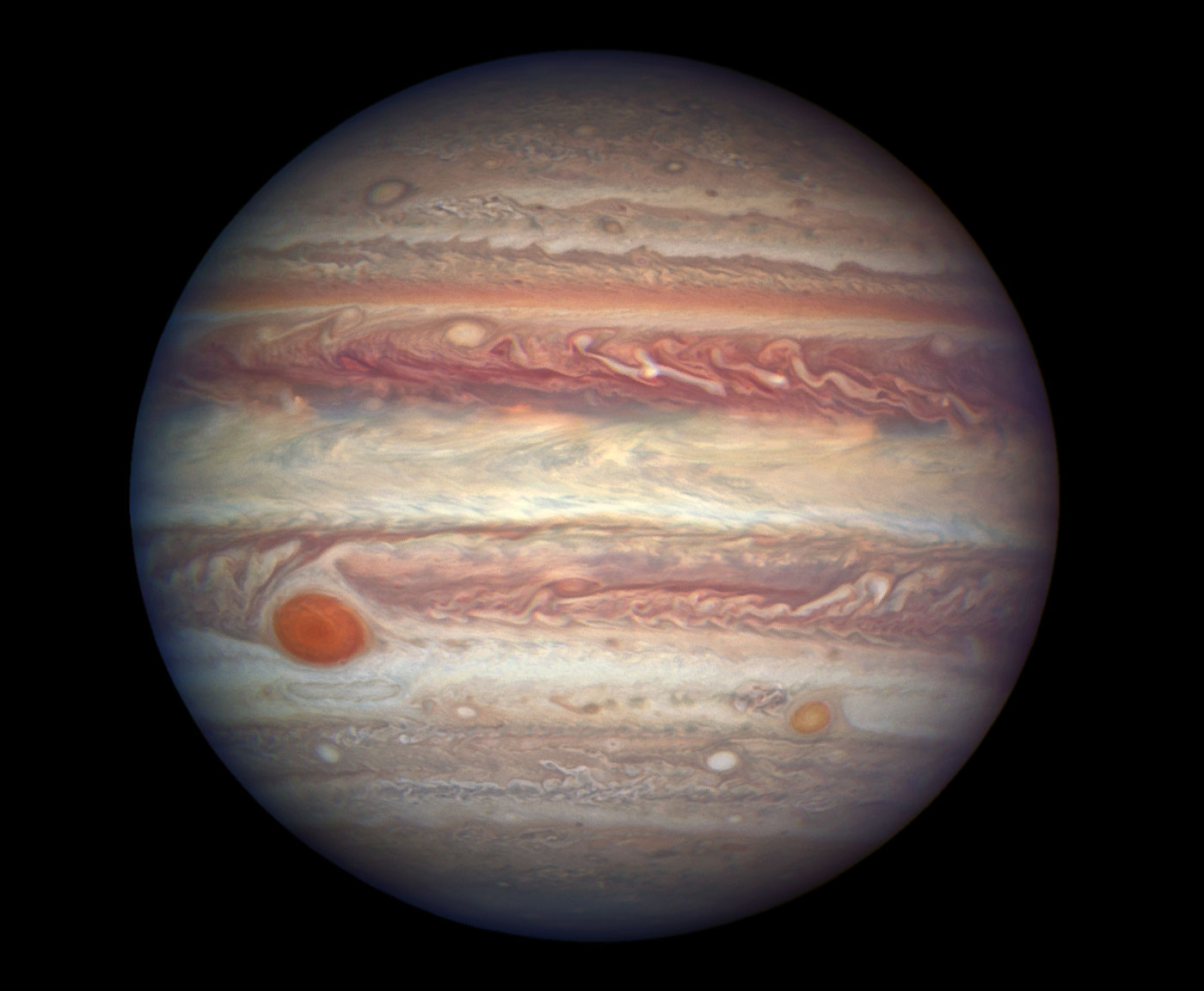
NASA’s James Webb Space Telescope, the most ambitious and complex space observatory ever built, will use its unparalleled infrared capabilities to study Jupiter’s Great Red Spot, shedding new light on the enigmatic storm and building upon data returned from NASA’s Hubble Space Telescope and other observatories.
Jupiter’s iconic storm is on the Webb telescope’s list of targets chosen by guaranteed time observers, scientists who helped develop the incredibly complex telescope and among the first to use it to observe the universe. One of the telescope’s science goals is to study planets, including the mysteries still held by the planets in our own solar system from Mars and beyond.
Leigh Fletcher, a senior research fellow in planetary science at the University of Leicester in the United Kingdom, is the lead scientist on the Webb telescope’s observations of Jupiter’s storm. His team is part of a larger effort to study several targets in our solar system with Webb, spearheaded by astronomer Heidi Hammel, the executive vice president of the Association of Universities for Research in Astronomy (AURA). NASA selected Hammel as an interdisciplinary scientist for Webb in 2002.
“Webb’s infrared sensitivity provides a wonderful complement to Hubble visible-wavelength studies of the Great Red Spot,” explained Hammel. “Hubble images have revealed striking changes in the size of the Great Red Spot over the mission’s multi-decade-long lifetime.”
Fletcher and his team plan to use Webb’s mid-infrared instrument (MIRI) to create multispectral maps of the Great Red Spot and analyze its thermal, chemical and cloud structures. The scientists will be able to observe infrared wavelengths that could shed light on what causes the spot’s iconic color, which is often attributed to the sun’s ultraviolet radiation interacting with nitrogen, sulfur and phosphorus-bearing chemicals that are lifted from Jupiter’s deeper atmosphere by powerful atmospheric currents within the storm.
Fletcher explained that using MIRI to observe in the 5 to 7 micrometer range could be particularly revealing for the Great Red Spot, as no other mission has been able to observe Jupiter in that part of the electromagnetic spectrum, and observations in such wavelengths are not possible from Earth. Those wavelengths of light could allow the scientists to see unique chemical byproducts of the storm, which would give insight into its composition.
“We’ll be looking for signatures of any chemical compounds that are unique to the [Great Red Spot]…which could be responsible for the red chromophores,” said Fletcher. Chromophores are the parts of molecules responsible for their color. Fletcher added, “If we don’t see any unexpected chemistry or aerosol signatures…then the mystery of that red color may remain unresolved.”
Webb’s observations may also help determine whether the Great Red Spot is generating heat and releasing it into Jupiter’s upper atmosphere, a phenomenon that could explain the high temperatures in that region. Recent NASA-funded research showed that colliding gravity waves and sound waves, produced by the storm, could generate the observed heat, and Fletcher said Webb might be able to gather data to support this.
“Any waves produced by the vigorous convective activity within the storm must pass through the stratosphere before they reach the ionosphere and thermosphere,” he explained. “So if they really do exist and are responsible for heating Jupiter’s upper layers, hopefully we’ll see evidence for their passage in our data.”
Generations of astronomers have studied the Great Red Spot; the storm has been monitored since 1830, but it has possibly existed for more than 350 years. The reason for the storm’s longevity largely remains a mystery, and Fletcher explained that the key to understanding the formation of storms on Jupiter is to witness their full life cycle — growing, shrinking, and eventually dying. We did not see the Great Red Spot form, and it may not die anytime soon (though it has been shrinking, as documented by images from NASA’s Hubble Space Telescope and other observatories), so scientists must rely on observing “smaller and fresher” storms on the planet to see how they begin and evolve, something that Webb may do in the future, said Fletcher.
“These particular observations will reveal the storm’s vertical structure, which will be an important constraint for numerical simulations of Jovian [Jupiter] meteorology,” he explained. “If those simulations can help explain what Webb observes in the infrared, then we’ll be a step closer to understanding how these gigantic maelstroms live for so long.”
The James Webb Space Telescope will be the world’s premier space science observatory. Webb will solve mysteries of our solar system, look beyond to distant worlds around other stars, and probe the mysterious structures and origins of our universe and our place in it. Webb is an international project led by NASA with its partners, the European Space Agency (ESA) and the Canadian Space Agency (CSA).
Never miss a breakthrough: Join the SciTechDaily newsletter.
Follow us on Google and Google News.