
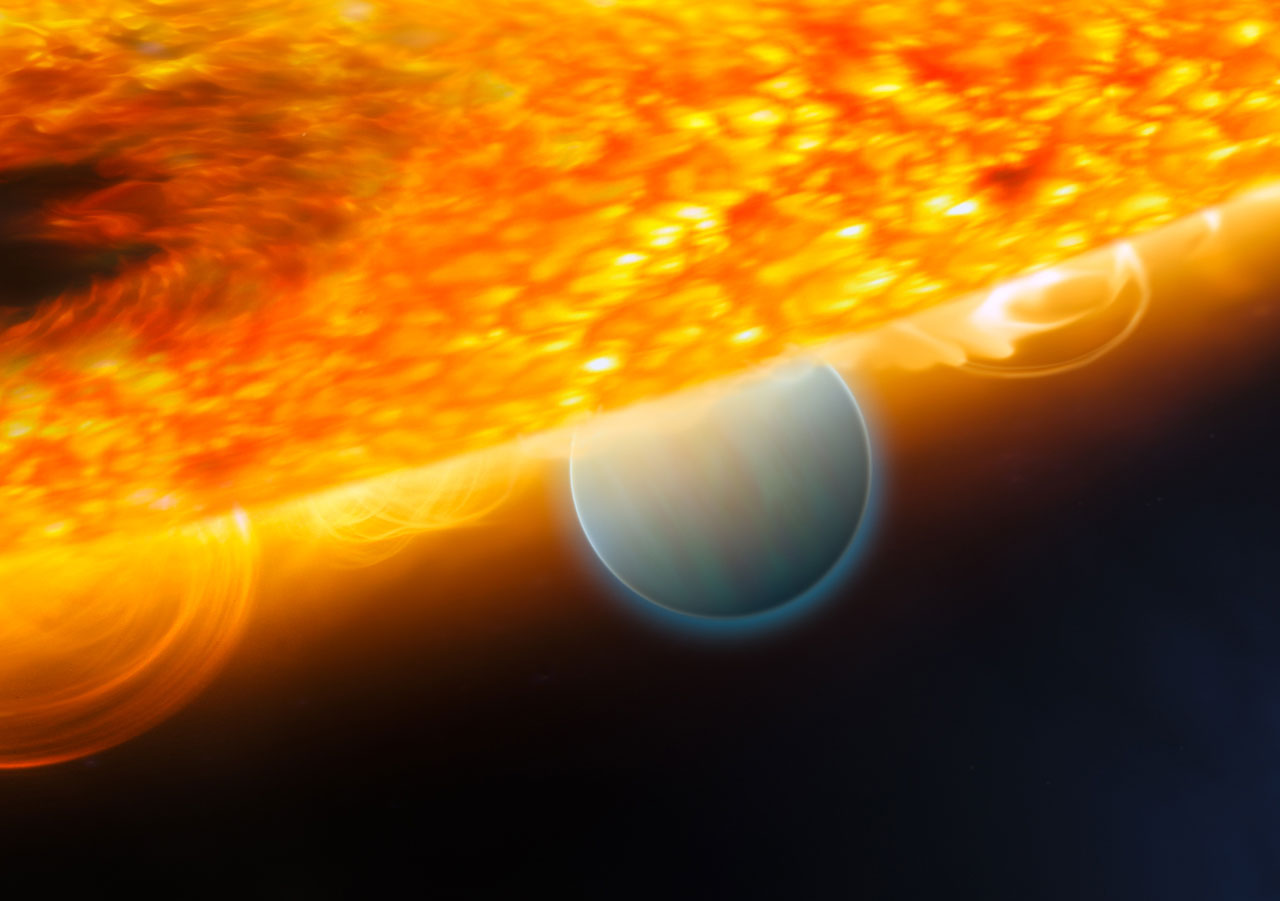
In April 2018, NASA launched the Transiting Exoplanet Survey Satellite (TESS). Its main goal is to locate Earth-sized planets and larger “super-Earths” orbiting nearby stars for further study. One of the most powerful tools that will examine the atmospheres of some planets that TESS discovers will be NASA’s James Webb Space Telescope. Since observing small exoplanets with thin atmospheres like Earth will be challenging for Webb, astronomers will target easier, gas giant exoplanets first.
Some of Webb’s first observations of gas giant exoplanets will be conducted through the Director’s Discretionary Early Release Science program. The transiting exoplanet project team at Webb’s science operations center is planning to conduct three different types of observations that will provide both new scientific knowledge and a better understanding of the performance of Webb’s science instruments.
“We have two main goals. The first is to get transiting exoplanet datasets from Webb to the astronomical community as soon as possible. The second is to do some great science so that astronomers and the public can see how powerful this observatory is,” said Jacob Bean of the University of Chicago, a co-principal investigator on the transiting exoplanet project.
“Our team’s goal is to provide critical knowledge and insights to the astronomical community that will help to catalyze exoplanet research and make the best use of Webb in the limited time we have available,” added Natalie Batalha of NASA Ames Research Center, the project’s principal investigator.
This animation describes how Webb will use transmission spectroscopy to study the atmospheres of distant exoplanets. Credit: NASA, ESA, CSA, and L. Hustak (STScI)
Transit – An atmospheric spectrum
When a planet crosses in front of, or transits, its host star, the star’s light is filtered through the planet’s atmosphere. Molecules within the atmosphere absorb certain wavelengths, or colors, of light. By splitting the star’s light into a rainbow spectrum, astronomers can detect those sections of missing light and determine what molecules are in the planet’s atmosphere.
For these observations, the project team selected WASP-79b, a Jupiter-sized planet located about 780 light-years from Earth. The team expects to detect and measure the abundances of water, carbon monoxide, and carbon dioxide in WASP-79b. Webb also might detect new molecules not yet seen in exoplanet atmospheres.
Phase curve – A weather map
Planets that orbit very close to their stars tend to become tidally locked. One side of the planet permanently faces the star while the other side faces away, just as one side of the Moon always faces the Earth. When the planet is in front of the star, we see its cooler backside. But as it orbits the star, more and more of the hot day-side comes into view. By observing an entire orbit, astronomers can observe those variations (called a phase curve) and use the data to map the planet’s temperature, clouds, and chemistry as a function of longitude.
The team will observe a phase curve of the “hot Jupiter” known as WASP-43b, which orbits its star in less than 20 hours. By looking at different wavelengths of light, they can sample the atmosphere to different depths and obtain a more complete picture of its structure. “We have already seen dramatic and unexpected variations for this planet with Hubble and Spitzer. With Webb we will reveal these variations in significantly greater detail to understand the physical processes that are responsible,” said Bean.
Eclipse – A planet’s glow
The greatest challenge when observing an exoplanet is that the star’s light is much brighter, swamping the faint light of the planet. To get around this problem, one method is to observe a transiting planet when it disappears behind the star, not when it crosses in front of the star. By comparing the two measurements, one taken when both star and planet are visible, and the other when only the star is in view, astronomers can calculate how much light is coming from the planet alone.
This technique works best for very hot planets that glow brightly in infrared light. The team plans to study WASP-18b, a planet that is baked to a temperature of almost 4,800 degrees Fahrenheit (2,900 K). Among other questions, they hope to determine whether the planet’s stratosphere exists due to the presence of titanium oxide, vanadium oxide, or some other molecule.
Habitable planets
Ultimately, astronomers want to use Webb to study potentially habitable planets. In particular, Webb will target planets orbiting red dwarf stars since those stars are smaller and dimmer, making it easier to tease out the signal from an orbiting planet. Red dwarfs are also the most common stars in our galaxy.
“TESS should locate more than a dozen planets orbiting in the habitable zones of red dwarfs, a few of which might actually be habitable. We want to learn whether those planets have atmospheres and Webb will be the one to tell us,” said Kevin Stevenson of the Space Telescope Science Institute, a co-principal investigator on the project. “The results will go a long way towards answering the question of whether conditions favorable to life are common in our galaxy.”
The James Webb Space Telescope will be the world’s premier space science observatory. Webb will solve mysteries of our solar system, look beyond to distant worlds around other stars, and probe the mysterious structures and origins of our universe and our place in it. Webb is an international project led by NASA with its partners, the European Space Agency (ESA) and the Canadian Space Agency (CSA).
Never miss a breakthrough: Join the SciTechDaily newsletter.
Follow us on Google and Google News.
2 Comments
Life? This terminology gets thrown around a lot in the science world. Us Disney/Conquest of Space ‘baby boomers’ want to desperately believe that the Universe is teeming with life. Though, there has not been one speck of any evidence whatsoever found for life existing anywhere else, except on Earth. For, the DRAKE equation and the FERMI paradox, do not play well together. But hey, its the James Webb telescope’s cash cow.
While Scitechdaily is at it here, with all of these ‘searching for e.t. life’ articles, about ‘life’ supposedly appearing on another celestial body other than Earth (that is, if the ‘molecular soup’ combo is just so so)…how exactly would that happen again?
You know, go from inanimate matter, to a living, breathing state of being?