

Close Menu
    Facebook X (Twitter) Instagram
    SciTechDaily
    • Biology
    • Chemistry
    • Earth
    • Health
    • Physics
    • Science
    • Space
    • Technology
    Facebook X (Twitter) Pinterest YouTube RSS
    SciTechDaily
    Home»Space»Webb Space Telescope Will Study Formation, Composition, Clouds of Distant Worlds
    Space

    Webb Space Telescope Will Study Formation, Composition, Clouds of Distant Worlds

    By NASA’s Goddard Space Flight CenterApril 15, 2022No Comments6 Mins Read
    Facebook Twitter Pinterest Telegram LinkedIn WhatsApp Email Reddit
    Share
    Facebook Twitter LinkedIn Pinterest Telegram Email Reddit
    Webb Space Telescope Poster
    NASA’s James Webb Space Telescope is a true technological marvel. The largest and most complex space telescope ever built, Webb is able to gather light that has been traveling for 13.5 billion years, almost since the beginning of the universe. In effect, Webb is a time machine, allowing us to peer at the first galaxies to form after the Big Bang. Because it gathers infrared light, sees right through the giant clouds of dust that block the view of most other telescopes. Webb is 100 times more powerful than the Hubble Space Telescope. Most notably, with its 21-foot-wide (6.5-meter-wide) set of segmented mirrors, Webb is powerful enough to search for water vapor in the atmospheres of planets orbiting other stars. It will open a new window on these exoplanets, observing them in wavelengths of light at which they have never been seen before and helping us gain new insights about their nature. Webb will help us understand how galaxies evolve over billions of years into grand spirals, like our own Milky Way, search for signs of habitability on distant planets, and penetrate into the hearts of dust-shrouded stellar nurseries. The observatory launched from South America on Christmas Day 2021. Credit: NASA/JPL-Caltech

    The journey of commissioning the Webb telescope continues this week with the successful cooling of the Mid-InfraRed Instrument (MIRI), through the critical ‘pinch point,’ down to its final operating temperature of less than 7 kelvins (-447 degrees Fahrenheit, or -266 degrees Celsius). This was a precondition to completing the seventh and final stage of the mirror alignment process.  The next steps include initial check-outs of MIRI and continue on to the final stages of multi-instrument, multi-field alignment with all four science instruments.

    Last week we shared the cool science on star and planet formation planned for Webb. Today, we get into details on how Webb will study planets around other stars, which are known as extrasolar planets, or exoplanets. Knicole Colón, Webb’s deputy project scientist for exoplanet science, takes us into the discovery space of exploring new worlds beyond our solar system. Dr. Colón brings a unique perspective as she is also the project scientist for the Transiting Exoplanet Survey Satellite (TESS), a mission that has found many exoplanet targets that Webb will observe.
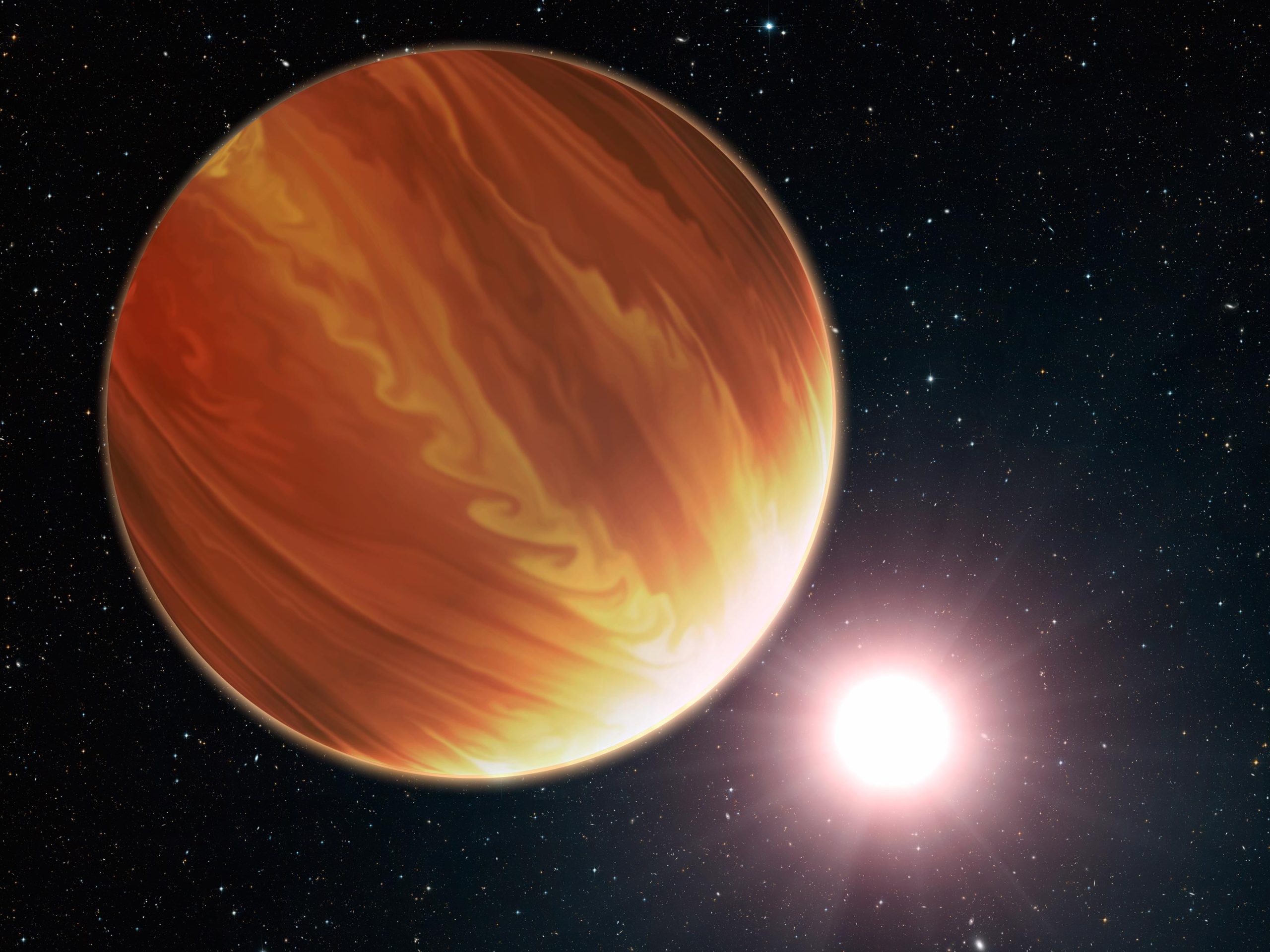
    Exoplanet Orbiting Its Much Brighter Star
    This illustration shows an exoplanet orbiting its much brighter star. With its onboard coronagraphs, Webb will allow scientists to view exoplanets at infrared wavelengths they’ve never seen them in before. Credit: NASA, ESA, and G. Bacon (STScI)

    “Over the last 30 years, astronomers have discovered over 5,000 extrasolar planets. These discoveries have revealed that exoplanets span a vast range of masses, sizes, and temperatures and orbit all types of stars, leading to extraordinarily diverse worlds.

    “With its powerful spectroscopic and imaging capabilities across a wide infrared wavelength range, Webb is poised to revolutionize our knowledge of the composition of these worlds and of planet-forming disks. From small, potentially rocky exoplanets up to giant, gaseous ones, Webb will observe these worlds with the transit technique. Direct imaging techniques will be used to study young, giant exoplanets along with the environments in which planets form and evolve around stars, known as protoplanetary disks and debris disks.

    “One specific exoplanet observation that will be done with Webb involves collecting observations over the course of a planet’s orbit to enable measurements of the atmospheric composition and dynamics. I am involved in a program to observe the gas giant HD 80606 b as part of Webb’s first year of observations. Because the orbit of HD 80606 b is extremely eccentric (non-circular) and long (111 days), the amount of energy received by the planet from its star ranges from approximately 1 to 950 times what Earth receives from the Sun! This results in extreme temperature variations, which are predicted to cause clouds to rapidly form and dissipate in the planet’s atmosphere on very short timescales. Our science team will probe these predicted cloud dynamics in real-time over the course of a continuous ~18 hour observation of HD 80606 b as it passes behind its star, using the NIRSpec instrument on Webb to measure thermal light from the planet’s atmosphere.
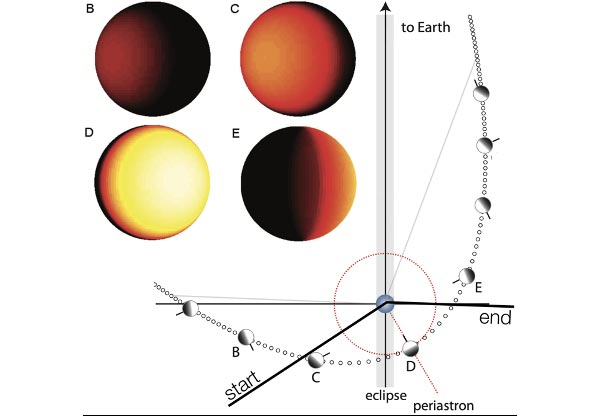
    HD 80606 b Orbital Configuration
    The orbital configuration of HD 80606 b is shown along with expected temperature variations as viewed from Earth and Webb at several orbital phases. The planned “start” and “end” of the ~18 hour stretch of Webb observations are indicated. Credit: adapted from de Wit et al. 2016; courtesy of James Sikora

    “Beyond gas giants, a number of Webb’s exoplanet targets in its first year of observations are small and orbit stars that are smaller and cooler than the Sun, known as M dwarfs. While exoplanet discovery began around 30 years ago, many of these small exoplanets around M dwarfs were just discovered in the last few years by surveys like TESS. Webb observations will start to reveal the diversity of atmospheres that exist on these small planets by searching for evidence of molecules like water, carbon dioxide, and methane in their atmospheres. Because M dwarfs are typically much more active than the Sun and have energetic stellar flares that could potentially strip the atmospheres off of these planets, Webb observations may even reveal that some of these small planets have no atmosphere at all.
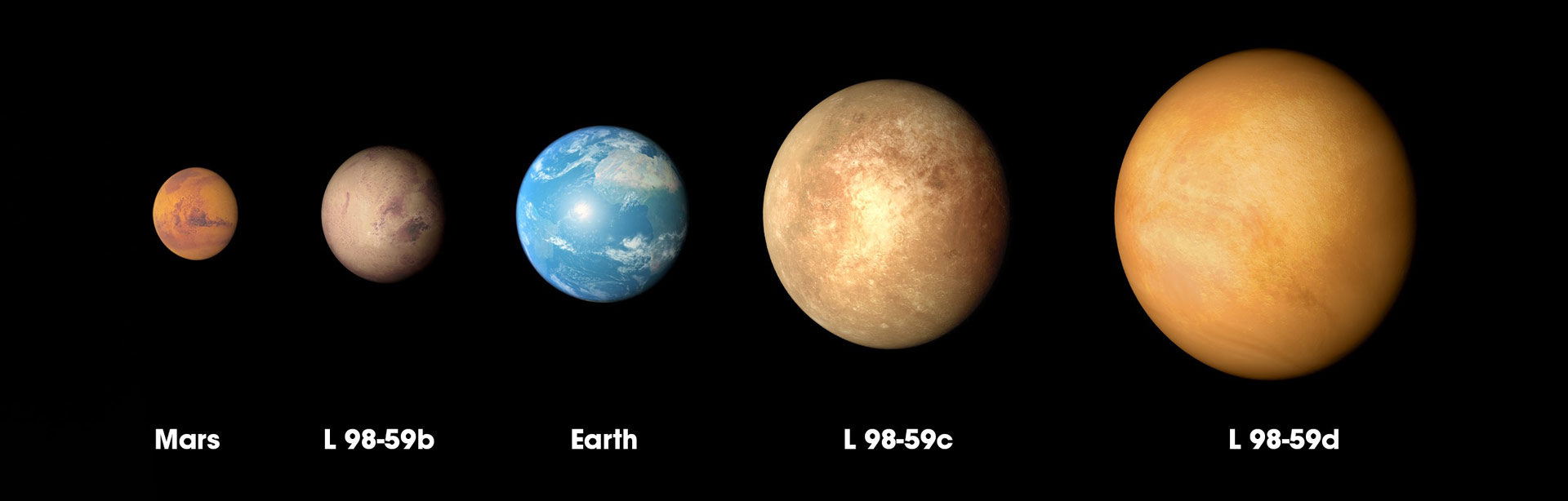
    NASA’s TESS Mission Finds Its Smallest Planet Yet
    This artist’s illustration shows three small planets discovered by TESS around an M dwarf star called L 98-59. Planets c and d are just 1.4 and 1.6 times larger than Earth and will be observed in Webb’s first year of science. Credit: NASA’s Goddard Space Flight Center

    “With TESS and other surveys continuing to discover additional planets in our galaxy at a regular pace and Webb preparing to study the atmospheres of many of these newly discovered worlds, our exoplanet adventures are in many ways just beginning.”

    Knicole Colón, Webb’s deputy project scientist for exoplanet science, NASA’s Goddard Space Flight Center

    Stefanie Milam, Webb deputy project scientist for planetary science, NASA Goddard

    Jonathan Gardner, Webb deputy senior project scientist, NASA Goddard

    Never miss a breakthrough: Join the SciTechDaily newsletter.
    Follow us on Google and Google News.

    Astronomy Exoplanet James Webb Space Telescope NASA NASA Goddard Space Flight Center Planets
    Share. Facebook Twitter Pinterest LinkedIn Email Reddit

    Related Articles

    Beyond Earth: Webb Space Telescope Detects Key Molecules on Exoplanet K2-18 b

    NASA’s Webb Space Telescope Detects Water Vapor in Rocky Planet-Forming Zone

    Exoplanet Discovery Alert: Webb Space Telescope Finds Water in Ultra-Hot Alien World

    NASA’s Webb Space Telescope Unveils the Sizzling Secrets of a Distant Rocky Exoplanet

    As Never Seen Before: NASA’s Webb Reveals an Exoplanet Unlike Any in Our Solar System

    Webb Space Telescope To Provide Details of Two Intriguing “Super-Earths” in the Milky Way

    Hubble Finds a Massive Planet – 9 Times the Size of Jupiter – Forming Through a Violent Process

    Exploring Alien Worlds With NASA’s Webb Space Telescope: TRAPPIST-1 System

    NASA’s Webb Space Telescope Primed To Reveal Secrets of Galaxy’s Most Mysterious Planets

    Leave A Reply Cancel Reply

    • Facebook
    • Twitter
    • Pinterest
    • YouTube

    Don't Miss a Discovery

    Subscribe for the Latest in Science & Tech!

    Trending News

    Scientists Warn That This Common Pet Fish Can Wreck Entire Ecosystems

    Scientists Make Breakthrough in Turning Plastic Trash Into Clean Fuel Using Sunlight

    This Popular Supplement May Interfere With Cancer Treatment, Scientists Warn

    Scientists Finally Solved One of Water’s Biggest Mysteries

    Could This New Weight-Loss Pill Disrupt the Entire Market? Here’s What You Should Know About Orforglipron

    Earth’s Crust Is Tearing Open in Africa, and It Could Form a New Ocean

    Breakthrough Bowel Cancer Trial Leaves Patients Cancer-Free for Nearly 3 Years

    Natural Compound Shows Powerful Potential Against Rheumatoid Arthritis

    Follow SciTechDaily
    • Facebook
    • Twitter
    • YouTube
    • Pinterest
    • Newsletter
    • RSS
    SciTech News
    • Biology News
    • Chemistry News
    • Earth News
    • Health News
    • Physics News
    • Science News
    • Space News
    • Technology News
    Recent Posts
    • Kratom Use Explodes in the US, With Life-Changing Consequences
    • Scientists Uncover Fatal Weakness in “Zombie Cells” Linked to Cancer
    • World-First Study Reveals Human Hearts Can Regenerate After a Heart Attack
    • Why Your Dreams Feel So Real Sometimes and So Strange Other Times
    • Scientists Debunk 100-Year-Old Belief About Brain Cells, Rewriting Textbooks
    Copyright © 1998 - 2026 SciTechDaily. All Rights Reserved.
    • Science News
    • About
    • Contact
    • Editorial Board
    • Privacy Policy
    • Terms of Use

    Type above and press Enter to search. Press Esc to cancel.