
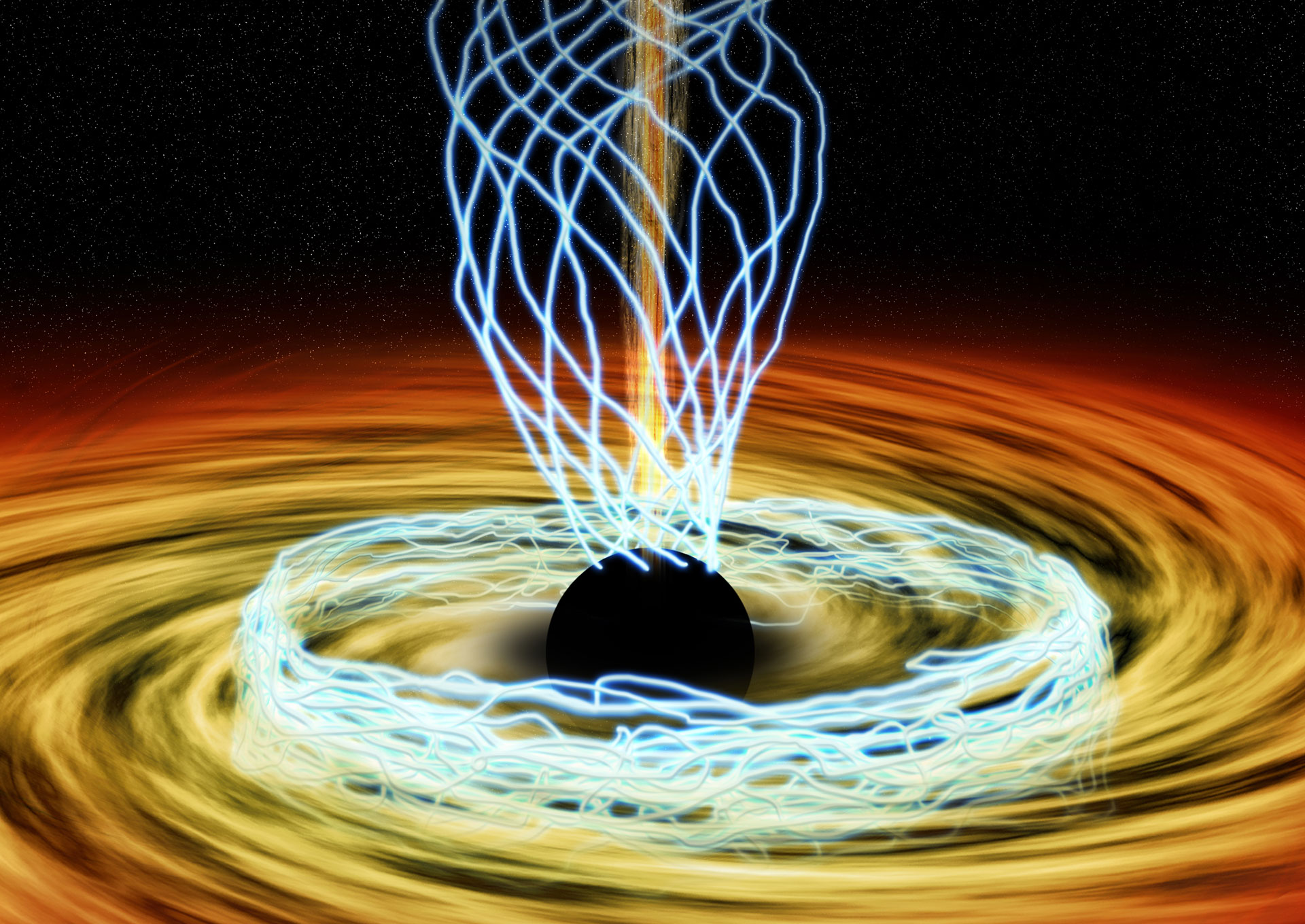
The Milky Way’s central black hole could lose mass by powering escaping particles, and new calculations suggest how astronomers might detect the process.
The supermassive black hole at the center of the Milky Way may be accelerating particles to energies far beyond anything achievable in Earth’s most powerful particle accelerators. A new theoretical study suggests that Sagittarius A*, a black hole roughly four million times the Sun’s mass, could accomplish this by transferring some of its rotational energy directly to protons.
The researchers estimate that these particles could reach energies of several petaelectronvolts (PeV), equivalent to several quadrillion electron volts. That would make Sagittarius A* a possible Galactic PeVatron, a natural particle accelerator capable of producing some of the most energetic cosmic rays in our galaxy.
How Black Holes Could Power Extreme Particle Acceleration
Most of the intense radiation associated with actively feeding black holes originates from surrounding matter rather than from the black holes themselves. However, physicist Roger Penrose proposed in 1969 that rotating black holes could also surrender some of their own energy through a mechanism known as the Penrose process.
This process operates in the ergosphere, a region where the black hole’s rotation twists spacetime so strongly that everything must move in the direction of its spin.
Think of the black hole as a giant, rapidly spinning merry-go-round that drags the surrounding spacetime along with it. Under certain conditions, a particle entering this region can split apart, with one fragment falling into the black hole while the other escapes with more energy than the original particle possessed.
The extra energy comes from the black hole’s own rotation, much like an object gaining an extra boost from a spinning merry-go-round. A more powerful variation, called the magnetic Penrose process (MPP), uses magnetic fields to transfer this rotational energy to charged particles much more efficiently, potentially launching them into space at extraordinarily high energies.
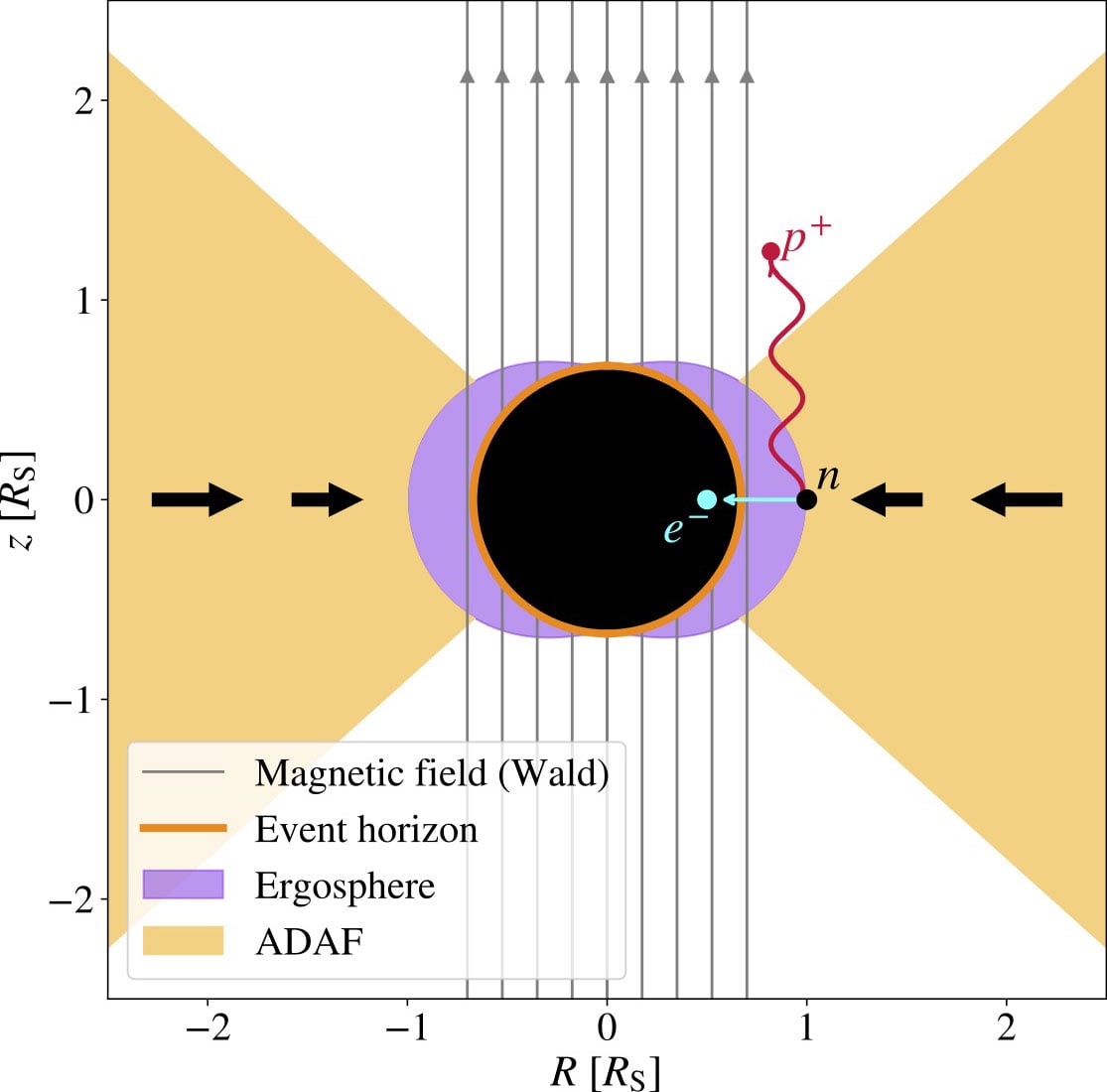
In the new study, researchers modeled neutrons produced by nuclear reactions in the hot gas surrounding Sagittarius A*. Some neutrons could enter the ergosphere and decay into protons, electrons, and antineutrinos. The resulting charged particles would interact with the magnetic field, potentially allowing protons to escape with enormous amounts of energy.
“Our results strengthen the interpretation of Sgr A* as a candidate Galactic PeVatron,” the researchers write in their study.
Could Gamma Rays Reveal the Hidden Process?
These accelerated protons would travel outward and collide with dense gas in the Central Molecular Zone surrounding the Galactic center. Such collisions can produce gamma rays and neutrinos, providing potential observational evidence of the mechanism.
Astronomers have already detected very-high-energy gamma rays from the Galactic center, but their precise origins remain uncertain. Tracing the source of cosmic rays is particularly difficult because their electric charges cause magnetic fields to bend their trajectories. Gamma rays, by comparison, travel without being deflected by those fields, making them valuable for locating regions of extreme particle acceleration.
The researchers calculated that the magnetic Penrose process could produce distinctive features in the gamma-ray energy spectrum and contribute to emission already observed by H.E.S.S. and HAWC. Their models predict signals within the expected sensitivity of the planned Southern Wide-field Gamma-ray Observatory (SWGO), with the Cherenkov Telescope Array Observatory (CTAO) potentially able to test some scenarios.
“Our results indicate that SWGO should be capable of probing all the scenarios that we are considering in this work,” the researchers write.
References: “Sgr A* as a Galactic PeVatron: Multimessenger Signatures of the Magnetic Penrose Process” by Marina Cermeño, Pedro De la Torre Luque, Cristina Fernández-Suárez, Viviana Gammaldi, Enrique Mier-Alonso, María J. Rodríguez, Miguel Á. Sánchez-Conde and Jaume Zuriaga-Puig, September 2, 2026, arXiv.
Never miss a breakthrough: Join the SciTechDaily newsletter.
Follow us on Google and Google News.