
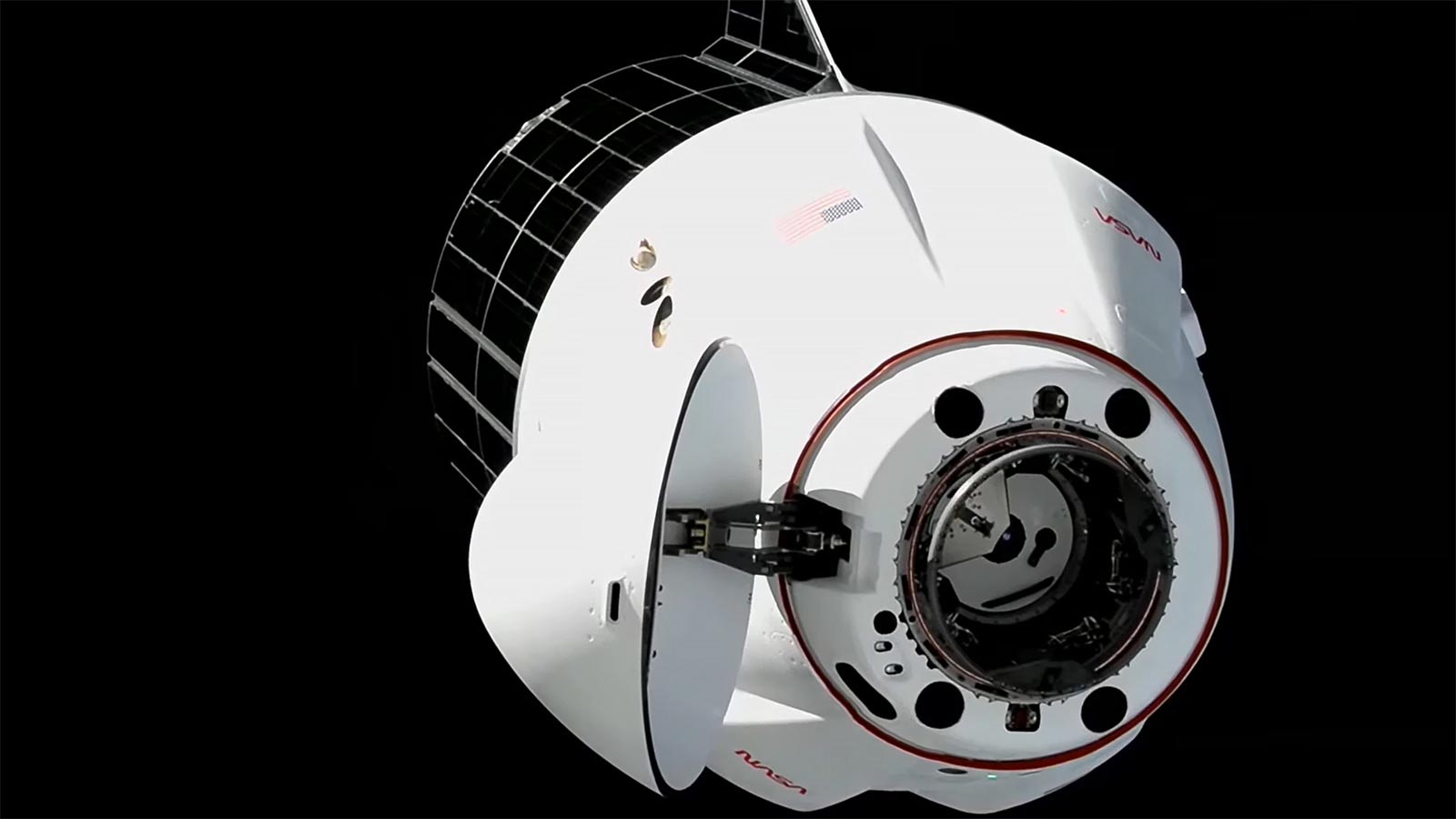
SpaceX has delivered tiny brain models, 3D heart tissue, and artificial retina technology to the space station in a mission that could open new doors for medical research on Earth.
SpaceX’s Dragon spacecraft successfully arrived at the International Space Station on October 15, docking at 10:27 a.m. EDT with the space-facing port of the station’s Harmony module. The spacecraft brought more than 6,300 pounds of food, equipment, and other essential supplies for the Expedition 75 crew. The delivery marks SpaceX’s 35th commercial resupply mission to the orbiting laboratory under its contract with NASA.
New Solar Arrays and Advanced Medical Research
Among the cargo is the final set of International Space Station Roll-Out Solar Arrays (IROSAs), which astronauts are expected to install later this fall. These arrays will expand the station’s ability to generate electricity from sunlight.
Dragon also delivered equipment for several ambitious scientific investigations that could lead to important advances in medicine and materials science. One experiment will explore manufacturing artificial retinas in microgravity, with the long-term goal of helping restore eyesight on Earth. Another will use 3D heart tissue models to support the development of large-scale drug testing during future space missions.
Additional research will examine how a new type of glass forms in the weightless environment of space. Scientists will also study brain organoids, miniature models of brain tissue that could help identify potential treatment targets for neurological conditions, including Alzheimer’s disease, Parkinson’s disease, and multiple sclerosis.
Dragon’s Return to Earth
Dragon is expected to remain docked at the space station until mid-November. It will then transport time-sensitive scientific research and other cargo back to Earth, concluding its mission with a splashdown off the California coast.
The spacecraft began its journey on October 13 at 6:33 a.m. EDT, launching aboard a SpaceX Falcon 9 rocket from Space Launch Complex 40 at Cape Canaveral Space Force Station in Florida.
Never miss a breakthrough: Join the SciTechDaily newsletter.
Follow us on Google and Google News.