

NASA’s SpaceX Crew-10 mission is gearing up for launch with an international team of astronauts and cosmonauts set to embark on a critical mission to the ISS.
As part of NASA’s ongoing partnership with SpaceX, Crew-10 will conduct groundbreaking scientific research, technology demonstrations, and maintenance tasks aboard the orbiting laboratory. Led by seasoned astronaut Anne McClain and joined by first-time spacefarers Nichole Ayers and Kirill Peskov, as well as returning JAXA astronaut Takuya Onishi, the crew will test future spacecraft materials, explore backup lunar navigation systems, and study the physiological effects of space travel. Their journey will also involve cargo deliveries, crew rotations, and the arrival of private space missions, ensuring that low Earth orbit remains a hub for innovation and human spaceflight advancements.
Launching Crew-10 to the ISS
Four astronauts are preparing to launch to the International Space Station (ISS) as part of NASA’s SpaceX Crew-10 mission. Their goal is to conduct scientific research, test new technologies, and perform maintenance aboard the orbiting laboratory.
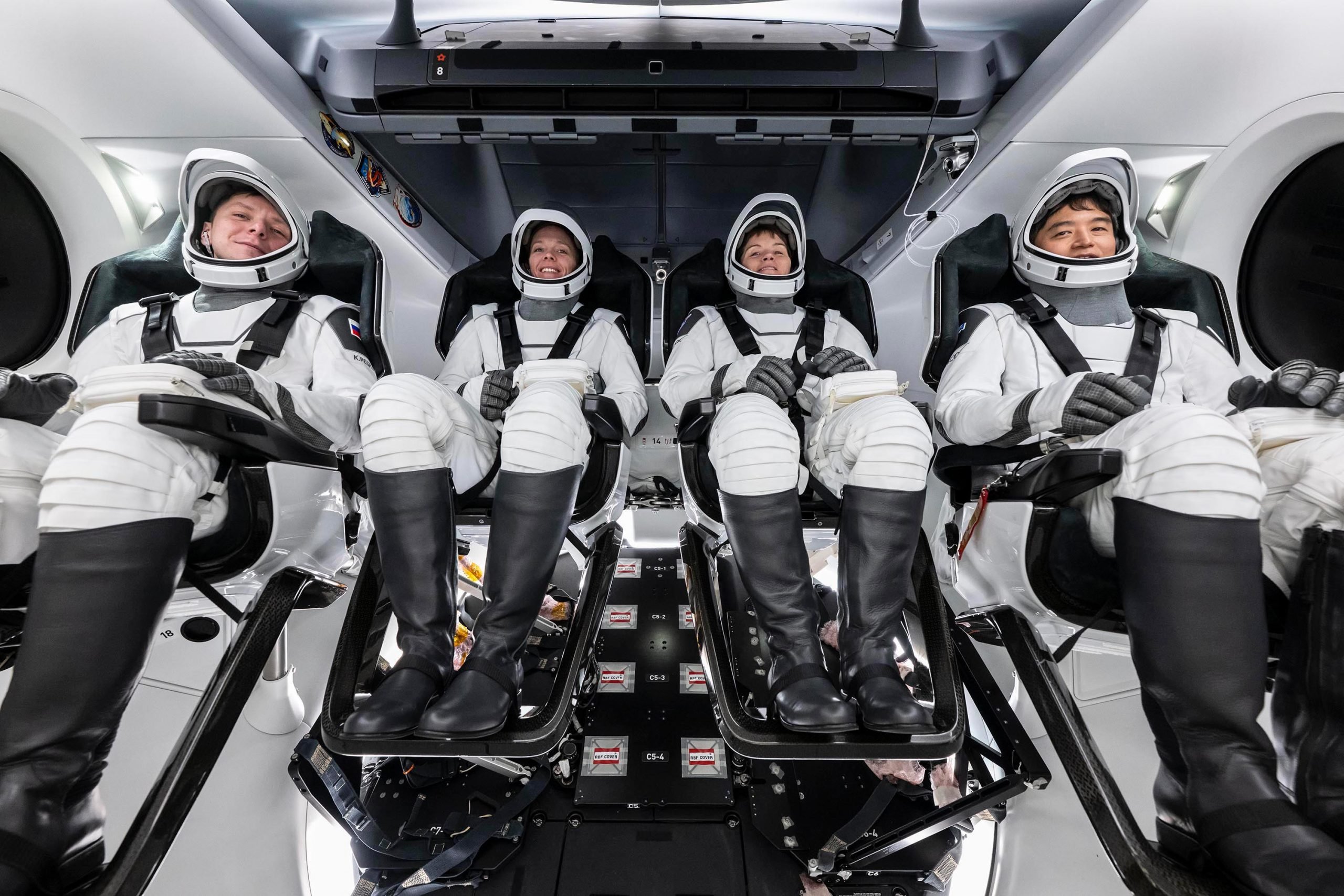
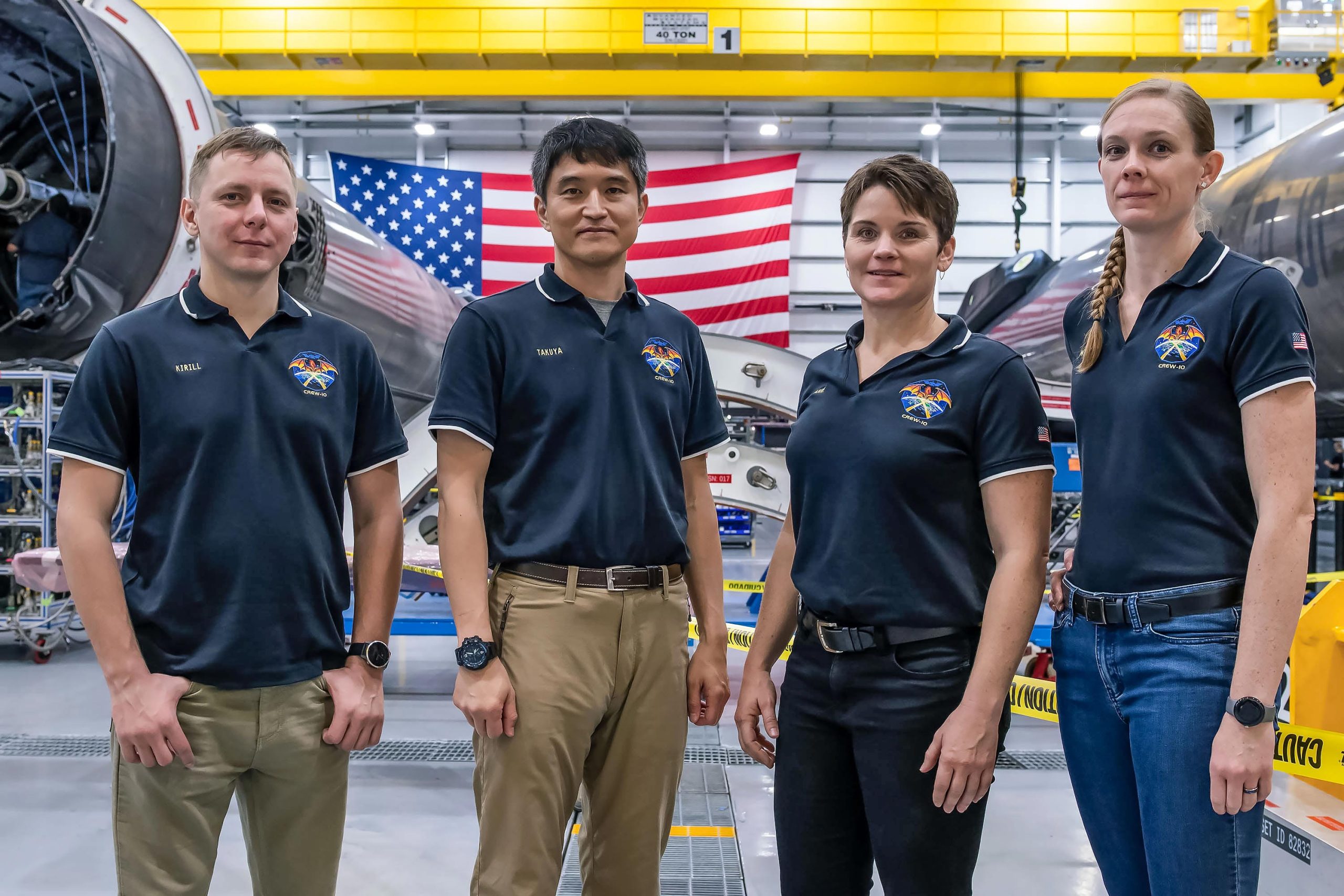
The crew includes NASA astronauts Anne McClain and Nichole Ayers, along with Takuya Onishi from the Japan Aerospace Exploration Agency (JAXA) and Kirill Peskov from Roscosmos. They will launch aboard a SpaceX Dragon spacecraft from Launch Complex 39A at NASA’s Kennedy Space Center in Florida.
This mission marks the 10th crew rotation to the ISS with SpaceX and the 11th human spaceflight under NASA’s Commercial Crew Program.
As preparations continue, teams are working through key milestones for the Dragon spacecraft and readying a previously flown Falcon 9 booster for the launch. Once all system checks are complete and flight certification is secured, the Dragon capsule will be attached to the Falcon 9 rocket inside SpaceX’s hangar. The fully assembled vehicle will then be transported to the launch pad, where it will be raised upright for a final dry dress rehearsal with the crew and a static fire test before liftoff.
Crew
Selected by NASA as an astronaut in 2013, this will be McClain’s second spaceflight. A colonel in the U.S. Army, she earned her bachelor’s degree in Mechanical Engineering from the U.S. Military Academy at West Point, New York, and holds master’s degrees in Aerospace Engineering, International Security, and Strategic Studies. The Spokane, Washington, native was an instructor pilot in the OH-58D Kiowa Warrior helicopter and is a graduate of the U.S. Naval Test Pilot School in Patuxent River, Maryland. McClain has more than 2,300 flight hours in 24 rotary and fixed-wing aircraft, including more than 800 in combat, and was a member of the U.S. Women’s National Rugby Team. On her first spaceflight, McClain spent 204 days as a flight engineer during Expeditions 58 and 59 and completed two spacewalks, totaling 13 hours and 8 minutes. Since then, she has served in various roles, including branch chief and space station assistant to the chief of NASA’s Astronaut Office.
This mission will be the first spaceflight for Ayers, who was selected as a NASA astronaut in 2021. Ayers is a major in the U.S. Air Force and the first member of NASA’s 2021 astronaut class named to a crew. The Colorado native graduated from the Air Force Academy in Colorado Springs with a bachelor’s degree in Mathematics and a minor in Russian, and was a member of the academy’s varsity volleyball team. She later earned a master’s in Computational and Applied Mathematics from Rice University in Houston. Ayers served as an instructor pilot and mission commander in the T-38 ADAIR and F-22 Raptor, leading multinational and multiservice missions worldwide. She has more than 1,400 total flight hours, including more than 200 in combat.
With 113 days in space, Crew-10 will mark Onishi’s second trip to the space station. After being selected as an astronaut by JAXA in 2009, he flew as a flight engineer for Expeditions 48 and 49, becoming the first Japanese astronaut to robotically capture the Cygnus spacecraft. He also constructed a new experimental environment aboard Kibo, the station’s Japanese experiment module. After his first spaceflight, Onishi became certified as a JAXA flight director, leading the team responsible for operating Kibo from JAXA Mission Control in Tsukuba, Japan. He holds a bachelor’s degree in Aeronautics and Astronautics from the University of Tokyo, and was a pilot for All Nippon Airways, flying more than 3,700 flight hours in the Boeing 767.
The Crew-10 mission also will be Peskov’s first spaceflight. Before his selection as a cosmonaut in 2018, he earned a degree in Engineering from the Ulyanovsk Civil Aviation School and was a co-pilot on the Boeing 757 and 767 aircraft for airlines Nordwind and Ikar. Assigned as a test cosmonaut in 2020, he has additional experience in skydiving, zero-gravity training, scuba diving, and wilderness survival.
Mission Overview
After liftoff, the Falcon 9 rocket will propel the Dragon spacecraft to a speed of approximately 17,500 mph as it heads toward the ISS. Once in orbit, the Crew-10 astronauts and SpaceX mission control in Hawthorne, California, will oversee a series of maneuvers guiding Dragon to the forward-facing port of the Harmony module. The spacecraft is designed to dock autonomously, but the crew can take manual control if needed.
Upon arrival, Expedition 72’s seven-member crew will welcome Crew-10 aboard the station. A short handover period will follow, allowing Crew-10 to transition into their new roles while receiving updates on ongoing science and maintenance work from the departing Crew-9 astronauts. Shortly after, NASA astronauts Nick Hague, Suni Williams, Butch Wilmore, and Roscosmos cosmonaut Aleksandr Gorbunov will undock from the ISS and return to Earth. Before Crew-9 departs, mission teams will assess weather conditions at the designated splashdown sites off Florida’s coast.
Once settled, Crew-10 will conduct groundbreaking scientific research to advance human space exploration and benefit life on Earth. Their planned work includes:
- Testing material flammability in microgravity for future spacecraft designs
- Engaging with students via ham radio, inspiring the next generation of explorers
- Using existing station hardware to evaluate a backup lunar navigation system
- Studying physiological and psychological changes in astronauts to support deep-space missions
These are just a few of the 200+ experiments and technology demonstrations Crew-10 will oversee during their mission.
During their stay, Crew-10 will also welcome a new Soyuz spacecraft carrying three additional astronauts, including NASA’s Jonny Kim, while bidding farewell to another Soyuz returning NASA astronaut Don Pettit to Earth. They will also assist with the arrival of several cargo resupply missions, including those from SpaceX’s Dragon, Roscosmos’ Progress, and Northrop Grumman’s Cygnus, as well as a private Axiom Mission 4 crew on a short-duration visit.
Crew-10 will travel aboard SpaceX’s Dragon capsule, Endurance, a proven spacecraft that previously supported Crew-3, Crew-5, and Crew-7 missions.
This mission is part of NASA’s Commercial Crew Program, which continues to maximize ISS operations by supporting cutting-edge research, technology development, and astronaut training. For more than 24 years, astronauts have lived and worked aboard the ISS, helping to refine the skills and innovations needed for future space stations, long-duration Moon missions under Artemis, and the eventual journey to Mars.
Never miss a breakthrough: Join the SciTechDaily newsletter.
Follow us on Google and Google News.
1 Comment
Sure, why not launch some astronauts on one of the remaining SpaceX rockets? SpaceX’s track-record gives them about a 9-in-10 chance of not being in a rapid unscheduled fireball. In grades that’s like an A- or B+, that’s good enough. They signed the release forms right?