
Natural killer cells reprogrammed inside mice eliminated lymphoma tumors and helped damaged livers heal, though whether this approach could help people with cancer or autoimmune disease remains unknown.
To make a cancer treatment from a patient’s T cells, doctors first collect a blood sample and send it to a laboratory. There, these immune cells are isolated and engineered to carry chimeric antigen receptors, or CARs, proteins that recognize a chosen target, such as a cancer protein. Once enough modified cells have been produced, they are shipped back to the hospital and infused into the patient. When a CAR detects its target, it activates the T cell to destroy the cell carrying it.
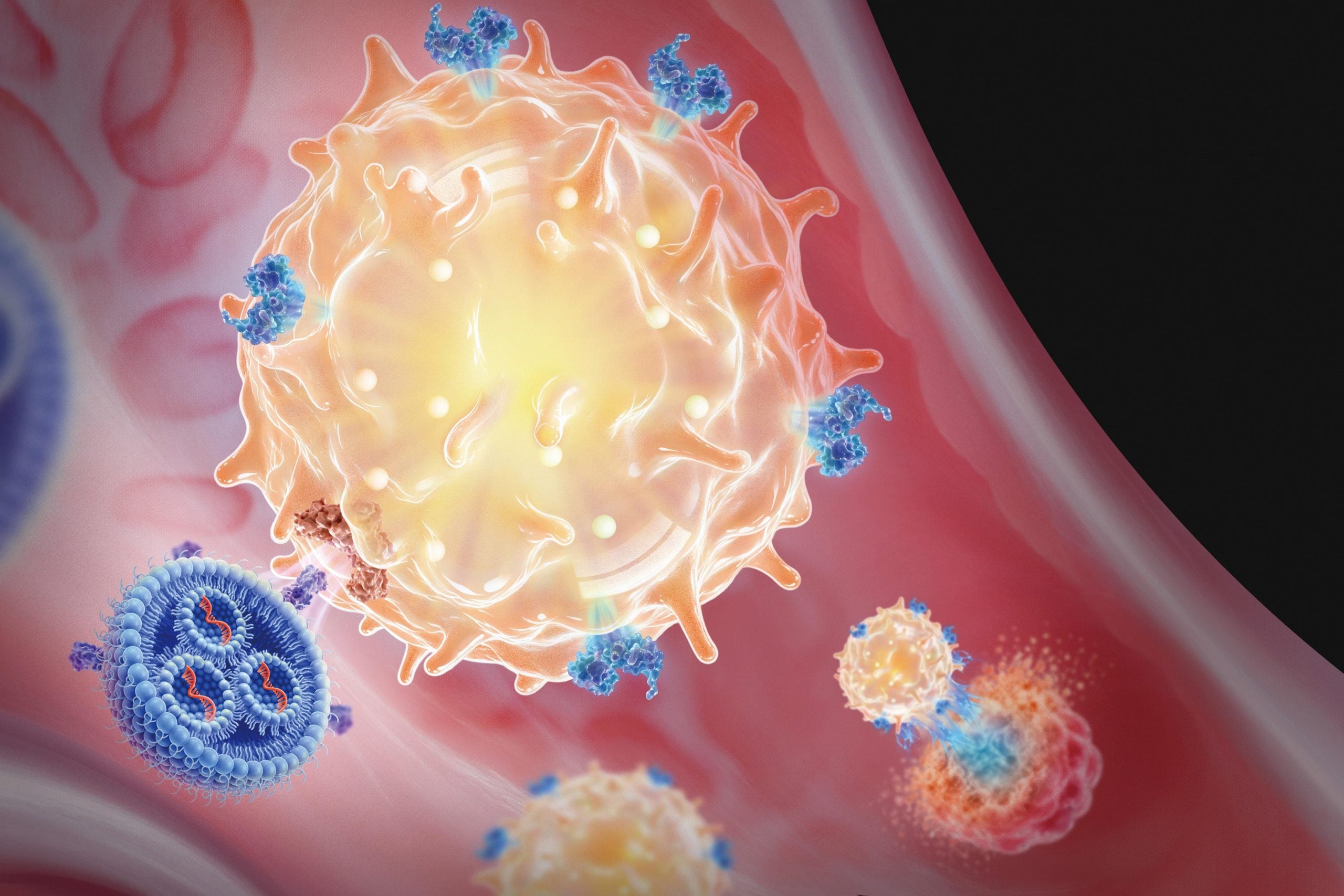
Producing similar treatments from natural killer (NK) cells poses many of the same manufacturing challenges, adding time and expense. MIT engineers have now developed a way to reprogram NK cells inside the body, without removing them for laboratory engineering. In experiments in mice, their approach successfully reprogrammed about 80 percent of the targeted NK cells. The study was published in Nature Biotechnology.
Over the past decade, the U.S. Food and Drug Administration has approved seven CAR T-cell cancer treatments. These therapies have had considerable success against blood cancers, primarily those originating in B cells, including several types of leukemia, lymphoma, and multiple myeloma. No CAR NK-cell therapies are currently FDA-approved, although many researchers are developing them for cancer and autoimmune disorders.
Nanoparticles program NK cells inside the body
“The manufacturing challenges with CAR NK cells are significant. The idea here is you can deliver a nanoparticle that will modify your own NK cells with a CAR construct and teach them to attack tumor cells,” says Daniel Anderson, the study’s senior author, a professor in MIT’s Department of Chemical Engineering, and a member of MIT’s Koch Institute for Integrative Cancer Research and Institute for Medical Engineering and Science.
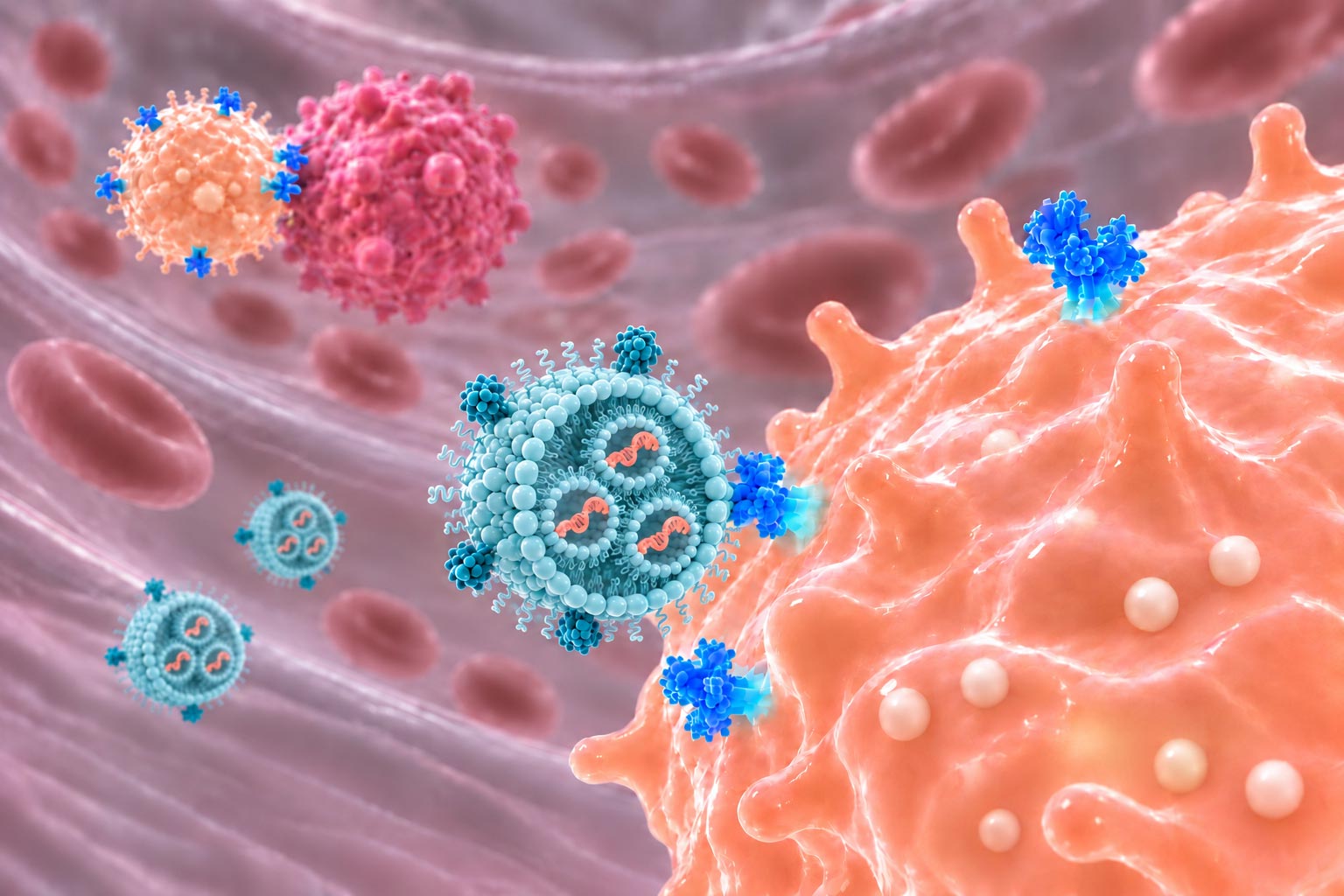
To deliver those instructions, the team designed lipid nanoparticles, tiny particles made from fatty molecules, that carry messenger RNA. The mRNA encodes a CAR protein that the receiving cell can make. Antibody fragments coating the particles bind to receptors on the surface of NK cells, helping direct the payload to the intended cells. This allows the engineering to happen “in vivo,” meaning inside the body.
The CAR encoded by the mRNA can be chosen according to the intended target. For example, the instructions could produce a receptor that recognizes CD19, a protein found on B cells, or CD3, a protein found on T cells, including autoreactive T cells that mistakenly attack the body’s own tissues.
“If a patient can just get an infusion of nanoparticles, it would dramatically simplify the process and reduce costs,” Anderson says.
When T cells attack each other
Using NK cells also addresses a difficulty that arises when engineered T cells are used against T-cell diseases. A CAR designed to recognize T-cell proteins may lead the engineered T cells to kill one another along with the diseased cells. NK cells can target T cells without that problem.
“NK cells can treat these T cell malignancies — not only T cell cancer, but also T cell autoimmune diseases,” says MIT postdoc Yuang Chen, who is a lead author of the study alongside MIT graduate students Julia Monkovic and Haseeb Mughal.
Tumor clearance and liver healing in mice
The researchers tested the approach against T-cell lymphoma in humanized mice. These animals receive transfusions of human blood cells, temporarily giving them a human-like immune system. After five injections of the reprogramming nanoparticles, the tumors were eradicated. The result was similar to treatment with CAR NK cells made through the conventional process of removing NK cells, reprogramming them outside the body, and returning them to the mice.
The same delivery strategy could also equip NK cells to attack autoreactive T cells. To test that possibility, the team studied mice with autoimmune hepatitis, in which T cells attack liver cells called hepatocytes. After a single injection of the nanoparticles, the autoreactive T cells were destroyed, and liver damage healed.
The experiments also extended beyond diseases involving dysfunctional T cells. In a mouse model of an aggressive form of melanoma, three of five mice went into complete remission after receiving nanoparticles that reprogrammed their NK cells to target the cancer cells.
“This study is an excellent example of the power of nano delivery systems and their ability to potentially treat cancer and other diseases,” says study coauthor Robert Langer, the David H. Koch Institute Professor at MIT.
The researchers hope that engineered NK cells could eventually be used to treat other autoimmune disorders caused by dysfunctional T cells, including multiple sclerosis and rheumatoid arthritis.
Reference: “In vivo engineering of CAR natural killer cells for immunotherapy using ligand-directed lipid nanoparticles” by Yuang Chen, Julia Monkovic, Haseeb Mughal, Binlong Chen, Elina Thadhani, Patrick McMullen, Ava Self, Yuxuan Chen, Yizong Hu, Samuel Detmer, Min Chen, Anna Lapteva, Ria Kamat, Ashley Vernon, Robert Langer and Daniel G. Anderson, 13 October 2026, Nature Biotechnology.
DOI: 10.1038/s41587-026-03310-1
The research was funded by Sanofi, the Marble Center for Cancer Nanomedicine, and a Koch Institute Support (core) Grant from the National Cancer Institute.
Never miss a breakthrough: Join the SciTechDaily newsletter.
Follow us on Google and Google News.