

A gravity model that lets dark energy change sign could help resolve a persistent disagreement over how fast the universe is expanding.
In an existing theory of gravity, the same present-day matter density can fit two very different histories of the universe. Researchers had largely pursued the one that kept dark energy’s density positive. Exploring the other has now revealed a possible history in which that density began below zero and turned positive billions of years later.
Dark energy is the mysterious ingredient believed to drive the universe’s accelerating expansion. The simplest explanation treats it as unchanged throughout cosmic history. In the new analysis, however, the effects attributed to dark energy arise from a modified description of gravity. Its density is an effective quantity derived from the gravitational equations, rather than a property of a newly introduced substance.
Prof. Özgür Akarsu of Istanbul Technical University’s (ITU) Department of Physics led the international study, published in 2025 in Physical Review D. The work was carried out in his ITU research group with postdoctoral researcher Dr. N. Merve Uzun and doctoral student Bilal Bulduk. They collaborated with Prof. Nihan Katırcı of Doğuş University, a former postdoctoral researcher in the group, and Prof. Antonio De Felice of Kyoto University’s Yukawa Institute for Theoretical Physics, one of the world’s leading centers for theoretical physics.
A possible solution to the Hubble tension
Akarsu and collaborators had already been developing a scenario called sign-switching ΛCDM, or ΛsCDM. In that scenario, the cosmological constant switches from negative to positive a few billion years after the Big Bang. Analyses have shown that this history can agree with observations from the Dark Energy Spectroscopic Instrument (DESI) and ease several long-standing disagreements in cosmology. Among them is the Hubble tension, the mismatch between estimates of how fast the universe is expanding today.
The new gravity model offers a possible physical basis for that earlier scenario. It also shows preliminary promise in addressing the expansion-rate disagreement. In an extended version that includes a cosmological constant, the model remains consistent with the cosmic microwave background, the ancient light left over from the early universe, while accommodating the higher expansion rates measured locally.
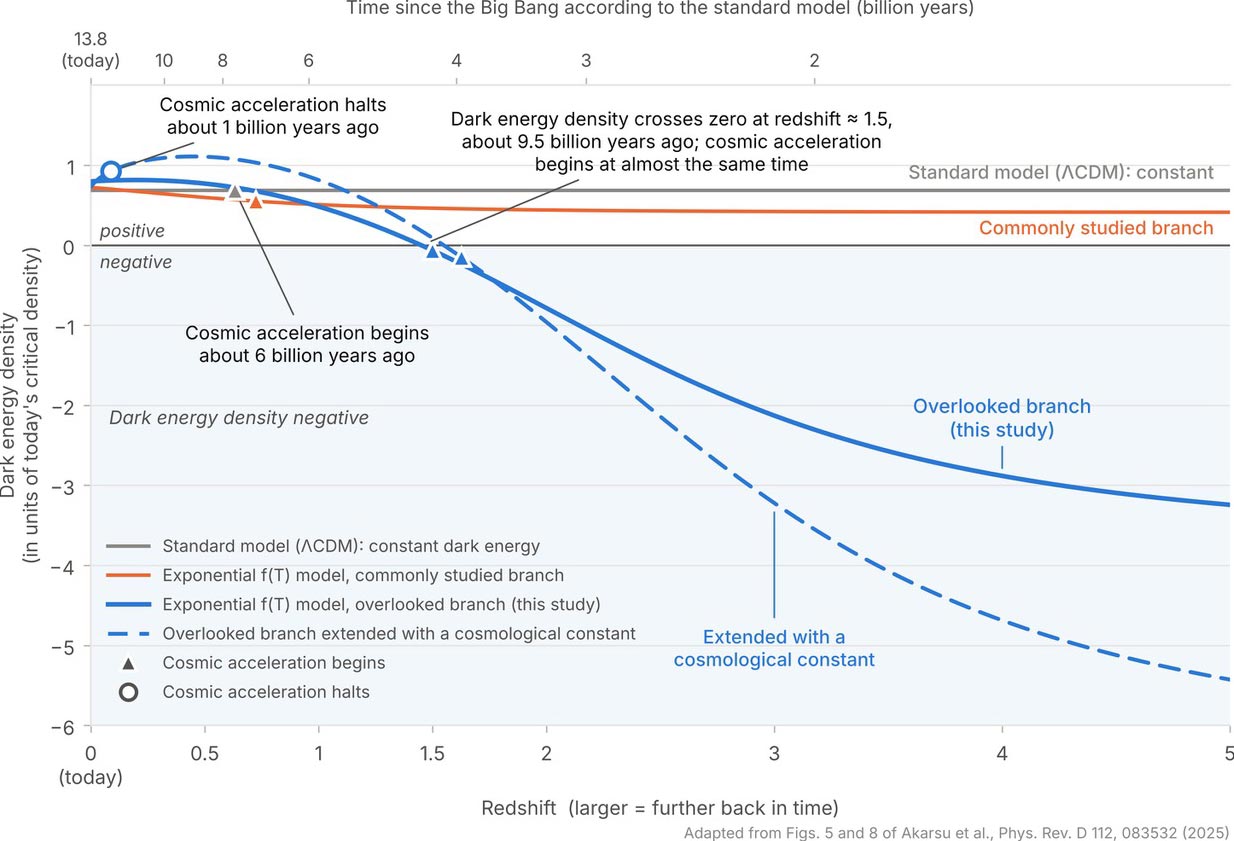
That extension allows another possibility: the acceleration of cosmic expansion could have slowed, or even stopped, in the very recent past. Recent analyses of DESI data have raised this possibility as well, although the model still needs rigorous testing against the full observations.
Akarsu said, “For several years we have been studying a scenario in which dark energy switches sign, and it has held up remarkably well against data such as DESI’s. The open question was what physical mechanism could produce such behavior. So we deliberately looked at a branch of a well-known theory of gravity that had been set aside because it violates the usual expectation that the dark energy density stays positive. The sign change emerged naturally from the theory itself.”
Gravity equations let dark energy change sign
The team’s starting point was teleparallel f(T) gravity. Whereas Einstein’s general relativity describes gravity through the curvature of spacetime, teleparallel gravity uses torsion, a different geometric property associated with twisting. Researchers have investigated extensions of this approach for years to see whether modified gravity could account for cosmic acceleration.
The exponential version examined in the study contains the two mathematical branches that lead to different cosmic histories. Earlier cosmological studies had favored the branch that followed the usual expectation, inherited from general relativity, of a positive dark energy density. Its evolution closely resembles the standard cosmological model.
On the alternative branch, effective dark energy density is negative during the universe’s first few billion years. It crosses zero at a redshift of around 1.5, corresponding to roughly 9.5 billion years ago, and remains positive afterward. The value governing the branch depends on the universe’s present matter density, so this behavior does not require an extra independently adjustable cosmological parameter. The basic model has six cosmological parameters, the same number as the standard ΛCDM model.
A modified theory must also account for the precise measurements that already support Einstein’s description of gravity. The paper finds that the alternative branch can remain consistent with Solar System tests because its departures from general relativity are naturally suppressed in dense environments.
Galaxy maps test whether dark energy changes
On cosmic scales, those departures provide opportunities to test the model. Alongside its predictions for expansion, researchers can examine how galaxies and larger structures grow and how gravity bends light through weak gravitational lensing. Galaxy motions offer another test through redshift-space distortions, patterns produced when those motions affect the redshifts used to map galaxy positions. Together, these measurements can help determine whether the proposed cosmic history is plausible.
DESI is making such comparisons increasingly demanding. By measuring the positions of millions of galaxies and quasars, it is assembling the largest three-dimensional map of the universe and tracing expansion over billions of years. In March 2025, the collaboration released results from its first three years of observations. When combined with measurements of the cosmic microwave background, supernovae, and weak lensing, they strengthened earlier hints that dark energy might evolve rather than behave as a simple cosmological constant.
The strength of those hints varies with the datasets used, and they have not reached the level required for a definitive discovery. They also do not establish that dark energy changed sign. The ITU-led study was first submitted in October 2024, months before DESI’s March 2025 announcement, and provides a theoretical explanation to investigate.
The search for physical mechanisms that could produce a sign change remains active across cosmology. The authors suggest that other modified gravity theories may also contain possibilities overlooked because researchers required effective dark energy density to stay positive.
DESI has now completed its planned five-year survey, observing more than 47 million galaxies and quasars. Its full dataset will offer a more rigorous test of whether the apparent evolution of dark energy persists. The ITU team has not yet compared its model with that full dataset.
“We identified an alternative path for the Universe within an existing theory. The next step is to test it rigorously against the full observational data. The preliminary picture is encouraging, and we are particularly interested in what it may tell us about the Hubble tension,” said Prof. Özgür Akarsu.
Reference: “Unexplored regions in teleparallel $f(T)$ gravity: Sign-changing dark energy density” by Ozgur Akarsu, Bilal Bulduk, Antonio De Felice, Nihan Katırcı and N. Merve Uzun, October 19, 2025, Physical Review D.
DOI: 10.1103/1xd4-k91h
Never miss a breakthrough: Join the SciTechDaily newsletter.
Follow us on Google and Google News.
1 Comment
When the universe starts to collapse, how soon will the fact become apparent from Earth? The universe we see today is pretty much the one that existed 7 to several billion light years ago.