
Astrophysicists at the University of Chicago have developed physics-based models suggesting that dark energy could be changing over time.
Dark energy, the mysterious force causing the universe to expand at an accelerating rate, remains one of the biggest puzzles in modern cosmology. The leading theory today holds that dark energy is a constant property of space itself, with the vacuum’s intrinsic energy driving cosmic acceleration.
Yet, new results from the Dark Energy Survey (DES) and the Dark Energy Spectroscopic Instrument (DESI) released last year have sparked renewed debate by suggesting that dark energy may not be constant after all, but instead evolving over time. “This would be our first indication that dark energy is not the cosmological constant introduced by Einstein over 100 years ago but a new, dynamical phenomenon,” explained Josh Frieman, Professor Emeritus of Astronomy and Astrophysics.
A recent study published in Physical Review D in September by Frieman and Anowar Shajib, a NASA Hubble Fellowship Program Einstein Fellow in Astronomy and Astrophysics, supports that possibility. By combining data from multiple observational probes, the researchers found that models describing dark energy as a dynamic, evolving quantity align more closely with current observations than those assuming a fixed cosmological constant.
Shajib’s research focuses on observational cosmology and galaxy evolution, using strong gravitational lensing to measure the Hubble constant and place constraints on dark energy’s properties. Frieman’s work centers on large-scale cosmic surveys, including the Sloan Digital Sky Survey (SDSS) and DES, with the goal of uncovering how the universe originated and evolved—and, ultimately, what dark energy truly is.
We spoke with Shajib and Frieman about the new models presented in their study, what these findings could mean for cosmology, and what future research might reveal.
Why is dark energy significant in the study of the universe?
Frieman: We now know precisely how much dark energy there is in the universe, but we have no physical understanding of what it is.
The simplest hypothesis is that it is the energy of empty space itself, in which case it would be unchanging in time, a notion that goes back to Einstein, Lemaitre, de Sitter, and others in the early part of the last century. It’s a bit embarrassing that we have little to no clue what 70 percent of the universe is. And whatever it is, it will determine the future evolution of the universe.
What recent findings led cosmologists to consider that dark energy may be evolving?
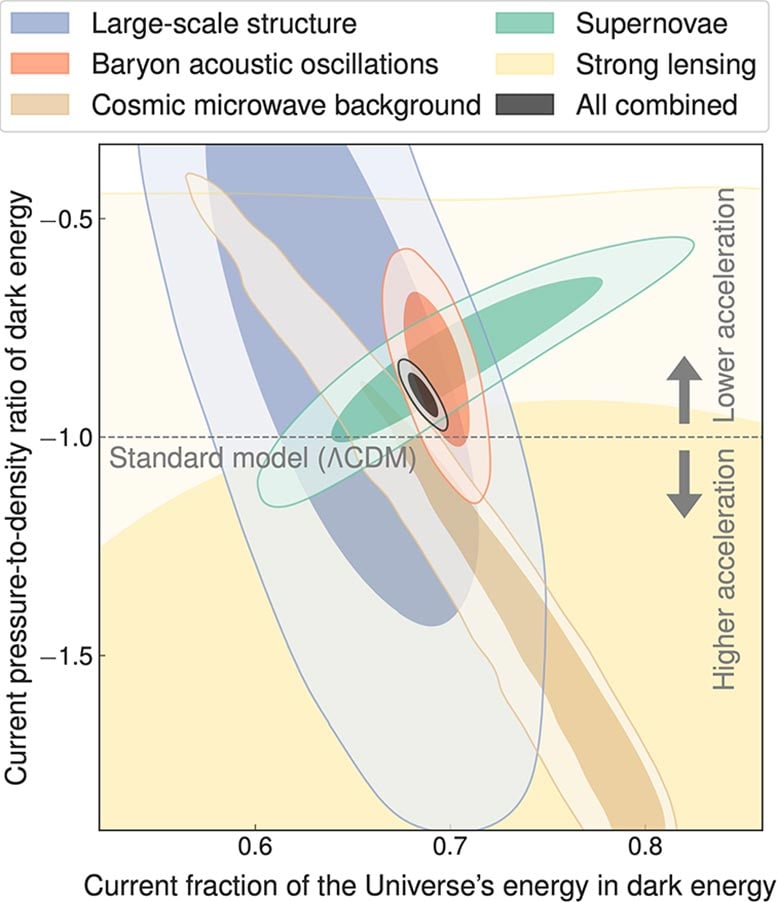
Shajib: Although there has been interest in the dynamical nature of dark energy since its discovery in the ’90s to resolve some observational discrepancies, until recently, most of the major and robust datasets were consistent with a non-evolving dark energy model, which is accepted as the standard cosmology. However, interest in evolving dark energy was vigorously rekindled last year from the combination of supernovae, baryon acoustic oscillation, and cosmic microwave background data from the DES, DESI, and Planck experiments.
This combination of datasets indicated a strong discrepancy with the standard, non-evolving model of dark energy. The interesting feature of non-evolving dark energy is that its density stays constant through time even though space is expanding. However, for the evolving dark energy model, dark energy density will change with time.
Frieman: The data from these surveys allow us to infer the history of cosmic expansion—how fast the universe has been expanding at different epochs in the past. If dark energy evolves in time, that history will be different than if dark energy is constant. The cosmic expansion history results suggest that over the last several billion years or so, the density of dark energy has decreased by about 10 percent—not much, and much less than the densities of other matter and energy, but still significant.
What was the goal of this study, and what were the overall findings?
Shajib and Frieman: The goal of this study is to compare the predictions of a physical model for evolving dark energy with the latest data sets and to infer the physical properties of dark energy from this comparison. The evolving dark energy “model” used in most previous data analyses is just a mathematical formula that isn’t constrained to behave as physical models do.
In our paper, we directly compare physics-based models for evolving dark energy to the data and find that these models describe the current data better than the standard, non-evolving dark energy model. We also show that near-future surveys such as DESI and the Vera Rubin Observatory Legacy Survey of Space and Time (LSST) will be able to definitively tell us whether these models are correct or if, instead, dark energy really is constant.
Describe the models presented and why they better explain the behavior of dark energy compared to existing models.
Frieman: These models are based on particle physics theories of hypothetical particles called axions. Axions were first predicted by physicists in the 1970s, who sought to explain certain observed features of strong interactions. Today, axions are considered plausible candidates for dark matter, and experiments worldwide are actively searching for them, including physicists at Fermilab and the University of Chicago.
The models in our paper are based on a different, ultra-light version of the axion that would act as dark energy, not dark matter. In these models, dark energy would, in fact, be constant for the first several billion years of cosmic history, but the axion would then start to evolve—like a ball on a sloping field that’s released from rest and starts to roll—and its density would slowly decrease, which is what the data appear to prefer. So the data suggest the existence of a new particle in nature that’s about 38 orders of magnitude lighter than the electron.
What are the implications of these findings for understanding cosmic expansion?
Shajib: In these models, the dark energy density decreases with time. Dark energy is the reason for the universe’s accelerated expansion, so if its density decreases, the acceleration will also decrease with time. If we consider the very far future of the universe, different characteristics of dark energy can lead to different outcomes.
Two extremes of these outcomes are a Big Rip, where the accelerated expansion itself accelerates to the point that it rips everything apart, even atoms, and a Big Crunch, where the universe stops expanding at some point and recollapses, which will look like a reverse Big Bang. Our models suggest that the universe will avoid both of these extremes: it will undergo accelerated expansion for many billions of years, yielding a cold, dark universe—a Big Freeze.
Could these results have other, less apparent implications?
Frieman: The only practical implications I can imagine are the technologies we need to develop to explore these ideas further—building new telescopes, launching new satellites, or developing novel detectors, for example. Such developments are likely to have much more of an impact on our lives than events happening trillions of years in the future.
What excites you the most about these results?
Shajib: For this paper, we gathered all the major data sets—from the DES, DESI, SDSS, Time-Delay COSMOgraphy, Planck, and Atacama Cosmology Telescope—and combined them to get the most constraining measurement of dark energy to date. All these measurements come from extensive experiments, so in a way, they represent the collective knowledge that the cosmological community has gathered as a whole.
Frieman: When we began working on the DES in 2003, our goal was to constrain the properties of dark energy to determine whether it was constant or changing. For two decades, the data indicated that it was constant. We almost gave up on that question because the data consistently supported the assumption. However, we now have the first hint in over 20 years that dark energy might be changing, and if it is evolving, it must be something new, which would change our understanding of fundamental physics. That feeling is reminiscent of where we were at the beginning. It could still turn out that these hints are incorrect, but we may be on the cusp of answering that question, and that’s quite exciting.
Reference: “Scalar-field dark energy models: Current and forecast constraints” by Anowar J. Shajib and Joshua A. Frieman, 8 September 2025, Physical Review D.
DOI: 10.1103/kjpb-r698
Never miss a breakthrough: Join the SciTechDaily newsletter.
Follow us on Google and Google News.
7 Comments
Fascinating
There is a alternative derivation of relativistic energy by Zbigniew Osiak that is arguably more faithful to the relativistic principle of Lorentz invariance of physical law than Einstein’s derivation. One has to suspect Einstein did it in a non-covariant way because he tried the covariant way but realized it doesn’t conserve energy. Up to half the energy in relativistic particle collisions can (seemingly) vanish. But it turns out that Osiak’s relativity respects a principle of temporal momentum conservation that can enforce particle creation energy thresholds, and also that there is apparently dark energy present.
According to Osiak’s relativity and assuming the unconserved energy converts to gravitational potential energy, the amount of dark energy is greatest near the big bang and decays as the universe ages. There is an extra relativistic (i.e. Lorentz) factor in Osiak’s energy formula, which implies the amount of energy in the early universe is hugely larger than according to the Einstein formula. Is it big enough to drive cosmic inflation? Cosmologist could calculate easily enough seems to me. The just need to recalculate the energy using the Osiak formula instead Einstein’s in early universe cosmological computer models.
Even better, there is a relatively simple test that can falsify one form or the other relativistic energy formula. It only needs a betatron. My paper has been peer-reviewed and published by IJQF, but the the fancy (i.e., indexed) journals won’t even review it.
https://ijqf.org/archives/7386
See also: https://www.youtube.com/watch?v=j1FhR34Awe0&t=41s
https://www.youtube.com/watch?v=g7I52_VpE9A
Yes, dark matter is evolving alright… from a lazy cop-out theory to a complete joke.
I have always seen the debate the last couple of decades(?) about whether Einstein’s “Cosmological Constant” is right or wrong as kind of absurd. I am not a scientist, just an enthusiest. But as I recall, Einstein added the CC to his equations to force them to show a static universe, which was the thought at the time, because his equations otherwise predicted an expanding universe. Again, as I recall, with the evidence a few years later of an expanding universe, Einstein called the CC the biggest blunder of his career. I guess my point is that Einstein was admittedly definitely wrong to add the CC given this reasons for doing so and discussions of whether he was right or wrong are moot. Hence, my distaste for and what I consider misleading titles to articles such as this one: “Is Einstein’s “Cosmological Constant” Wrong?” Another thing I dislike is the saying “just saying” although as regards my comment, just saying.
Yes, Einstein admitted his cosmological constant was a baseless concept so why is being taken seriously now?
Equating the photon energy with the Planck quantum, as Einstein did, isn’t justified either, because Planck’s spectrum is based on standing wave modes in a cavity oscillator, which would take at least two photons per mode. The evidence that this is incorrect has been around since 1926, it’s called the spin-orbit coupling anomaly. Einstein may have broken his own principle of Lorentz invariance to obtain the rest energy E_0 = m c^2 in agreement with his previous careless assumption. Osiak follows Einstein’s own rule and obtains E_0 = (1/2) m c^2, resolving the anomaly, while incidentally (probably) explaining dark energy and possibly dark matter as well.
This could have been a shorter article:
Is Einstein’s “Cosmological Constant” Wrong?
Yes.
thanks