
By studying faint distortions in galaxy shapes across a vast region of sky, scientists probed the hidden structure of the universe.
In the standard picture of the universe, nearly everything is hidden from view. About 95 percent of the cosmos consists of dark matter and dark energy, substances that cannot be seen directly and are still not fully understood.
Even so, they play a major role in shaping the universe, with dark matter influencing how galaxies form through gravity and dark energy causing the expansion of space to speed up. Scientists learn about these unseen components by tracking how they affect visible objects, and researchers at the University of Chicago have now studied these effects across a newly analyzed region of the sky.
Mapping the dark universe
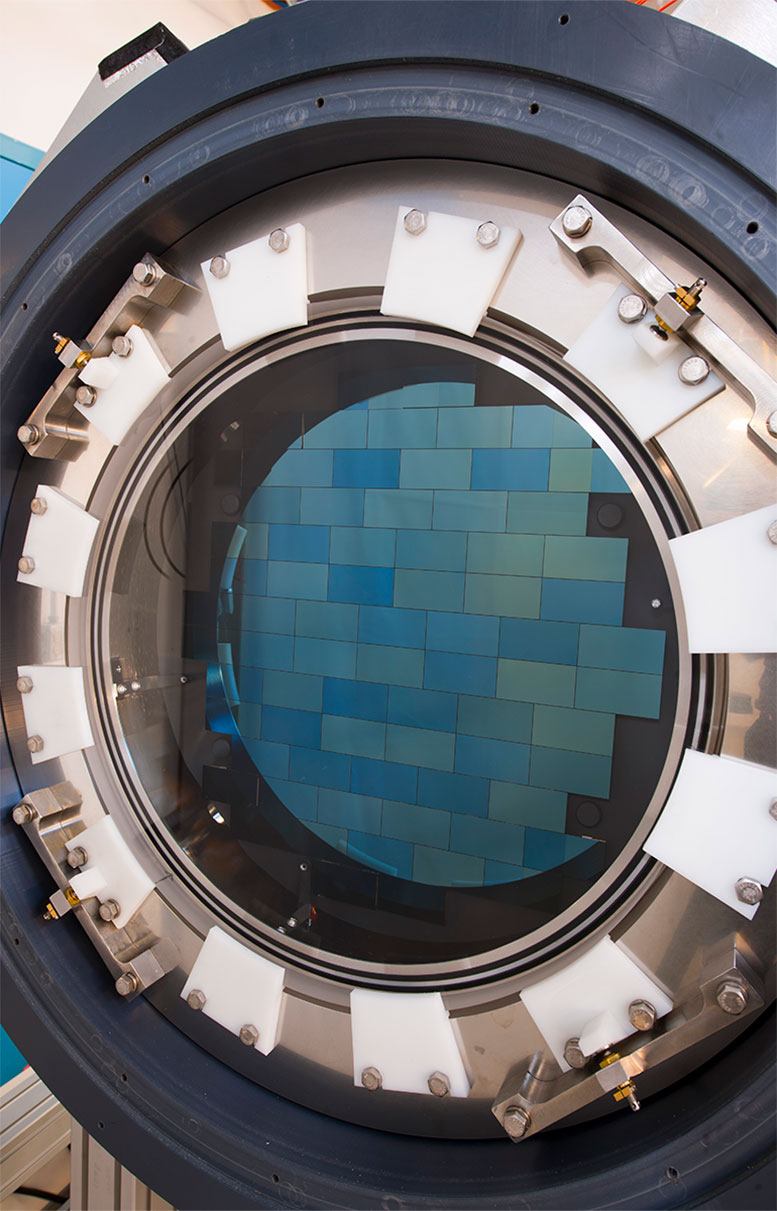
Between 2013 and 2019, the Dark Energy Survey (DES) gathered observations with the Dark Energy Camera (DECam), which is installed on the 4-meter Blanco Telescope at the Cerro Tololo Inter-American Observatory in Chile. Using this instrument, the survey precisely measured the shapes of more than 150 million galaxies spread across 5,000 square degrees (about an eighth) of the sky. This detailed map helps scientists better understand how matter is distributed throughout the universe and how dark energy behaves.
DES data has also played a key role in examining recent questions surrounding the leading cosmological framework, the Lambda-CDM (LCDM) model. Some measurements of the nearby universe, based on galaxy surveys like DES, appear to differ from measurements of the early universe that come from the cosmic microwave background (CMB)—the leftover radiation from the Big Bang.
In addition to its primary survey work, DECam also captured images of vast areas beyond the official DES boundaries. In a new series of studies published in the Open Journal of Astrophysics, University of Chicago researchers used these additional observations to nearly double the number of galaxies with accurately measured shapes.
The expanded dataset spans thousands of square degrees outside the original DES footprint. Although these observations were not initially designed for weak gravitational lensing research, the team showed that they could still be used to closely investigate the reported differences within the LCDM model using an independent set of data.
Distortion and distance
Gravitational lensing, the bending of light by massive objects, is a key method used to probe the amount of mass and its distribution in the universe, thereby gleaning insight into the interactions between dark matter, ordinary matter, and dark energy, explained Chihway Chang, associate professor of Astronomy and Astrophysics and lead of the Dark Energy Camera All Data Everywhere (DECADE) weak lensing cosmic shear project.
With weak gravitational lensing, the shape of galaxies observed from Earth appears slightly distorted (sheared) because the light from those galaxies must travel through and around the matter in the universe in order to reach us. The effect is so subtle that it requires statistical analysis to measure.
“Weak lensing measurements are best at probing the ‘clumpiness’ of matter,” said Dhayaa Anbajagane, a PhD student in Astronomy and Astrophysics who is the lead analyst and first author on the series of DECADE papers. “Quantifying this clumpiness sheds light on the origin and evolution of structures like galaxies and galaxy clusters. This is loosely akin to measuring the distribution of people (the matter) living across a region and using that to understand features such as the landscape’s topography or the location or age of urban areas (factors that influence the origin and evolution of structures).”
For this project, the team measured the shapes of more than 100 million galaxies. They also measured their distances by determining how much a galaxy’s light has shifted toward the red end of the light spectrum (redshift), which indicates how fast the galaxy is receding. From that measurement, they can calculate the distance from Earth.
Using those shapes and distances, the team fit the LCDM model to the data. This is the standard model of cosmology widely accepted to explain observations about the universe, with components related to dark energy, dark matter, ordinary matter, neutrinos, and radiation. “This is a well-tested model that has survived many, many examinations in the past decade, and our data point is going to add to that story,” said Chang.
The DECADE study finds that the growth of structure in the universe is consistent with predictions from the LCDM model, supporting the results of previous weak lensing measurements. “In addition, when comparing our constraints with those derived and extrapolated from the early universe’s CMB, we also agree well,” said Chang. “This last point has been a source of debate over the past five or so years, and with our new results, we can say that we do not see tension between weak lensing and CMB.”
“We are also able to combine the DECADE lensing measurements with those of DES, resulting in a galaxy lensing analysis that uses the largest number of galaxies (270 million) covering the widest patch of sky (13,000 square degrees) to date,” said Anbajagane. “Given this large amount of data, we can make particularly conservative choices in our analysis—such as only making or using the measurements we trust most, rather than all useful or possible measurements—and still make a measurement with enough precision to meaningfully inform our comparisons with the CMB.”
“An unconventional weak lensing survey”
The DECADE project independently checks consistency between CMB and weak lensing measurements on a completely different but similarly sized patch of sky from DES. However, this outcome was not a given at the start of the project, notes Alex Drlica-Wagner, Scientist at Fermilab and UChicago associate professor in Astronomy and Astrophysics, who led the DECADE observing campaign. “It was not clear that the DECADE dataset would be of sufficient quality to perform a cosmological analysis, but we have shown that it can indeed produce robust results,” he added.
“One unique result from this work has to do with choices we make on image quality,” said Anbajagane. A conventional weak lensing–focused survey takes nearly a hundred thousand dedicated images over many years, yet many are discarded because, for example, the image quality failed to meet the set criteria. “The DECADE project is unique as it repurposes archival data—images originally taken by the astronomy community for a wide variety of science goals, from studying dwarf galaxies to stars to distant galaxy clusters—and uses significantly more permissive criteria for image quality. Our work shows robust lensing analyses can be done even if we do not have lensing-dedicated imaging campaigns,” he said.
This changes how astronomers might view future lensing analyses, such as those from the Vera C. Rubin Legacy Survey of Space and Time (Rubin LSST) survey. Such analyses could use more of their images than they may have otherwise, improving how precisely astronomers measure cosmological properties. The DECADE project’s ability to use such archival image data was also enabled in large part by meticulous inspection of the images, a task led by Chin Yi Tan, a PhD student in Physics.
The completed catalog combined with DES covers approximately one-third of the sky (13,000 square degrees) and contains 270 million galaxies. This catalog was released to the scientific community this fall and has already caught the interest of cosmologists and astronomers. For instance, the team’s imaging data has been used to study dwarf galaxies and make maps of the mass in the universe. “We’re actively working on applying other analysis methods to our data alongside experts at the Kavli Institute for Cosmological Physics,” said Anbajagane.
Scientists from UChicago, Fermilab, and NCSA at UIUC joined forces with researchers at Argonne, UW-Madison, and many other institutions around the world to carry out the DECADE analysis. “It was quite special to have these different components all sitting in the hallway,” said Chang. “It also allowed us to learn from each other—and resulted in an unexpected but wonderful outcome of this project.”
Reference: “The DECADE cosmic shear project I: A new weak lensing shape catalog of 107 million galaxies” by D. Anbajagane, Z. Zhang, C. Chang, C. Y. Tan, M. Adamow, L. F. Secco, M. R. Becker, P. S. Ferguson, A. Drlica-Wagner, R. A. Gruendl, K. Herron, A. Tong, M. A. Troxel, D. Sanchez-Cid, I. Sevilla-Noarbe, N. Chicoine, R. Teixeira, A. Alarcon, D. Suson, A. N. Alsina, A. Amon, C. R. Bom, J. A. Carballo-Bello, W. Cerny, A. Choi, Y. Choi, C. Doux, K. Eckert, M. Gatti, D. Gruen, M. Jarvis, D. J. James, N. Kuropatkin, C. E. Martínez-Vázquez, P. Massana, S. Mau, J. McCullough, G. E. Medina, B. Mutlu-Pakdil, M. Navabi, N. E. D. Noël, A. B. Pace, J. Prat, M. Raveri, A. H. Riley, E. S. Rykoff, J. D. Sakowska, D. J. Sand, L. Santana-Silva, T. Shin, M. Soares-Santos, G. S. Stringfellow, A. K. Vivas and M. Yamamoto, 22 October 2025, The Open Journal of Astrophysics.
DOI: 10.33232/001c.146158
Never miss a breakthrough: Join the SciTechDaily newsletter.
Follow us on Google and Google News.
2 Comments
Freely sharing my unique lay findings in 2009 of gravity and various related interpretations in online videos since 2012 (2013 being the first full year) with little to no professional acceptance, from time to time I’m compelled to reach deeper into my mind (like astronomers reaching deeper into the universe) to find more compelling explanations of what I seem to individually perceive. Now, in late 2025, I’m adding that in my gradually unfolding model of the universe the speed of light (“C”) is not constant, except in an ambient field of gravity, like here on earth. With photons emitted by distant sources accelerating on expanding lines of radiant gravity force (blueshift) not being limited to 3 * 10^8 m/s in deep space, the farther they originate from earth the faster they’ll be traveling when encountering our solar-earth field of gravity and the more deceleration (redshift) they’ll exhibit by the time they are detected in near earth orbit, and/or here on earth.
Therefore, what appeared to be an accelerating expansion of the visible universe to Edwin Hubble in 1929 may actually be a collapsing universe in 2025. More likely, in my lay opinion, the expansion of the universe is simply slowing now, due to invisible radiant lines of gravity force permeating the entire universe. Regrettably, about all I can personally demonstrate in down-to-earth videos is how even in our ambient field of gravity individual objects can exhibit intensified local fields of their own via mere rotation and their local fields can be compelled to disengage and reengage with earth’s ambient field as “inertia,” via the forced motion of a loosely connected object (https://odysee.com/@charlesgshaver:d/5Gravity:c). In my model of the universe there is no need for either dark matter or dark energy to explain the resultant natural motions of distant cosmic objects following a, likely, historical “Big Bang.”
Please continue.
Researchers have been immersed in existing paradigms for a long time and it difficult to quickly accept new theories that require reconstructing fundamental concepts. Although TVT possesses a clear mathematical and physical foundation, it has been marginalized by some so-called scholars due to its challenge to authority. Mainstream theories sustain a vast academic industry chain. Challenging the paradigm may touch on vested interest groups. Some people, in order to enter the so-called mainstream academic community, no longer have the concepts of dirty, ugly, and shameful in their dictionaries. Honesty has no connection with them.
When we pursue the ultimate truth of all things, the space in which our bodies and all things exist may itself be the final and deepest puzzle we need to explore. This is not only the pursuit of physics, but also the most magnificent exploration of the origin of the universe by human reason.
Based on the Topological Vortex Theory (TVT), space is an uniformly incompressible physical entity. Space-time vortices are the products of topological phase transitions of the tipping points in space, are the point defects in spacetime. Point defects do not only impact the thermodynamic properties, but are also central to kinetic processes. They create all things and shape the world through spin and self-organization.
In today’s physics, some so-called peer-reviewed journals—including Physical Review Letters, Nature, Science, and others—stubbornly insist on and promote the following:
1. Even though θ and τ particles exhibit differences in experiments, physics can claim they are the same particle. This is science.
2. Even though topological vortices and antivortices have identical structures and opposite rotational directions, physics can define their structures and directions as entirely different. This is science.
3. Even though two sets of cobalt-60 rotate in opposite directions and experiments reveal asymmetry, physics can still define them as mirror images of each other. This is science.
4. Even though vortex structures are ubiquitous—from cosmic accretion disks to particle spins—physics must insist that vortex structures do not exist and require verification. Only the particles that like God, Demonic, or Angelic are the most fundamental structures of the universe. This is science.
5. Even though everything occupies space and maintains its existence in time, physics must still debate and insist on whether space exists and whether time is a figment of the human mind. This is science.
6. Even though space, with its non-stick, incompressible, and isotropic characteristics, provides a solid foundation for the development of physics, physics must still insist that the ideal fluid properties of space do not exist. This is science.
and go on.
Is this the counterintuitive science they widely promote? Compromising with pseudo academic publications and peer review by pseudo scholars is an insult to science and public intelligence. Some so-called scholars no longer understand what shame is. The study of Topological Vortex Theory (TVT) reminds us that the most profound problems in physics often lie at the intersection of different theories. By exploring these border regions, we can not only resolve contradictions in existing theories but also discover new physical phenomena and application possibilities.
Under the topological vortex architecture, it is highly challenging for even two hydrogen atoms or two quarks to be perfectly symmetrical, let alone counter-rotating two sets of cobalt-60. Contemporary physics and so-called peer-reviewed publications (including Physical Review Letters, Science, Nature, etc.) stubbornly believe that two sets of counter rotating cobalt-60 are two mirror images of each other, constructing a more shocking pseudoscientific theoretical framework in the history of science than the “geocentric model”. This pseudo scientific framework and system have seriously hindered scientific progress and social development.
For nearly a century, physics has been manipulated by this pseudo scientific theoretical system and the interest groups behind it, wasting a lot of manpower, funds, and time. A large amount of pseudo scientific research has been conducted, and countless pseudo scientific papers have been published, causing serious negative impacts on scientific and social progress, as well as humanistic development.
Complexity does not necessarily mean that there is no logical and architectural framework to follow. Mathematics is the language and tool that reveals the motion of spacetime, rather than the motion itself. Although the physical form of spacetime vortices is extremely simple, their interaction patterns are highly complex, and we must develop more and richer mathematical languages to describe and understand them.
The development of the Topological Vortex Theory (TVT) reflects a progression from concrete physical phenomena to abstract mathematical modeling and, ultimately, to interdisciplinary unification. Its core innovation lies in forging the continuous spacetime geometry of general relativity with the discrete interactions of quantum field theory within the same topological dynamical system.
——Excerpted from https://scitechdaily.com/microscope-spacecrafts-most-precise-test-of-key-component-of-the-theory-of-general-relativity/#comment-909171 and https://zhuanlan.zhihu.com/p/1943715764965188178.