
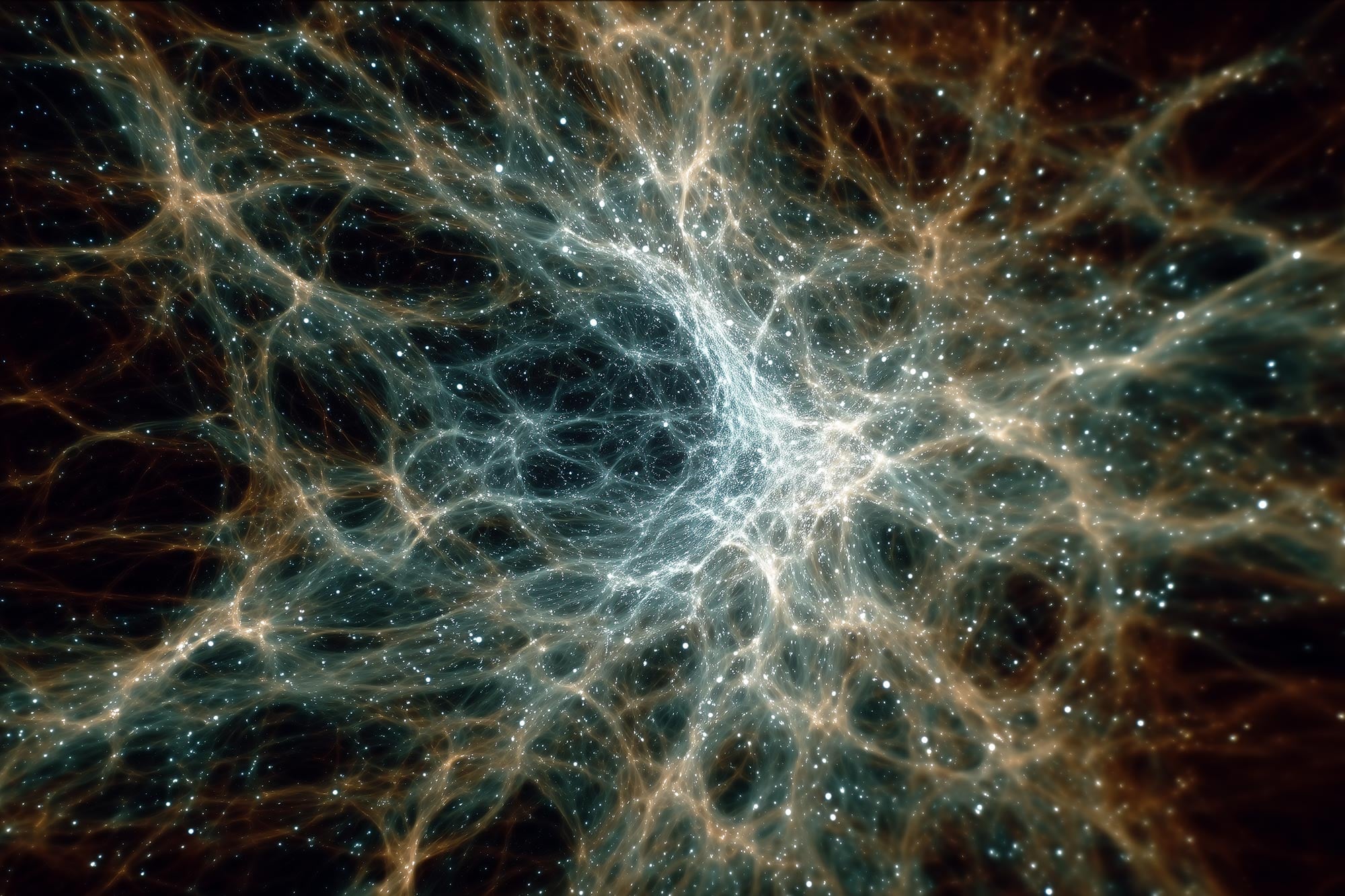
New research suggests that dark energy, the mysterious force driving the Universe’s accelerating expansion, might not be constant after all.
Since the early 20th century, researchers have gathered strong evidence that the Universe is not only expanding but doing so at an accelerating pace. This acceleration is linked to a mysterious influence known as dark energy, a property of spacetime thought to push galaxies apart.
For many years, the dominant cosmological framework, the Lambda Cold Dark Matter (ΛCDM) model, has treated dark energy as a fixed quantity that remains unchanged throughout the history of the cosmos. That assumption has long provided a simple foundation for understanding the Universe, yet it leaves open a crucial possibility: dark energy may not be constant and could instead vary over time.
New Observations Hint at Dynamic Dark Energy
Recent observational breakthroughs are beginning to challenge the long-standing view of dark energy as unchanging. Data from the Dark Energy Spectroscopic Instrument (DESI), an advanced survey designed to map distant galaxies, suggests that a dynamic dark energy (DDE) component may better describe the cosmos.
This potential shift away from the ΛCDM model points to a more intricate cosmic evolution than previously recognized. At the same time, it underscores a major gap in current knowledge: scientists still have limited understanding of how a time-dependent dark energy component might influence the formation and growth of the Universe’s largest structures.
Massive Simulations Explore a Changing Universe
To address this challenge, a research team led by Associate Professor Tomoaki Ishiyama of the Digital Transformation Enhancement Council at Chiba University in Japan carried out one of the most ambitious cosmological simulations ever created.
The study, conducted with collaborators Francisco Prada from the Instituto de Astrofísica de Andalucía in Spain and Anatoly A. Klypin from New Mexico State University in the USA, was published in Physical Review D. Their goal was to examine how a time-varying dark energy component could reshape the Universe and provide clearer guidance for interpreting future astronomical data.
Supercomputer Fugaku Tests Multiple Dark Energy Models
Using the Fugaku supercomputer, one of Japan’s premier computing systems, the researchers performed three high-resolution N-body simulations that each covered a computational volume eight times larger than earlier work.
One simulation followed the standard Planck-2018 ΛCDM model, while two others included versions of dynamic dark energy. By comparing a DDE model with fixed parameters to the ΛCDM model, they were able to identify the specific effects produced by a changing dark energy component. A third simulation incorporated DESI Year-1 best-fit parameters, enabling the team to investigate how a more realistic, observation-based DDE scenario would influence an updated cosmological model.
How Shifts in Matter Density Transform the Cosmos
The findings indicate that dynamic dark energy on its own produces relatively small changes. However, when the researchers adjusted the cosmological parameters in line with DESI results, particularly by raising the matter density by about 10 percent, the consequences became much more substantial.
A greater matter density strengthens gravitational attraction, which leads to the earlier development of massive galaxy clusters. These clusters act as the structural backbone of the Universe, supporting the networks of galaxies we observe today. In this scenario, the DESI-informed DDE model predicted up to 70 percent more massive clusters during the Universe’s early stages.
Testing the Model with Ancient Cosmic Signals
The team also evaluated how the models affected baryonic acoustic oscillations (BAOs), which are patterns left by ancient sound waves and serve as a key tool for measuring cosmic distances. In the DESI-derived DDE simulation, the BAO peak shifted by 3.71 percent toward smaller scales. This shift closely matched DESI’s observational data, demonstrating strong agreement between the simulation and real measurements and reinforcing confidence in the model’s predictive capability.
Galaxy Clustering Offers Additional Evidence
Beyond BAOs, the researchers examined how galaxies cluster across the Universe. The DESI-based DDE model showed clearly enhanced clustering compared with other models, especially on smaller scales. This behavior is a direct consequence of the higher matter density used in the simulation. When the team compared these results to DESI observations, they found that the patterns of galaxy clustering aligned well with the model’s predictions.
Key Insights Into Structure Formation
Overall, the study reveals how significantly the Universe’s structure can change when both dark energy and cosmological parameters such as matter density are varied. As Dr. Ishiyama states, “Our large simulations demonstrate that variations in cosmological parameters, particularly the matter density in the Universe, have a greater influence on structure formation than the DDE component alone.”
Preparing for Next-Generation Galaxy Surveys
With several major surveys forthcoming, these findings will be essential for interpreting increasingly precise measurements. “In the near future, large-scale galaxy surveys from the Subaru Prime Focus Spectrograph and DESI are expected to significantly improve measurements of cosmological parameters. This study provides a theoretical basis for interpreting such upcoming data,” Dr. Ishiyama concludes.
Reference: “Evolution of clustering in cosmological models with time-varying dark energy” by Tomoaki Ishiyama, Francisco Prada and Anatoly A. Klypin, 4 August 2025, Physical Review D.
DOI: 10.1103/4k5f-gyrx
Never miss a breakthrough: Join the SciTechDaily newsletter.
Follow us on Google and Google News.
2 Comments
Results on the measurement of Hubble Tension is improving,since adoptiòn of the Dynamic Big Bang version,in the modern cosmology.Hope,from every independent stream of study and research is so enlightening to achive one sound gòal for the estabĺishment of this path or chapter of astrophysics,within fair limits of experimental uncertañities.
Since 2013 I’ve had a video online of my down-to-earth experiments demonstrating the radiant coherent pulsing angular lines of attraction nature of gravity force, which are intensified in rotating objects in an ambient field thereof. With my model of gravity there is no need to include hypothetical dark energy or dark matter in any simulations modified to include more mass. Over time, rotation alone can alter the trajectories of stars and the densities of galaxies (e.g., https://odysee.com/@charlesgshaver:d/5Gravity:c).