
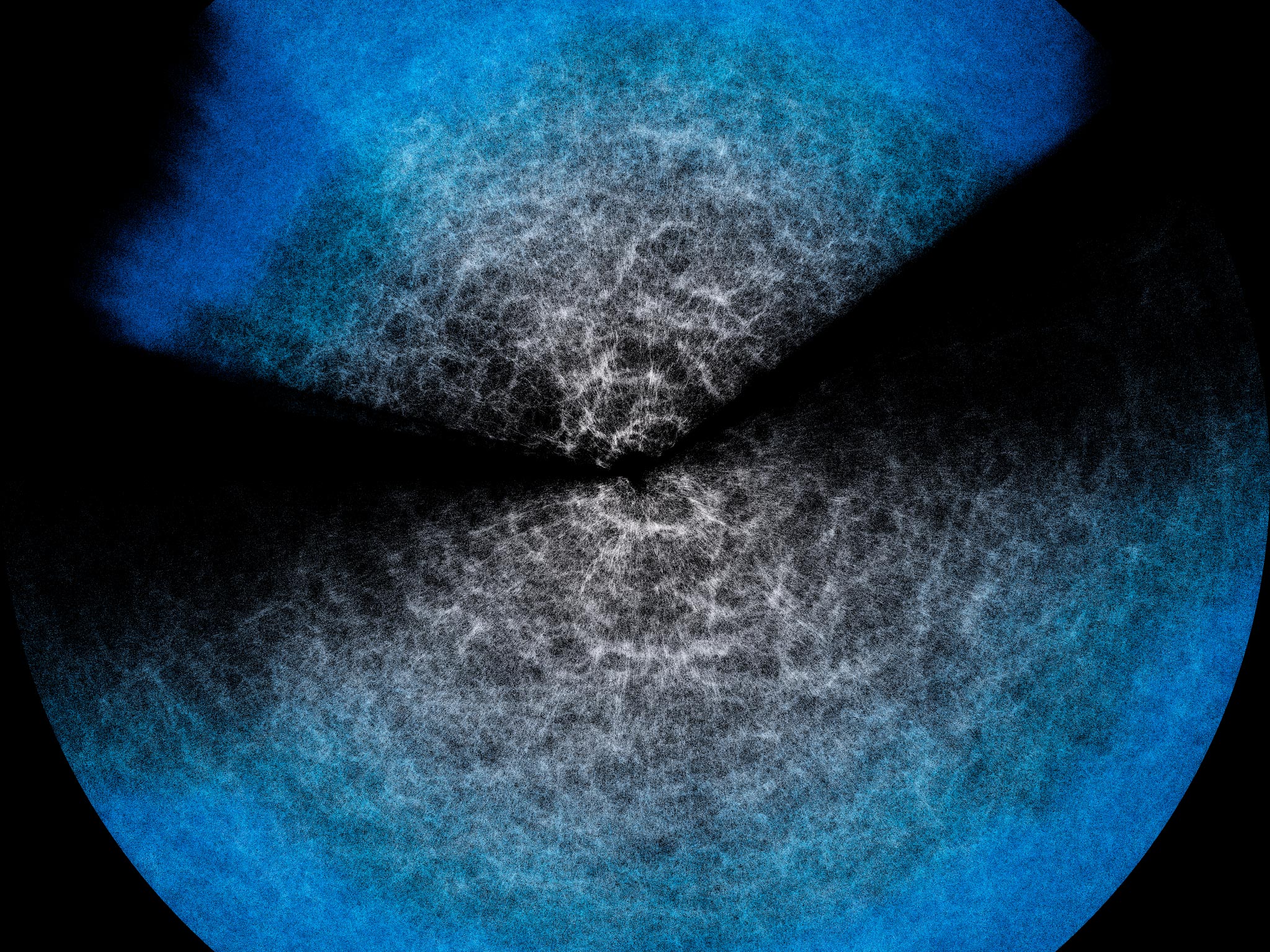
The Universe is woven into a vast cosmic web of galaxies, clusters, and filaments, but modeling such complexity has always demanded supercomputers and immense time.
Now, scientists have introduced Effort.jl, an innovative emulator that mimics the behavior of advanced cosmological models with striking accuracy, sometimes even improving on them, while running in minutes on a laptop.
The Vast Skeleton of the Universe
A single galaxy may seem enormous, but compared with the entire Universe it is no more than a pinpoint. Countless galaxies gather into clusters, which themselves combine into vast superclusters. These assemble into immense filaments interlaced with empty regions, forming a colossal three-dimensional framework known as the cosmic web.
Trying to grasp such an immense structure is far from simple. To make sense of it, researchers bring together physical theories of the Universe with observations from telescopes and other instruments. They then construct theoretical models, one of the most important being EFTofLSS (Effective Field Theory of Large-Scale Structure). With data as input, these models provide a statistical description of the cosmic web and make it possible to calculate its fundamental properties.
Why Emulators Matter in Cosmology
Although powerful, models like EFTofLSS require huge amounts of computing time and resources. With astronomical datasets expanding at an accelerating pace, researchers need more efficient methods to process the information without compromising accuracy. This is where emulators come in. They replicate the behavior of complex models while working at a much faster speed.
Of course, shortcuts raise concerns about precision. To address this, a collaboration involving INAF (Italy), the University of Parma (Italy), and the University of Waterloo (Canada) tested a newly developed emulator called Effort.jl. Their results, published in the Journal of Cosmology and Astroparticle Physics (JCAP), reveal that Effort.jl matches the accuracy of the original model it reproduces and, in some cases, even provides finer detail. Remarkably, it can perform these tasks within minutes on a typical laptop rather than relying on a supercomputer.
From Water Molecules to Galaxies
“Imagine wanting to study the contents of a glass of water at the level of its microscopic components, the individual atoms, or even smaller: in theory you can. But if we wanted to describe in detail what happens when the water moves, the explosive growth of the required calculations makes it practically impossible,” explains Marco Bonici, a researcher at the University of Waterloo and first author of the study.
“However, you can encode certain properties at the microscopic level and see their effect at the macroscopic level, namely the movement of the fluid in the glass. This is what an effective field theory does, that is, a model like EFTofLSS, where the water in my example is the Universe on very large scales and the microscopic components are small-scale physical processes.”
The theoretical model statistically explains the structure that gives rise to the data collected: the astronomical observations are fed to the code, which computes a “prediction.” But this requires time and substantial compute. Given today’s data volume—and what is expected from surveys just begun or coming soon (such as DESI, which has already released its first batch of data, and Euclid)—it’s not practical to do this exhaustively every time.
How Effort.jl Learns Faster
“This is why we now turn to emulators like ours, which can drastically cut time and resources,” Bonici continues. An emulator essentially mimics what the model does: its core is a neural network that learns to associate the input parameters with the model’s already-computed predictions. The network is trained on the model’s outputs and, after training, can generalize to combinations of parameters it hasn’t seen. The emulator doesn’t “understand” the physics itself: it knows the theoretical model’s responses very well and can anticipate what it would output for a new input.
Effort.jl’s originality is that it further reduces the training phase by building into the algorithm knowledge we already have about how predictions change when parameters change: instead of making the network “re-learn” these, it uses them from the start. Effort.jl also uses gradients—i.e., “how much and in which direction” predictions change if you tweak a parameter by a tiny amount—another element that helps the emulator learn from far fewer examples, cutting compute needs and allowing it to run on smaller machines.
Accuracy Tested, Universe Approved
A tool like this needs extensive validation: if the emulator doesn’t know the physics, how sure are we that its shortcut yields correct answers (i.e., the same ones the model would give)? The newly published study answers exactly this, showing that Effort.jl’s accuracy—on both simulated and real data—is in close agreement with the model.
“And in some cases, where with the model you have to trim part of the analysis to speed things up, with Effort.jl we were able to include those missing pieces as well,” Bonici concludes. Effort.jl thus emerges as a valuable ally for analyzing upcoming data releases from experiments like DESI and Euclid, which promise to greatly deepen our knowledge of the Universe on large scales.
Reference: “Effort.jl: a fast and differentiable emulator for the Effective Field Theory of the Large Scale Structure of the Universe” by Marco Bonici, Guido D’Amico, Julien Bel and Carmelita Carbone, 16 September 2025, Journal of Cosmology and Astroparticle Physics.
DOI: 10.1088/1475-7516/2025/09/044
The study “Effort.jl: a fast and differentiable emulator for the Effective Field Theory of the Large Scale Structure of the Universe” by Marco Bonici, Guido D’Amico, Julien Bel and Carmelita Carbone is available in the Journal of Cosmology and Astroparticle Physics (JCAP).
Never miss a breakthrough: Join the SciTechDaily newsletter.
Follow us on Google and Google News.
3 Comments
So, we all fit into that laptop?
Worked for Moriarty on STNG.
A miniature holodeck.