
A mysterious and very distant object, in a universe as it was ‘just’ two billion years after the Big Bang, that hides from even the most advanced instruments. Its features have finally been described by a SISSA study published in The Astrophysical Journal.
An extremely remote celestial body in a still young Universe, one-sixth the size of the present one. An object so dark that it is almost invisible, even to highly sophisticated instruments. Its nature has long been the subject of debate, but by means of surveys made with the ALMA interferometer, the SISSA research group led by Prof. Andrea Lapi that conducts research into the formation and evolution of galaxies has finally succeeded in identifying its main properties. Compact, and containing large quantities of interstellar dust, it is a young galaxy, forming stars at about 1000 times the rate of the Milky Way. The description of this galaxy will be useful for revealing more about this very distant object and indicating new approaches for the study of other ‘dark’ celestial bodies. The research just published in The Astrophysical Journal will also provide new insights for developing advanced models of galaxy formation and evolution.
Remote, Dark and Invaluable: The Most Distant Galaxies
“Very distant galaxies are real mines of information about the past and future evolution of our Universe,” explains the first author Marika Giulietti, who studies Astrophysics and Cosmology at SISSA. “However, studying them is very challenging. They are very compact and therefore difficult to observe. Also, because of distance, we receive very weak light from them. The cause of this obscuration is the massive presence of interstellar dust, which intercepts visible light from young stars, and makes it difficult to detect with optical instruments, and re-emits it at greater wavelengths where it can be observed only with powerful interferometers in the (sub-) millimeter and radio wavebands.”
These dark bodies are not particularly rare: “In recent years” explains Giulietti “several distant galaxies have been discovered that are particularly obscured, appearing completely invisible even to the most powerful optical instruments, such as the Hubble Space Telescope.”
Gravitational Lensing
A tool used in these cases is the so-called gravitational lensing, a solution of great scientific potential. The principle is simple: general relativity means that space objects closer to us that have a great mass distort light coming from more distant sources that are perfectly aligned with them. Giulietti continues: “In this way, large celestial bodies act as a kind of enormous cosmic lens that makes the ‘background’ galaxies appear larger and brighter, allowing them to be identified and studied.” Over the past decade, many observation programs have been carried out with this approach. “About a hundred have been discovered so far, but there could be many more.”
A Truly Special Object
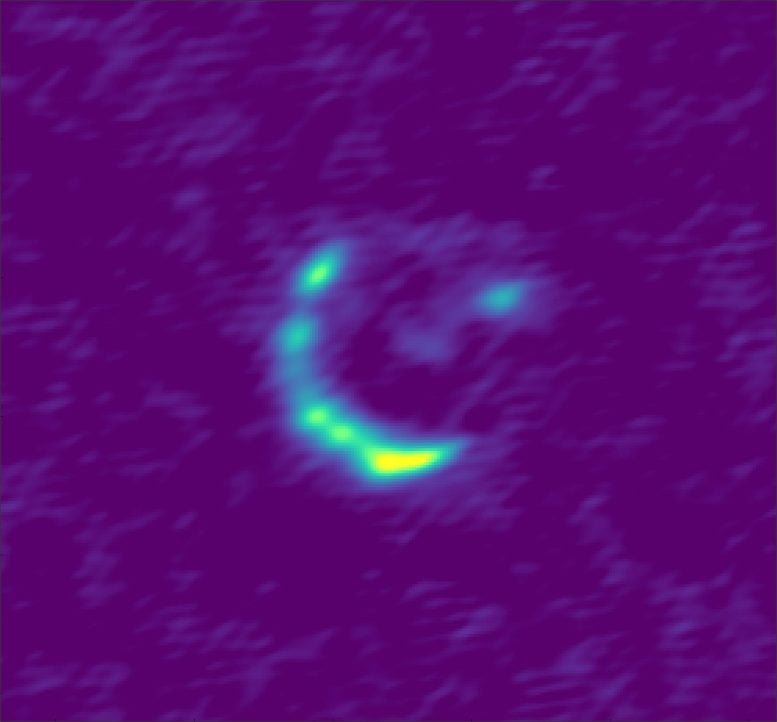
It was in one of these investigations, says Giulietti, that the main object of this current study was identified: “This was a very special celestial body. It is very bright and potentially subject to lensing, but this occurs only at certain precise wavelengths, probably due to the presence of large quantities of interstellar dust. Studying it is consequently very complex. Observations made with ALMA, a very modern sub-millimeter interferometer located in the Atacama desert of Chile, enabled us to determine its features. We studied this peculiar object by adopting particular codes that enabled us to reconstruct the original shape of the background source and also to understand certain properties of the lens itself. The observations also provided valuable information about the gas content of this source, and we were able to determine how it is distributed. Our analysis showed that this object is very compact, presumably young, and forming stars at an extremely high rate. In the future, the James Webb Space Telescope will reveal much more about this galaxy, something that only it can do at the moment.”
Prof. Lapi, co-author of the research, concludes by stressing the importance of this study: “Distant galaxies that are young, compact, characterized by vigorous star formation, and largely obscured by dust, and that possess a very rich reservoir of molecular gas, are forerunners of the massive quiescent galaxies that we see in the local Universe, and therefore provide very valuable insights into the processes leading to the formation and evolution of these structures during the history of the Cosmos.”
“I would like to emphasize” continues the professor “that the success of this research was achieved through synergy between the SISSA Astrophysics and Cosmology group and the ALMA Regional Centre based at the INAF – Institute of Radio Astronomy in Bologna (in particular through collaboration with Dr. Marcella Massardi, co-author of the study), which allowed our students to access, and learn how to use effectively, the ALMA data archive, a real gold mine for astrophysics research today.”
Reference: “ALMA Resolves the First Strongly Lensed Optical/Near-IR-dark Galaxy” by Marika Giulietti, Andrea Lapi, Marcella Massardi, Meriem Behiri, Martina Torsello, Quirino D’Amato, Tommaso Ronconi, Francesca Perrotta and Alessandro Bressan, 3 February 2023, The Astrophysical Journal.
DOI: 10.3847/1538-4357/aca53f
Never miss a breakthrough: Join the SciTechDaily newsletter.
Follow us on Google and Google News.
2 Comments
Excuse me, but Who was making MilkyWay lookalikes 12 Billion years ago?
More correctly, Milky Way is the lookalike of that ancient galaxy.
Most young galaxies are spiral like Milky Way because that’s what the laws of physics prefer.