
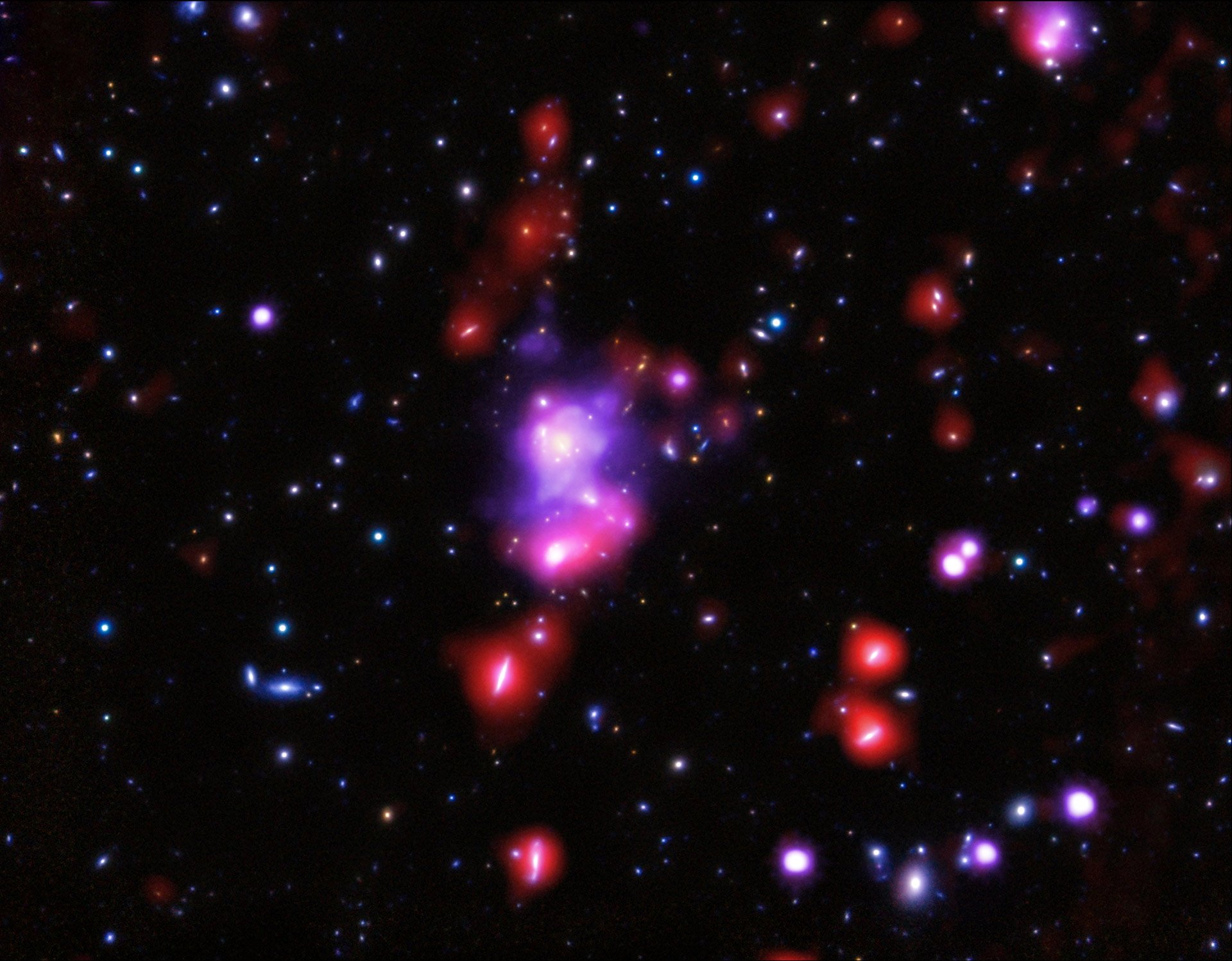
Using Chandra data, researchers were able to accurately determine the mass and other properties of the most distant massive galaxy cluster discovered to date. Officially named XDCP J0044.0-2033, the cluster is about 9.6 billion light-years from Earth.
A newly discovered galaxy cluster is the most massive one ever detected with an age of 800 million years or younger. Using data from NASA’s Chandra X-ray Observatory, astronomers have accurately determined the mass and other properties of this cluster. This is an important step in understanding how galaxy clusters, the largest structures in the Universe held together by gravity, have evolved over time.
A composite image shows the distant and massive galaxy cluster that is officially known as XDCP J0044.0-2033. Researchers, however, have nicknamed it “Gioiello”, which is Italian for “jewel”. They chose this name because an image of the cluster contains many sparkling colors from the hot, X-ray-emitting gas and various star-forming galaxies within the cluster. Also, the research team met to discuss the Chandra data for the first time at Villa il Gioiello, a 15th-century villa near the Observatory of Arcetri, which was the last residence of prominent Italian astronomer Galileo Galilei. In this new image of the Gioiello Cluster, X-rays from Chandra are purple, infrared data from ESA’s Hershel Space Telescope appear as large red halos around some galaxies, and optical data from the Subaru telescope on Mauna Kea in Hawaii are red, green, and blue.
Astronomers first detected the Gioiello Cluster, located about 9.6 billion light years away, using ESA’s XMM-Newton observatory. They were then approved to study the cluster with Chandra in observations that were equivalent to over four days of time. This is the deepest X-ray observation yet made on a cluster beyond a distance of about 8 billion light years.
The long observing time allowed the researchers to gather enough X-ray data from Chandra that, when combined with scientific models, provides an accurate weight of the cluster. They determined that the Gioiello Cluster contains a whopping 400 trillion times the mass of the Sun.
Previously, astronomers had found an enormous galaxy cluster, known as “El Gordo,” at a distance of 7 billion light years away and a few other large, distant clusters. According to the best current model for how the Universe evolved, there is a low chance of finding clusters as massive as the Gioiello Cluster and El Gordo. The new findings suggest that there might be problems with the theory, and are enticing astronomers to look for other distant and massive clusters.
These results are being published in The Astrophysical Journal. The first author is Paolo Tozzi, from the National Institute for Astrophysics (INAF) in Florence, Italy. The co-authors are Johana Santos, also from INAF in Florence, Italy;
James Jee from the University of California in Davis; Rene Fassbender from INAD in Rome, Italy; Piero Rosati from the University of Ferrara in Ferrara, Italy; Alessandro Nastasi from the University of Paris-Sud, in Orsay, France; William Forman from Harvard-Smithsonian Center for Astrophysics (CfA) in Cambridge; MA; Barbara Sartoris and Stefano Borgani from the University of Trieste in Trieste, Italy; Hans Boehringer from the Max Planck Institute for Astrophysics in Garching, Germany; Bruno Altieri from the European Space Agency in Madrid, Spain; Gabriel Pratt from CEA Saclay in Cedex, France; Mario Nonino from the University of Trieste in Trieste, Italy and Christine Jones from CfA.
Reference: “Chandra deep observation of XDCP J0044.0-2033, a massive galaxy cluster at z>1.5” by P. Tozzi, J. S. Santos, M. J. Jee, R. Fassbender, P. Rosati, A. Nastasi, W. Forman, B. Sartoris, S. Borgani, H. Boehringer, B. Altieri, G. W. Pratt, M. Nonino and C. Jones, 19 January 2015, The Astrophysical Journal.
DOI: 10.1088/0004-637X/799/1/93
NASA’s Marshall Space Flight Center in Huntsville, Alabama, manages the Chandra program for NASA’s Science Mission Directorate in Washington. The Smithsonian Astrophysical Observatory in Cambridge, Massachusetts, controls Chandra’s science and flight operations.
Never miss a breakthrough: Join the SciTechDaily newsletter.
Follow us on Google and Google News.
2 Comments
How can the Gioiello cluster be less than a billion years old yet be 9.6 billion light years away? Surely we would not be able to see it yet. Or, do they estimate the age as it was 9.6 billion years ago?
To an astronomer, “now” means now on Earth, our now, the now of when s/he sees whatever it is s/he’s looking at. So the paradox disappears. As we see it now, the cluster is less than a billion years old. If you had to add on the transit time of the light we see it by, the whole business would soon turn into a dog’s breakfast. In other words, it’s a useful convention.