
Close Menu
    Facebook X (Twitter) Instagram
    SciTechDaily
    • Biology
    • Chemistry
    • Earth
    • Health
    • Physics
    • Science
    • Space
    • Technology
    Facebook X (Twitter) Pinterest YouTube RSS
    SciTechDaily
    Home»Space»Astronomers Detect X-rays From the Remains of Supernova SN 1957D
    Space

    Astronomers Detect X-rays From the Remains of Supernova SN 1957D

    By Chandra X-ray ObservatoryJuly 31, 2012No Comments5 Mins Read
    Facebook Twitter Pinterest Telegram LinkedIn WhatsApp Email Reddit
    Share
    Facebook Twitter LinkedIn Pinterest Telegram Email Reddit
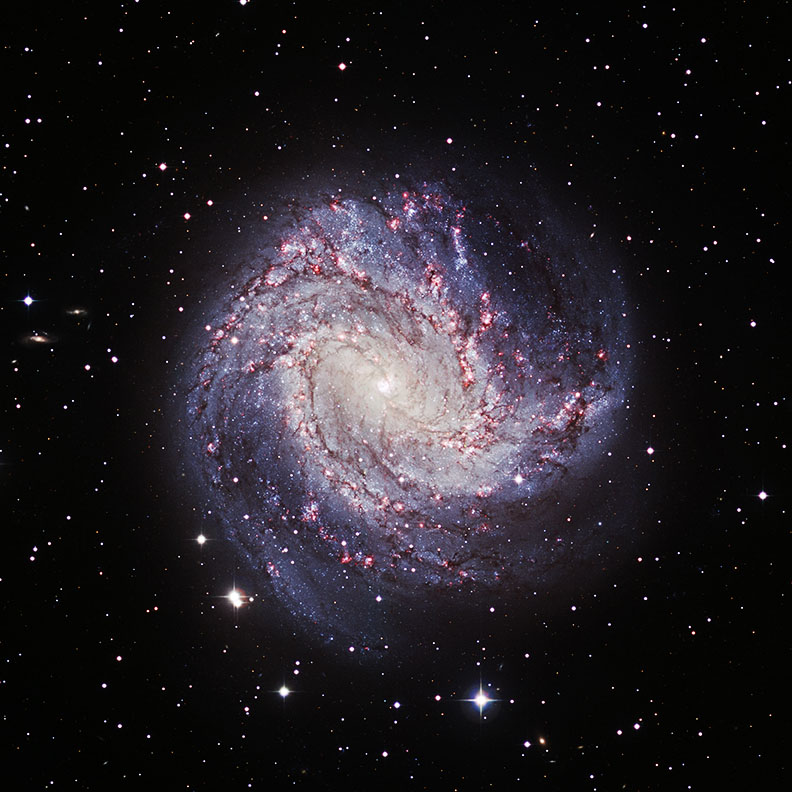
    spiral galaxy M83
    M83 is a spiral galaxy 15 million light years from Earth in the constellation Hydra. This optical image of M83 from the Very Large Telescope in Chile, operated by the European Southern Observatory. Credit: Optical: ESO/VLT

    After 8 and a half days of observations of the spiral galaxy M83, astronomers using NASA’s Chandra X-ray Observatory detected X-rays from the remains of supernova SN 1957D that was first seen from Earth over 50 years ago.

    Over fifty years ago, a supernova was discovered in M83, a spiral galaxy about 15 million light-years from Earth. Astronomers have used NASA’s Chandra X-ray Observatory to make the first detection of X-rays emitted by the debris from this explosion.

    Named SN 1957D because it was the fourth supernova to be discovered in the year of 1957, it is one of only a few located outside of the Milky Way galaxy that is detectable, in both radio and optical wavelengths, decades after its explosion was observed. In 1981, astronomers saw the remnant of the exploded star in radio waves, and then in 1987 they detected the remnant at optical wavelengths, years after the light from the explosion itself became undetectable.

    A relatively short observation — about 14 hours long — from NASA’s Chandra X-ray Observatory in 2000 and 2001 did not detect any X-rays from the remnant of SN 1957D. However, a much longer observation obtained in 2010 and 2011, totaling nearly 8 and 1/2 days of Chandra time, did reveal the presence of X-ray emission. The X-ray brightness in 2000 and 2001 was about the same as or lower than in this deep image.
    X-Rays Discovered from Young Supernova Remnant
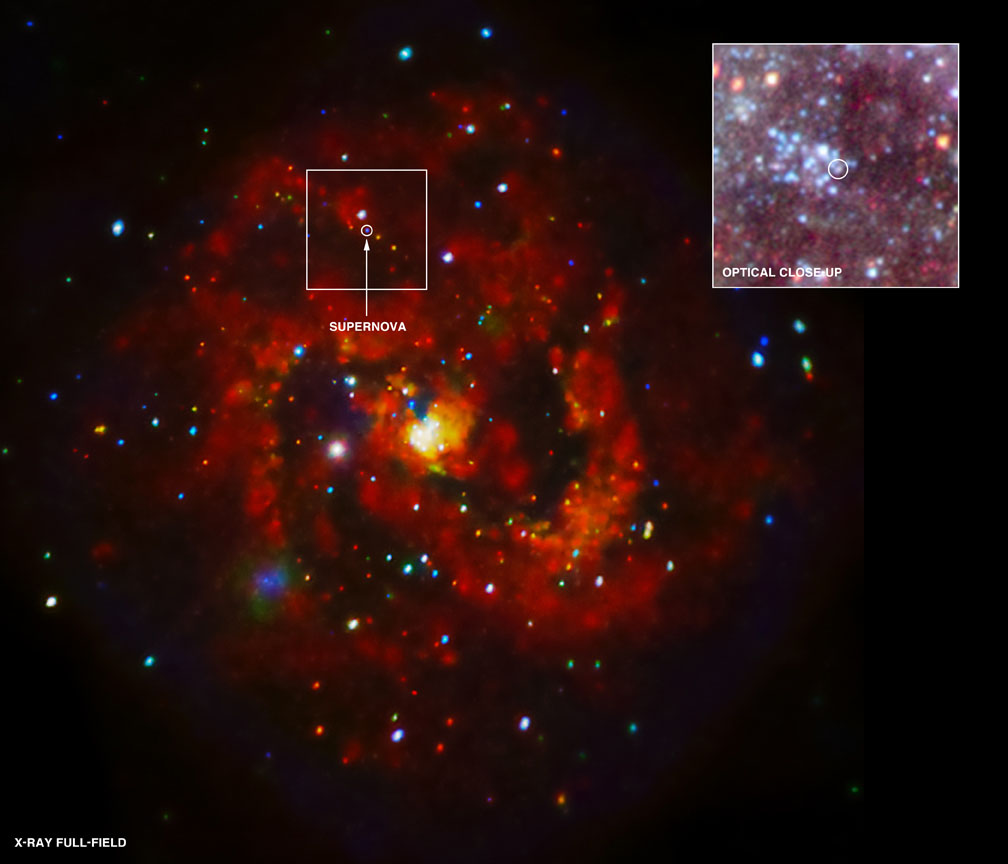
    Using Chandra, astronomers have detected X-rays from the remains of a supernova that was spotted from Earth over 50 years ago. The full-field image shows Chandra’s view of M83 during a long observation where low, medium, and high-energy X-rays are red, green, and blue respectively. This is the first time the remains of SN 1957D have been detected in X-rays. Chandra’s new X-ray data provide important information about the nature of this explosion that astronomers think happened when a massive star ran out of fuel and collapsed. Credit: X-ray: NASA/CXC/STScI/K.Long et al.

    This new Chandra image of M83 is one of the deepest X-ray observations ever made of a spiral galaxy beyond our own. This full-field view of the spiral galaxy shows the low, medium, and high-energy X-rays observed by Chandra in red, green, and blue respectively. The location of SN 1957D, which is found on the inner edge of the spiral arm just above the galaxy’s center, is outlined in the box.

    The new X-ray data from the remnant of SN 1957D provide important information about the nature of this explosion that astronomers think happened when a massive star ran out of fuel and collapsed. The distribution of X-rays with energy suggests that SN 1957D contains a neutron star, a rapidly spinning, dense star formed when the core of pre-supernova star collapsed. This neutron star, or pulsar, may be producing a cocoon of charged particles moving at close to the speed of light known as a pulsar wind nebula.

    If this interpretation is confirmed, the pulsar in SN 1957D is observed at the age of 55 years, one of the youngest pulsars ever seen. The remnant of SN 1979C in the galaxy M100 contains another candidate for the youngest pulsar, but astronomers are still unsure whether there is a black hole or a pulsar at the center of SN 1979C.
    area around SN 1957D in M83
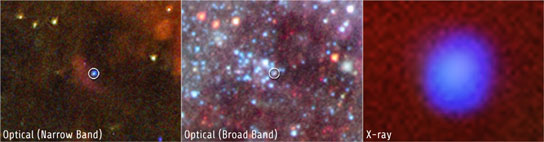
    This set of images from the Hubble Space Telescope shows optical and H-alpha images of the area around SN 1957D in M83. The optical images, shown at two different zooms, includes one filter at ultraviolet wavelengths and two different filters at optical wavelengths, colored blue, green and red. The H-alpha images show light emitted by hydrogen in red, sulfur in green and oxygen in blue. In each case SN 1957D is located in the middle of the image. In the optical images the star cluster containing the supernova is visible and in the H-alpha images the remains of the supernova are visible. The multipanel shows the optical and H-alpha images next to the Chandra image. Credit: Optical: NASA/STScI

    An image from the Hubble Space Telescope shows that the debris of the explosion that created SN 1957D is located at the edge of a star cluster less than 10 million years old. Many of these stars are estimated to have masses about 17 times that of the Sun. This is just the right mass for a star’s evolution to result in a core-collapse supernova as is thought to be the case in SN 1957D.

    Reference: “Recovery of the Historical SN1957D in X-Rays With Chandra” by Knox S. Long, William P. Blair, L. E. H. Godfrey, K. D. Kuntz, Paul P. Plucinsky, Roberto Soria, Christopher J. Stockdale, Bradley C. Whitmore and P. Frank Winkler, 9 August 2012, The Astrophysical Journal.
    DOI: 10.1088/0004-637X/756/1/18

    These results will appear in an upcoming issue of The Astrophysical Journal. The researchers involved with this study were Knox Long (Space Telescope Science Institute), William Blair (Johns Hopkins University), Leith Godfrey (Curtain University, Australia), Kip Kuntz (Johns Hopkins), Paul Plucinsky (Harvard-Smithsonian Center for Astrophysics), Roberto Soria (Curtain University), Christopher Stockdale (University of Oklahoma and the Australian Astronomical Observatory), Bradley Whitmore (Space Telescope Science Institute), and Frank Winkler (Middlebury College).

    NASA’s Marshall Space Flight Center in Huntsville, Alabama, manages the Chandra program for NASA’s Science Mission Directorate in Washington. The Smithsonian Astrophysical Observatory controls Chandra’s science and flight operations from Cambridge, Massachusetts.

    Never miss a breakthrough: Join the SciTechDaily newsletter.
    Follow us on Google and Google News.

    Astronomy Astrophysics Chandra X-ray Observatory Galaxy Popular Supernova
    Share. Facebook Twitter Pinterest LinkedIn Email Reddit

    Related Articles

    Breaking the Cosmic Code: NASA Telescopes Start the Year With a Double Bang

    Stellar Assassins: NASA’s Chandra Unmasks New Cosmic Threat to Planetary Life

    Mysterious Kilonova Explosion Afterglow Potentially Spotted for First Time

    A Cosmic Powder Keg: When a Stable Star Explodes

    Astronomers Capture Cosmic Hand Hitting a Wall – Watch Blast Wave Moving at 9 Million MPH

    How Do the Most Massive Stars Explode? Bubbles With Titanium Trigger Titanic Explosions

    Reclusive Neutron Star May Have Been Found in Famous Supernova SN 1987A

    Chandra Measures Massive Galaxy Cluster in Distant Universe

    Swift Reveals Before and After Images of Supernova SN 2014J

    Leave A Reply Cancel Reply

    • Facebook
    • Twitter
    • Pinterest
    • YouTube

    Don't Miss a Discovery

    Subscribe for the Latest in Science & Tech!

    Trending News

    Researchers Have Found a Dietary Compound That Increases Longevity

    Scientists Baffled by Bizarre “Living Fossil” From 275 Million Years Ago

    Your IQ at 23 Could Predict Your Wealth at 27, Study Finds

    320 Light-Years Away, a Planet Confirms a Fundamental Cosmic Assumption

    The Crown Jewel of Dentistry? Breakthrough Tech Could Transform Tooth Repair

    Python Blood Could Hold the Secret to Weight Loss Without Side Effects

    Naturally Occurring Bacteria Completely Eradicate Tumors in Mice With a Single Dose

    New “Nanozyme Hypothesis” Could Rewrite the Story of Life’s Origins

    Follow SciTechDaily
    • Facebook
    • Twitter
    • YouTube
    • Pinterest
    • Newsletter
    • RSS
    SciTech News
    • Biology News
    • Chemistry News
    • Earth News
    • Health News
    • Physics News
    • Science News
    • Space News
    • Technology News
    Recent Posts
    • 34-Million-Year-Old Snake Found in Wyoming Rewrites Our Understanding of Evolution
    • Prehistoric “Vomit Fossil” Reveals Never-Before-Seen Flying Reptile
    • Scientists Discover Bizarre Crocodile Relative That Walked on Two Legs
    • How Quantum Mechanics Went From Baffling Theory to Revolutionizing Modern Technology
    • Scientists May Have Found the Key to Jupiter and Saturn’s Moon Mystery
    Copyright © 1998 - 2026 SciTechDaily. All Rights Reserved.
    • Science News
    • About
    • Contact
    • Editorial Board
    • Privacy Policy
    • Terms of Use

    Type above and press Enter to search. Press Esc to cancel.