
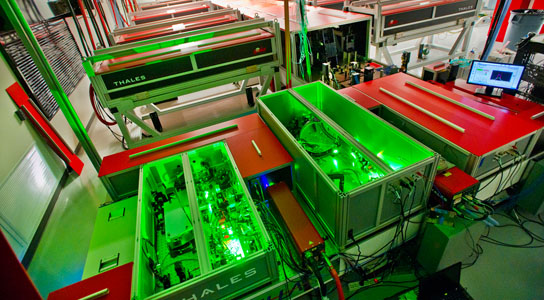
Nearing completion, the laser system of the Berkeley Lab Laser Accelerator delivered something that no other laser system has achieved, a petawatt of power in a pulse just 40 femtoseconds long at a pulse rate of one hertz.
On the night of July 20, 2012, the laser system of the Berkeley Lab Laser Accelerator (BELLA), which is nearing completion at the U.S. Department of Energy’s Lawrence Berkeley National Laboratory (Berkeley Lab), delivered a petawatt of power in a pulse just 40 femtoseconds long at a pulse rate of one hertz – one pulse every second. A petawatt is 1015 watts, a quadrillion watts, and a femtosecond is 10-15 second, a quadrillionth of a second. No other laser system has achieved this peak power at this rapid pulse rate.
“This represents a new world record,” said Wim Leemans of Berkeley Lab’s Accelerator and Fusion Research Division (AFRD) when announcing the late-night success to his team. Leemans heads AFRD’s Lasers and Optical Accelerator Systems Integrated Studies program (LOASIS) and conceived BELLA in 2006.
“My congratulations to the BELLA team for this early mark of success,” said Berkeley Lab Director Paul Alivisatos. “This is encouraging progress toward a future generation of smaller and far more efficient accelerators to maintain our nation’s leadership in the tools of basic science.”
“Congratulations to all of you on this spectacular achievement,” said Stephen Gourlay, Director of AFRD. “It doesn’t seem that long ago that BELLA was just a dream, and now there is even more to look forward to. Thank you all for the hard work and support that made this a reality.”
Leemans says, “BELLA will be an exceptional tool for advancing the physics of laser and matter interactions. The laser’s peak power will give us access to new regimes, such as developing compact particle accelerators for high-energy physics, and tabletop free electron lasers for investigating materials and biological systems. As we investigate these new regimes, the laser’s repetition rate of one pulse per second will allow us to do ‘science with error bars’ – repeated experiments within a reasonable time.”
The BELLA design draws on years of laser plasma accelerator research conducted by LOASIS. Unlike conventional accelerators that use modulated electric fields to accelerate charged particles such as protons and electrons, laser plasma accelerators generate waves of electron density that move through a plasma, using laser beams to either heat and drill through a plume of gas or drive through plasma enclosed in a thin capillary in a crystalline block like sapphire. The waves trap some of the plasma’s free electrons and accelerate them to very high energies within very short lengths, as if the accelerated electrons were surfing on the near-light-speed wave.
LOASIS reported its first high-quality electron beams of 100 million electron volts (100 MeV) in 2004 and the first beams of a billion electron volts (1 GeV) in 2006 – in a sapphire block just 3.3 centimeters (1.3 inches) long. Planning for BELLA began shortly thereafter.
The BELLA laser is expected to drive what will be the first laser plasma accelerator to produce a beam of electrons with an energy of 10 billion electron volts (10 GeV). Before being converted to other uses, the Stanford Linear Accelerator Center achieved 50‑GeV electron beams with traditional technology, but required a linear accelerator two miles long to do it. By contrast, the BELLA accelerator is just one meter long, supported by its laser system in an adjacent room.
“LOASIS know-how in assembling our own laser systems allowed us to specify the laser requirements and specifications we’d need to achieve reliable, stable, tunable 10‑GeV beams with short warm-up time,” Leemans says. “U.S. Secretary of Energy Steven Chu said that new tools lead to new science, the kind BELLA is specifically designed to do. ”
The BELLA laser system has already demonstrated compressed output energy of 42.4 joules in about 40 femtoseconds at 1 Hz. Its initial peak power of one petawatt is twice that of lasers recently said to produce pulses more powerful than that consumed by the entire U.S. “at any instant in time.” “Instant” is the operative word, since the BELLA laser’s average power is just 42.4 watts, about what a typical household light bulb uses. The enormous peak power results from compressing that modest average power into an extremely short pulse.
Developed by Thales of France, whose team at Berkeley Lab was led by Francois Lureau, and installed in facilities constructed at Berkeley Lab, the BELLA laser system is fully integrated with Berkeley Lab equipment and personnel protection systems. It is expected to rapidly improve upon its first record-breaking performance and will soon be able to deliver the powerful pulses needed to create 10-billion-electron-volt electron beams in an accelerator just one meter long. Experiments to demonstrate BELLA’s ability to attain 10-GeV beams will begin this fall.
Never miss a breakthrough: Join the SciTechDaily newsletter.
Follow us on Google and Google News.