
Close Menu
    Facebook X (Twitter) Instagram
    SciTechDaily
    • Biology
    • Chemistry
    • Earth
    • Health
    • Physics
    • Science
    • Space
    • Technology
    Facebook X (Twitter) Pinterest YouTube RSS
    SciTechDaily
    Home»Space»Artificial Intelligence Identifies 80,000 Spiral Galaxies – Promises More Astronomical Discoveries in the Future
    Space

    Artificial Intelligence Identifies 80,000 Spiral Galaxies – Promises More Astronomical Discoveries in the Future

    By National Institutes of Natural SciencesAugust 25, 2020No Comments3 Mins Read
    Facebook Twitter Pinterest Telegram LinkedIn WhatsApp Email Reddit
    Share
    Facebook Twitter LinkedIn Pinterest Telegram Email Reddit
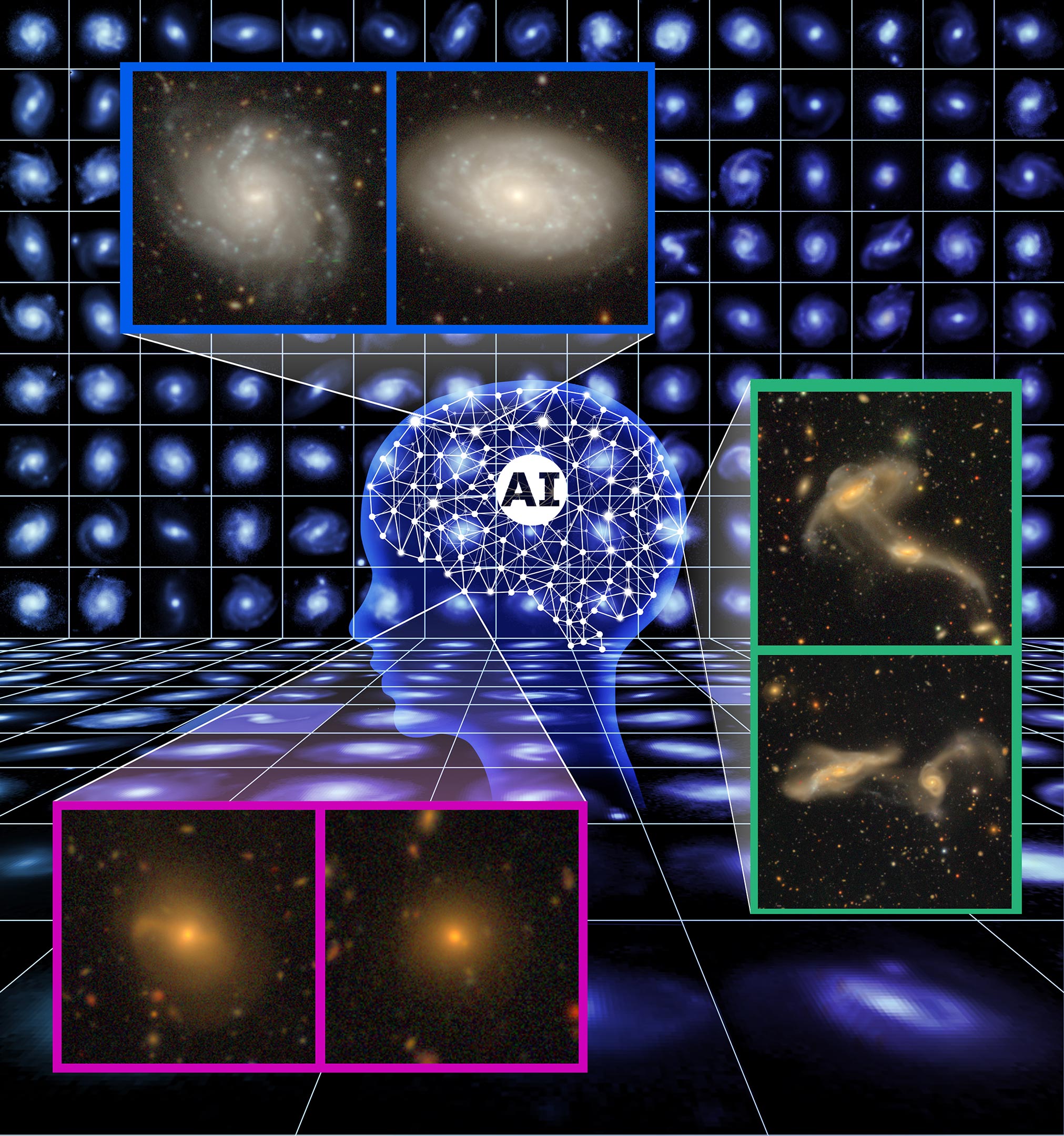
    Artificial Intelligence Classifies Galaxies
    Conceptual illustration of how artificial intelligence classifies various types of galaxies according to their morphologies. Credit: NAOJ/HSC-SSP

    Astronomers have applied artificial intelligence (AI) to ultra-wide field-of-view images of the distant Universe captured by the Subaru Telescope, and have achieved a very high accuracy for finding and classifying spiral galaxies in those images. This technique, in combination with citizen science, is expected to yield further discoveries in the future.

    A research group, consisting of astronomers mainly from the National Astronomical Observatory of Japan (NAOJ), applied a deep-learning technique, a type of AI, to classify galaxies in a large dataset of images obtained with the Subaru Telescope. Thanks to its high sensitivity, as many as 560,000 galaxies have been detected in the images. It would be extremely difficult to visually process this large number of galaxies one by one with human eyes for morphological classification. The AI enabled the team to perform the processing without human intervention.

    Automated processing techniques for extraction and judgment of features with deep-learning algorithms have been rapidly developed since 2012. Now they usually surpass humans in terms of accuracy and are used for autonomous vehicles, security cameras, and many other applications. Dr. Ken-ichi Tadaki, a Project Assistant Professor at NAOJ, came up with the idea that if AI can classify images of cats and dogs, it should be able to distinguish “galaxies with spiral patterns” from “galaxies without spiral patterns.” Indeed, using training data prepared by humans, the AI successfully classified the galaxy morphologies with an accuracy of 97.5%. Then applying the trained AI to the full data set, it identified spirals in about 80,000 galaxies.

    Now that this technique has been proven effective, it can be extended to classify galaxies into more detailed classes, by training the AI on the basis of a substantial number of galaxies classified by humans. NAOJ is now running a citizen-science project “GALAXY CRUISE,” where citizens examine galaxy images taken with the Subaru Telescope to search for features suggesting that the galaxy is colliding or merging with another galaxy. The advisor of “GALAXY CRUISE,” Associate Professor Masayuki Tanaka has high hopes for the study of galaxies using artificial intelligence and says, “The Subaru Strategic Program is serious Big Data containing an almost countless number of galaxies. Scientifically, it is very interesting to tackle such big data with a collaboration of citizen astronomers and machines. By employing deep-learning on top of the classifications made by citizen scientists in GALAXY CRUISE, chances are, we can find a great number of colliding and merging galaxies.”

    Reference: “Spin Parity of Spiral Galaxies II: A catalogue of 80k spiral galaxies using big data from the Subaru Hyper Suprime-Cam Survey and deep learning” by Ken-ichi Tadaki, Masanori Iye, Hideya Fukumoto, Masao Hayashi, Cristian E Rusu, Rhythm Shimakawa and Tomoka Tosaki, 2 July 202, Monthly Notices of the Royal Astronomical Society.
    DOI: 10.1093/mnras/staa1880

    Never miss a breakthrough: Join the SciTechDaily newsletter.
    Follow us on Google and Google News.

    Artificial Intelligence Astronomy Astrophysics National Astronomical Observatory of Japan National Institutes of Natural Sciences Popular Subaru Telescope
    Share. Facebook Twitter Pinterest LinkedIn Email Reddit

    Related Articles

    ‘Ammonite’: A Mysterious Deep Space Fossil That Could Rewrite Solar System History

    Peering Back 13 Billion Years: Dancing Galaxies Craft a Monster at the Dawn of the Universe

    Astronomers Use Artificial Intelligence to Reveal the Actual Shape of the Universe

    Next Target Asteroid for Hayabusa2 Photographed by Subaru Telescope

    Earth 16,000 MPH Faster, 2000 Light-Years Closer to Supermassive Black Hole in the Center of the Milky Way

    AI and Photonics Decipher the “Twinkle” of Stars to Make It Easier to Find “New Earths”

    Second Alignment Plane of Solar System Discovered After Accounting for Galactic Gravity

    Evolved Binary Star System Wolf-Rayet 112: Unraveling a Spiral Stream of Dusty Embers From a Massive Stellar Forge

    Surprisingly Recent Galaxy Discovered Using Machine Learning – May Be the Last Generation Galaxy in the Long Cosmic History

    Leave A Reply Cancel Reply

    • Facebook
    • Twitter
    • Pinterest
    • YouTube

    Don't Miss a Discovery

    Subscribe for the Latest in Science & Tech!

    Trending News

    Breakthrough Parkinson’s Drug Targets Disease at Its Genetic Roots

    Just 4 Weeks of Simple Diet Changes Reversed Signs of Aging in Older Adults

    Scientists May Have Finally Solved Why Humans Are Right-Handed

    NASA’s Hubble Accidentally Witnesses a Comet Shattering in Space

    Researchers Discover the Body’s Hidden “Off Switch” for Inflammation

    Scientists Discover Metformin Doesn’t Work the Way We Thought

    Tea or Coffee? Your Daily Choice Could Affect Osteoporosis Risk

    Vitamin C May Fight Cancer in a Surprising Way

    Follow SciTechDaily
    • Facebook
    • Twitter
    • YouTube
    • Pinterest
    • Newsletter
    • RSS
    SciTech News
    • Biology News
    • Chemistry News
    • Earth News
    • Health News
    • Physics News
    • Science News
    • Space News
    • Technology News
    Recent Posts
    • Scientists Stunned by Hybrid California Bees That Beat Deadly Mites
    • Scientists Discover Terrifying Giant Crocodile That Hunted Human Ancestors
    • Scientists Finally Think They Know Why T. rex Had Tiny Arms
    • Scientists Are Turning Ocean Trash Into Roads – and It’s Actually Working
    • This Alien Planet Has Rock Clouds That Vaporize Before Sunset
    Copyright © 1998 - 2026 SciTechDaily. All Rights Reserved.
    • Science News
    • About
    • Contact
    • Editorial Board
    • Privacy Policy
    • Terms of Use

    Type above and press Enter to search. Press Esc to cancel.