
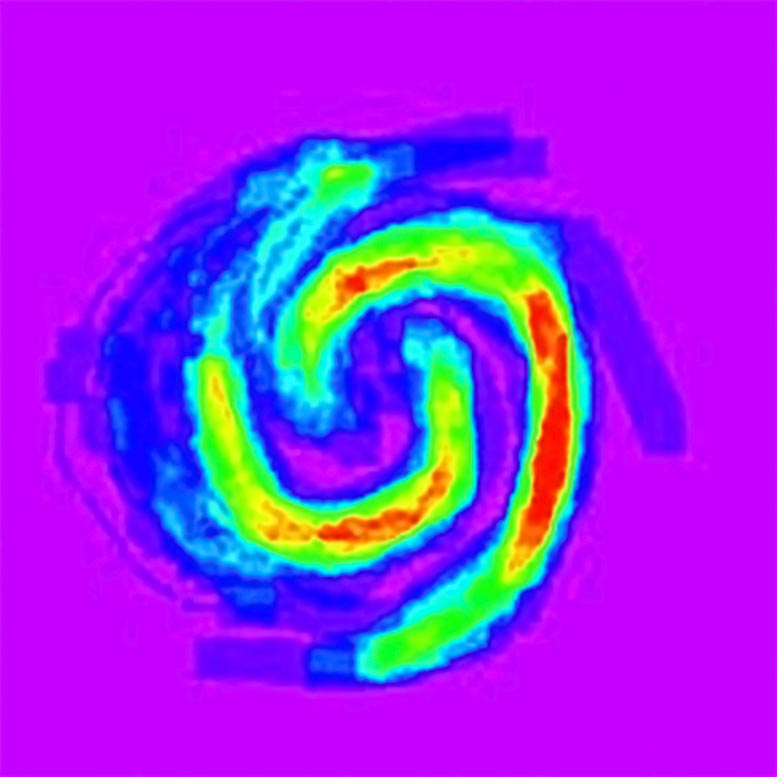
Spiral structure is seen in a variety of natural objects, ranging from plants and animals to tropical cyclones and galaxies. Now researchers at the North Carolina Museum of Natural Sciences have developed a technique to accurately measure the winding arms of spiral galaxies that is so easy, virtually anyone can participate. This new and simple method is currently being applied in a citizen science project, called Spiral Graph, that takes advantage of a person’s innate ability to recognize patterns, and ultimately could provide researchers with some insight into how galaxies evolve.
Spiral galaxies, like our own Milky Way, make up approximately 70 percent of the galaxies in the nearby Universe. In many of these galaxies the difference in brightness between the winding arms and the inter-arm regions is very subtle, making it challenging for automated methods to measure. Even bright foreground stars can skew the automated analysis of a galaxy. Additionally, patterns in spiral galaxies are easily seen and followed by people but computer algorithms have a harder time determining where spirals begin and end, especially if they aren’t continuous.
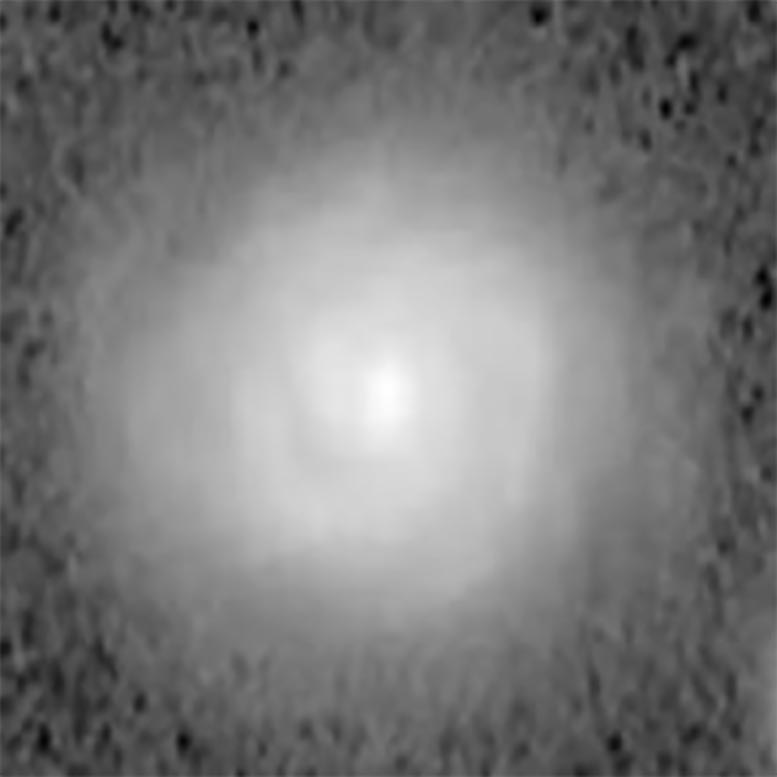
The Spiral Graph project takes advantage of a time-honored short cut common in art classes — tracing. Ian Hewitt, Research Adjunct at the NC Museum of Natural Sciences, and Patrick Treuthardt, Assistant Head of the Museum’s Astronomy & Astrophysics Research Lab, tested their tracing method on a set of simple model images of spiral galaxies with known windings. They then traced out the spiral structure and measured the winding of the tracings with their own specially designed software, P2DFFT. When they compared their results against other approaches that involved an artificial intelligence program, fitting observed structure with mathematical models, or even directly inputting images into their own measurement software, none produced results as precise and accurate as their tracing method. A paper detailing this comparison appeared online on March 9, 2020. Spiral Graph is available on the Zooniverse.org platform for citizen science projects.
“These human-generated tracings give our software a boost so it can accurately measure how tightly wrapped the structure is,” Treuthardt says. “The degree of wrapping of the spiral arms is called the pitch angle. If a spiral pattern has very tightly wrapped arms, it has a small pitch angle. If it the spiral pattern is very open, it has a large pitch angle.” Why is pitch angle important? Because it relates to other parameters of the host galaxy that are more difficult and time consuming to measure, such as the mass of the black hole found in the nucleus, or dark matter content of the galaxy. “If we know the pitch angle we can quickly and easily estimate these parameters and identify interesting galaxies for more detailed, follow-up telescope observations,” Treuthardt adds.
Hewitt’s work on this study, and the Spiral Graph citizen science project, is especially rewarding since he started out as a volunteer working with Treuthardt. Although a long-time amateur astronomer, Hewitt retired from a career in industry to pursue astronomy full time. He later completed a degree in astronomy and began teaching and working on programming projects in the Museum’s Astronomy & Astrophysics Research Lab. “It’s been really exciting to get a chance to participate in this kind of research, but even better to have a part in enabling others to contribute to the efforts to better understand our Universe,” says Hewitt. And with an estimated 6,000 galaxies in their study, enlisting citizen scientists is a must.
Reference: “Comparison of Galaxy Spiral Arm Pitch Angle Measurements Using Manual and Automated Techniques” by Ian Hewitt and Patrick Treuthardt, 9 March 2020, Monthly Notices of the Royal Astronomical Society.
DOI: 10.1093/mnras/staa354
The software used to measure spiral arm winding, P2DFFT, can be found at here.
Spiral Graph can be found at here.
Never miss a breakthrough: Join the SciTechDaily newsletter.
Follow us on Google and Google News.