
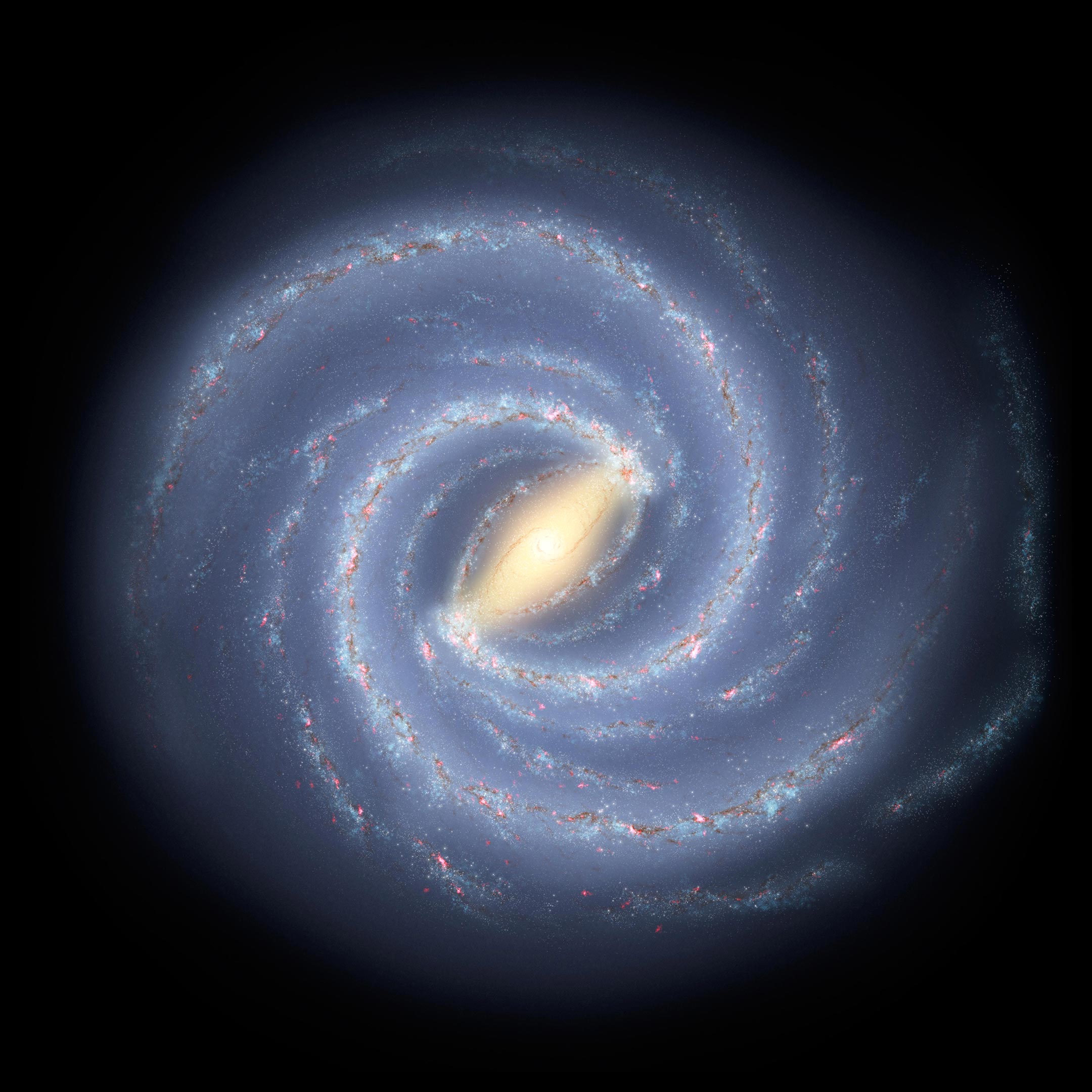
The newly discovered feature offers insight into the large-scale structure of our galaxy, which is difficult to study from Earth’s position inside it.
Scientists have spotted a previously unrecognized feature of our Milky Way galaxy: A contingent of young stars and star-forming gas clouds is sticking out of one of the Milky Way’s spiral arms like a splinter poking out from a plank of wood. Stretching some 3,000 light-years, this is the first major structure identified with an orientation so dramatically different than the arm’s.
Astronomers have a rough idea of the size and shape of the Milky Way’s arms, but much remains unknown: They can’t see the full structure of our home galaxy because Earth is inside it. It’s akin to standing in the middle of Times Square and trying to draw a map of the island of Manhattan. Could you measure distances precisely enough to know if two buildings were on the same block or a few streets apart? And how could you hope to see all the way to the tip of the island with so many things in your way?

To learn more, the authors of the new study focused on a nearby portion of one of the galaxy’s arms, called the Sagittarius Arm. Using NASA’s Spitzer Space Telescope prior to its retirement in January 2020, they sought out newborn stars, nestled in the gas and dust clouds (called nebulae) where they form. Spitzer detects infrared light that can penetrate those clouds, while visible light (the kind human eyes can see) is blocked.
Young stars and nebulae are thought to align closely with the shape of the arms they reside in. To get a 3D view of the arm segment, the scientists used the latest data release from the ESA (European Space Agency) Gaia mission to measure the precise distances to the stars. The combined data revealed that the long, thin structure associated with the Sagittarius Arm is made of young stars moving at nearly the same velocity and in the same direction through space.

“A key property of spiral arms is how tightly they wind around a galaxy,” said Michael Kuhn, an astrophysicist at Caltech and lead author of the new paper. This characteristic is measured by the arm’s pitch angle. A circle has a pitch angle of 0 degrees, and as the spiral becomes more open, the pitch angle increases. “Most models of the Milky Way suggest that the Sagittarius Arm forms a spiral that has a pitch angle of about 12 degrees, but the structure we examined really stands out at an angle of nearly 60 degrees.”
Similar structures – sometimes called spurs or feathers – are commonly found jutting off the arms of other spiral galaxies. For decades scientists have wondered whether our Milky Way’s spiral arms are also dotted with these structures or if they are relatively smooth.
Measuring the Milky Way
The newly discovered feature contains four nebulae known for their breathtaking beauty: the Eagle Nebula (which contains the Pillars of Creation), the Omega Nebula, the Trifid Nebula, and the Lagoon Nebula. In the 1950s, a team of astronomers made rough distance measurements to some of the stars in these nebulae and were able to infer the existence of the Sagittarius Arm. Their work provided some of the first evidence of our galaxy’s spiral structure.
“Distances are among the most difficult things to measure in astronomy,” said co-author Alberto Krone-Martins, an astrophysicist and lecturer in informatics at the University of California, Irvine and a member of the Gaia Data Processing and Analysis Consortium (DPAC). “It is only the recent, direct distance measurements from Gaia that make the geometry of this new structure so apparent.”
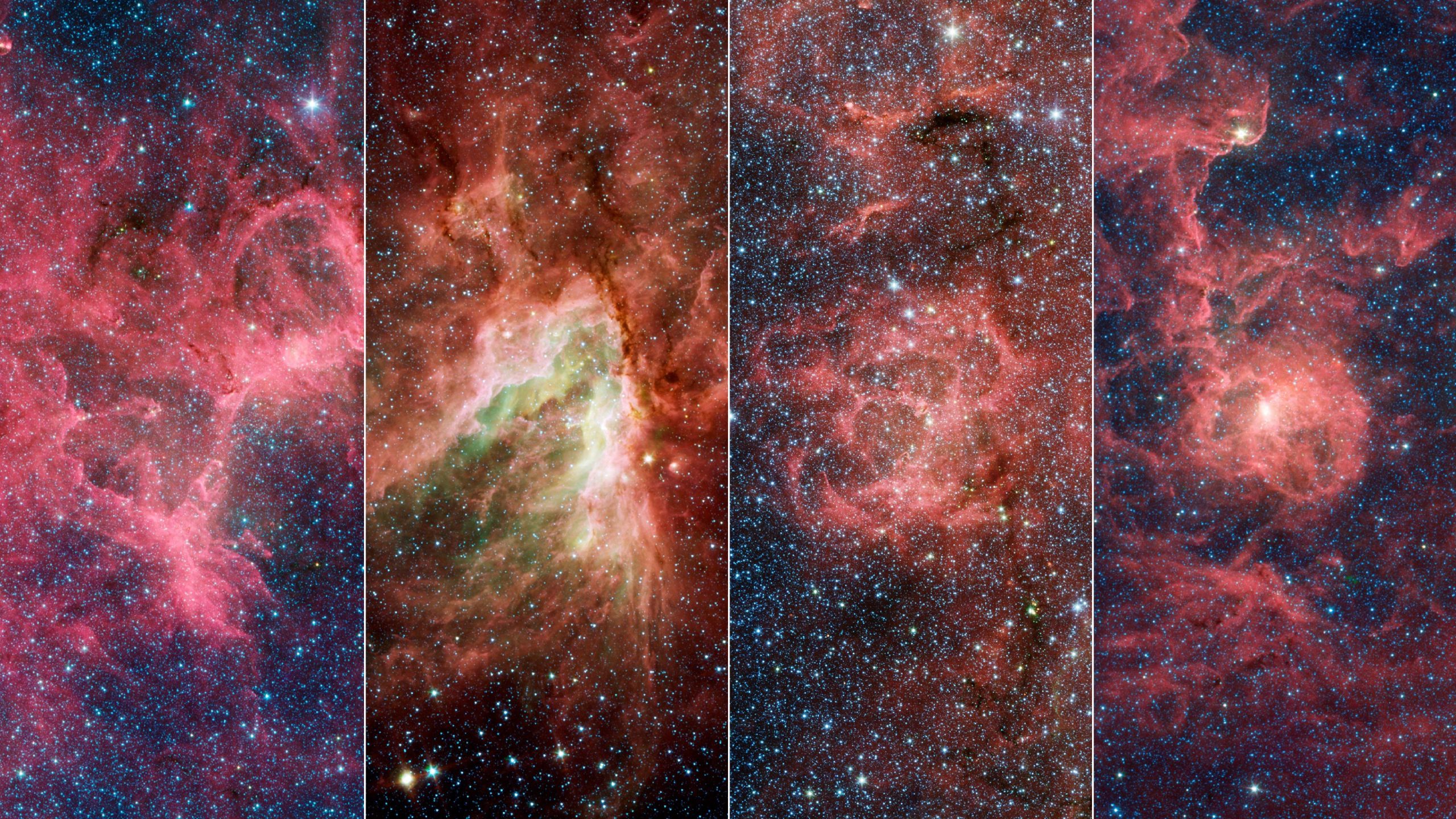
In the new study, researchers also relied on a catalog of more than a hundred thousand newborn stars discovered by Spitzer in a survey of the galaxy called the Galactic Legacy Infrared Mid-Plane Survey Extraordinaire (GLIMPSE).
“When we put the Gaia and Spitzer data together and finally see this detailed, three-dimensional map, we can see that there’s quite a bit of complexity in this region that just hasn’t been apparent before,” said Kuhn.
Astronomers don’t yet fully understand what causes spiral arms to form in galaxies like ours. Even though we can’t see the Milky Way’s full structure, the ability to measure the motion of individual stars is useful for understanding this phenomenon: The stars in the newly discovered structure likely formed around the same time, in the same general area, and were uniquely influenced by the forces acting within the galaxy, including gravity and shear due to the galaxy’s rotation.
“Ultimately, this is a reminder that there are many uncertainties about the large-scale structure of the Milky Way, and we need to look at the details if we want to understand that bigger picture,” said one of the paper’s co-authors, Robert Benjamin, an astrophysicist at the University of Wisconsin-Whitewater and a principal investigator on the GLIMPSE survey. “This structure is a small piece of the Milky Way, but it could tell us something significant about the Galaxy as a whole.”
Reference: “A high pitch angle structure in the Sagittarius Arm” by M. A. Kuhn1, R. A. Benjamin, C. Zucker, A. Krone-Martins, R. S. de Souza, A. Castro-Ginard, E. E. O. Ishida, M. S. Povich9 and L. A. Hillenbrand for the COIN Collaboration, 21 July 2021, Astronomy & Astrophysics.
DOI: 10.1051/0004-6361/202141198
Never miss a breakthrough: Join the SciTechDaily newsletter.
Follow us on Google and Google News.
10 Comments
🔴How Does Someone Become a Muslim?
Simply by saying with conviction, “La ilaha illa Allah, Muhammadur rasoolu Allah,” one converts to Islam and becomes a Muslim . This saying means “There is no true god (deity) but God (Allah),and Muhammad is the Messenger (Prophet) of God.” The first part, “There is no true god but God,” means that none has the right to be worshipped but God alone, and that God has neither partner nor son. To be a Muslim, one should also:
🔴 Believe that the Holy Quran is the literal word of God, revealed by Him.
🔵 Believe that the Day of Judgment (the Day of Resurrection) is true and will come, as God promised in the Quran.
🔴 Accept Islam as his or her religion.
🔵 Not worship anything nor anyone except God.
Cover your women and hide the goats.
another instance of “but my invisible guy is better and more right than your invisible man”….
Superstition – obviously irrelevant.
An answer to a question no one here asked.
Rape and murder, that’s what your “prophet” did!
Addressing the galactic structure issue: I wonder is this is not an artifact of a galactic collision. There are others scattered through the galaxy. It has apparently assimilated a number of smaller galaxies in its distant past.
I had also wondered about a local stellar nursery blowout that distorted adjacent bubbles.
From the paper:
” Several theoretical models have
been developed to explain the formation of spur-like structures in
gaseous galactic disks, including formation due to gravitational
instabilities and shear (Balbus 1988; Kim & Ostriker 2002) with
magnetohydrodynamical effects explored by Shetty & Ostriker
(2006), formation due to hydrodynamics in spiral shocks
(Wada & Koda 2004; Dobbs et al. 2006), or expanding superbubbles (Kim et al. 2020). In the gravitational instability models,
mass condensations form within the spiral arms, which are then
sheared into the inter-arm regions to form spurs. In these models,
even within the arm, the mass condensations are elongated with
high pitch angles and lengths of ∼1 kpc. Thus, it is plausible that
the feature we examined here corresponds to one of these mass
concentrations within the Sagittarius Arm.”
How does the milky way become an excuse to ask stupid questions that belong on a different platform. Space the final frontier and we have idiotic questions. Really