
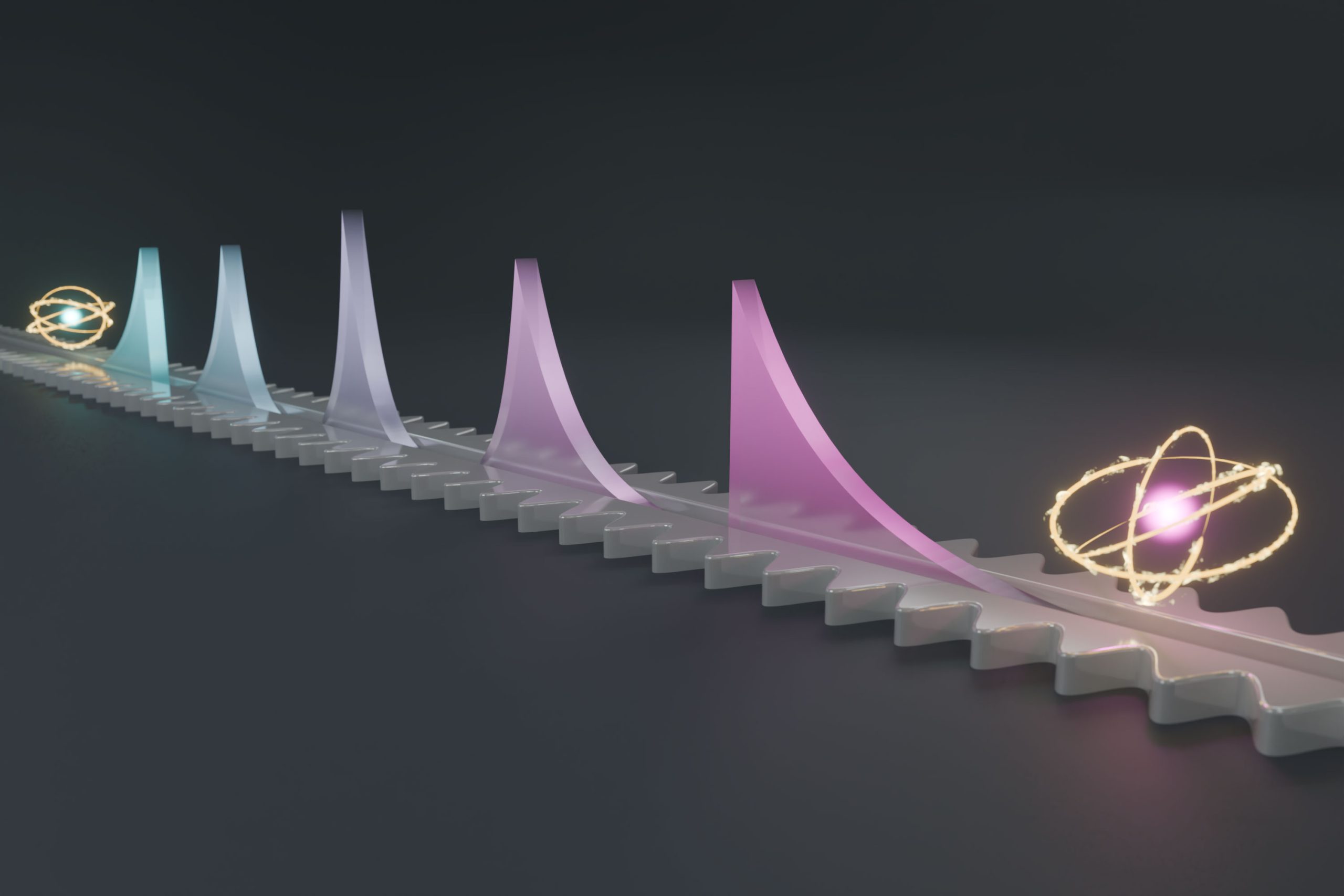
Scientists have proposed a surprisingly simple way to improve photon absorption using specially engineered waveguides, potentially making future quantum technologies far more efficient.
Quantum technologies depend on a process that remains surprisingly unreliable: transferring a single photon between two quantum bits, or qubits. With conventional methods, the receiving qubit successfully absorbs the photon only about 54 percent of the time. This inefficiency creates a major obstacle for quantum computers, secure quantum communication, and future quantum networks.
Researchers at TU Wien have proposed a way to overcome this limitation by changing the shape of a photon’s wave as it travels between qubits. Their calculations and computer simulations suggest that the method could achieve 100 percent absorption under ideal conditions.
Why the Shape of a Photon Matters
Two qubits (two atoms, for example) can exchange quantum information when one emits a photon and the other absorbs it. But photons do not behave simply like tiny particles moving between two points. Their wave properties determine how efficiently they can be transferred.
“When a qubit emits a photon, you must not picture the photon as a tiny particle that is simply shot out,” says Dr. Zeyu Kuang from the Institute of Theoretical Physics at TU Wien. “The photon is a wave, and a wave has a certain shape and a certain extension.”
The researchers compare photon emission to striking a bell. The sound begins strongly and gradually fades, much like the wave emitted by a qubit. Unfortunately, this waveform is poorly suited to absorption by another qubit. A pulse that gradually increases in strength before reaching its peak would work much better.
Reversing a Photon’s Waveform
The solution relies on time-reversal symmetry, a fundamental principle of quantum mechanics. Under ideal conditions, a quantum process can run in reverse, meaning a photon emitted with a particular waveform can be perfectly absorbed if that waveform is reversed in time.
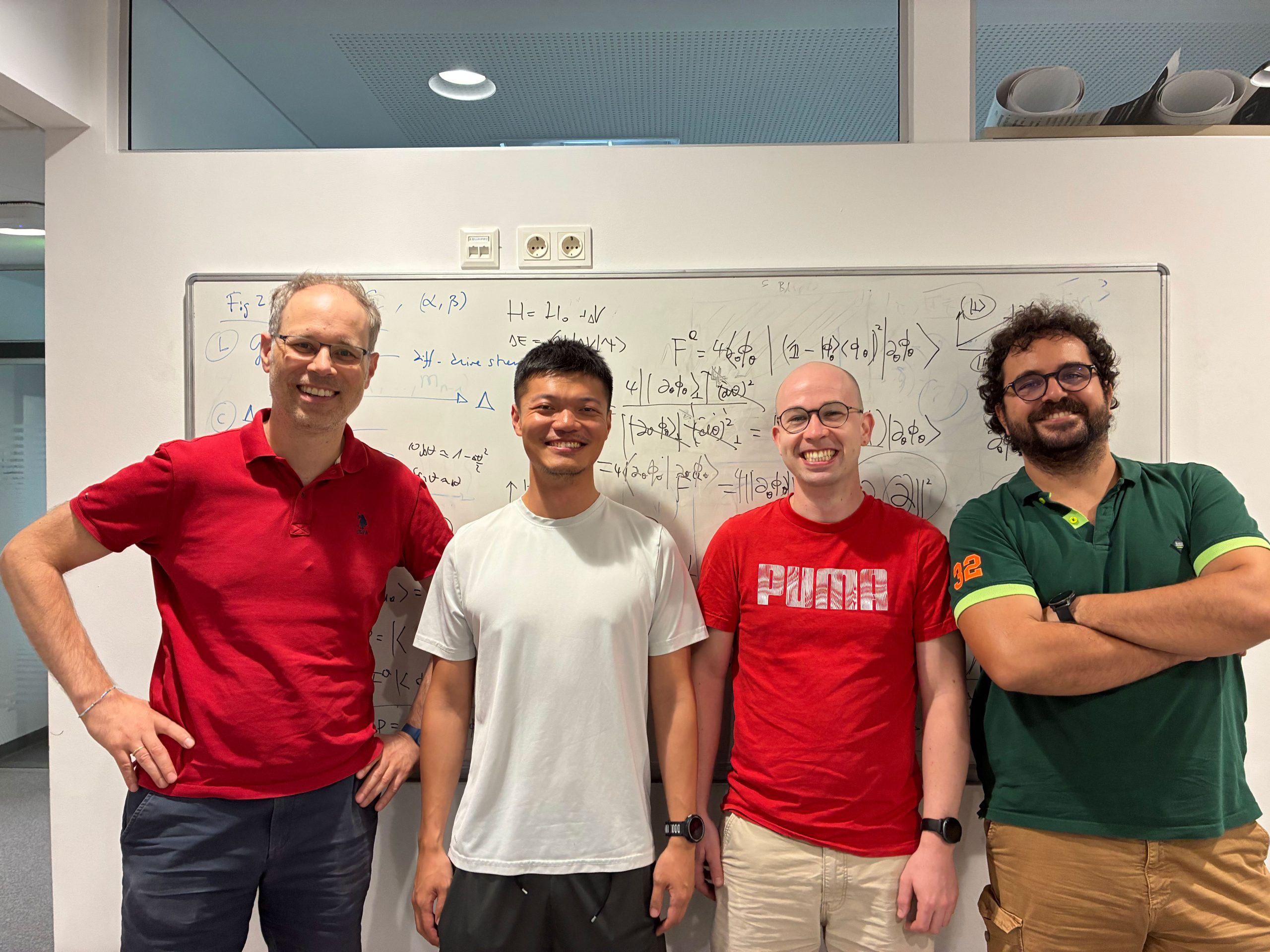
“This follows from time-reversal symmetry in quantum mechanics,” Oliver Diekmann explains. “Under ideal conditions, quantum dynamics are reversible. If a qubit perfectly emits a photon with a particular waveform, the time-reversed process tells us which waveform that qubit can absorb perfectly.”
To achieve this reversal, the researchers propose using a specially engineered optical waveguide. Unlike light traveling through a vacuum, different frequency components of light inside a waveguide can move at different speeds. This behavior, known as dispersion, can be controlled to reshape the photon pulse during transmission.
A Potential Breakthrough for Quantum Communication
By adjusting the waveguide’s dispersion, the team calculated that an emitted photon could arrive at the receiving qubit with precisely the waveform needed for optimal absorption. Under ideal conditions, the theoretical success rate could reach 100 percent.
“We calculated how this goal can be achieved and simulated the process on a computer,” says Prof. Carlos Gonzalez-Ballestero. “Our results indicate that the required setup should be technically feasible. This passive approach could significantly improve the absorption of photons by qubits and thereby increase the efficiency of many quantum technologies.”
Although the approach has not yet been demonstrated experimentally, the simulations suggest that carefully designed waveguides could make photon transfer substantially more reliable, potentially improving the performance of future quantum computers and communication networks.
Reference: “Passive Quantum State Transfer in a Dispersion-Engineered Waveguide” by Zeyu Kuang, Oliver Diekmann, Lorenz Fischer, Stefan Rotter and Carlos Gonzalez-Ballestero, 4 September 2026, Physical Review Letters.
DOI: 10.1103/m2md-rxkv
Never miss a breakthrough: Join the SciTechDaily newsletter.
Follow us on Google and Google News.
3 Comments
From 54% to 100%: Scientists Reveal a Potential Breakthrough in Quantum Technology.
VERY GOOD.
Ask the Scientists:
What ate the Quantum Technology?
What are the Quantum?
Is quantum a cat that is both dead and alive?
If we don’t use decimal and divide the circumference of a circle by its diameter to define 1, what should be the value of π?
How are numbers and geometry related?