
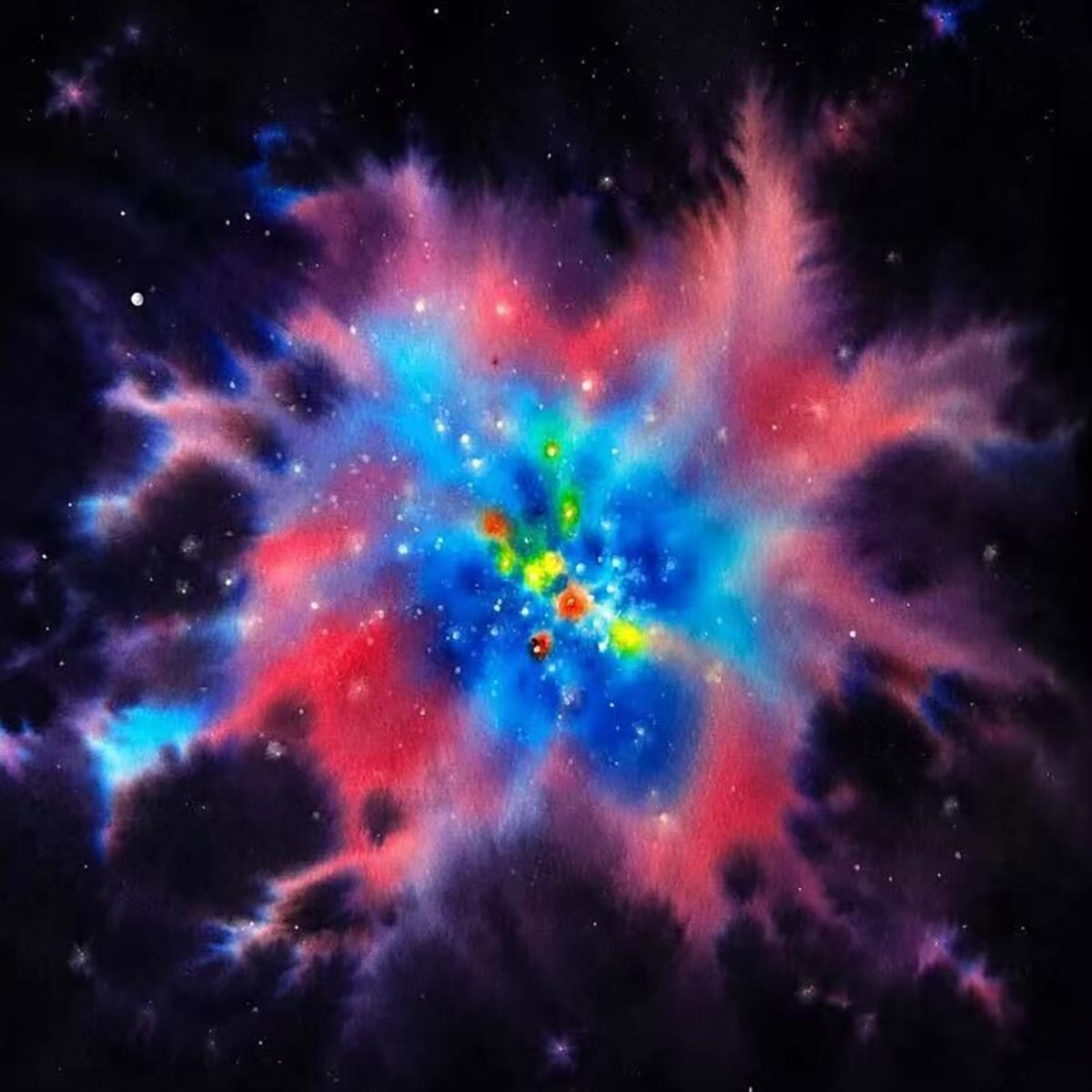
Hubble observations of nearby starburst galaxies challenge the idea that supernova winds helped reionize the early universe, suggesting young stars may have enabled radiation to escape before those winds formed.
Powerful winds from exploding stars were thought to clear paths for ultraviolet radiation to escape early galaxies. A new study of nearby galaxies suggests those winds may instead make escape more difficult, challenging a leading explanation for how the universe emerged from a fog of neutral hydrogen.
Within the first billion years after the Big Bang, that fog made the universe opaque to ultraviolet light. It began to clear during an era called reionization, which started about 13 billion years ago. Energetic radiation from early galaxies struck neutral hydrogen atoms, separating them into charged protons and electrons.
“Eventually, when it ionized the majority of hydrogen filling intergalactic space, that was the end of reionization and we see the universe today,” said Cody Carr, a postdoctoral researcher in the Department of Astronomy at the University of Michigan. “We call reionization the last major phase transition of the universe.”
For radiation to transform the gas between galaxies, it first had to get out of the galaxies that produced it. Astronomers proposed that supernovae, or large exploding stars, helped by generating winds powerful enough to reshape galaxies and clear routes through the surrounding gas.
“Basically, how these galaxies were leaking ionizing radiation isn’t what we thought,” Carr said.
Faster winds, less escaping radiation
Carr led and carried out the study as a postdoctoral scholar at Zhejiang University in China before joining Michigan. The international team, which includes University of Michigan researchers, used the Hubble Space Telescope to observe nearby starburst galaxies, where stars form at exceptionally high rates. These galaxies resemble some of those thought to have helped reionize the early universe, giving researchers a way to investigate how radiation escapes.
The team analyzed the galaxies’ spectra, which separate their light into different wavelengths, to measure the speeds of their galactic winds. Gas moving in those winds absorbs light at specific wavelengths, leaving dips whose positions and widths reveal how the gas is moving. Galaxies with the fastest winds allowed the smallest fraction of ionizing radiation to escape.
“It appears that energy input from supernovae has stirred up the surroundings and increased, rather than decreased, the coverage of neutral gas and dust that suppresses ionizing radiation escape,” said Stephan McCandliss, a senior author of the study and director of the Center for Astrophysical Sciences at Johns Hopkins University.
Young stars may help radiation escape
The findings, published in Nature Astronomy, strengthen an alternative explanation centered on activity from young stars. Radiation and smaller winds operating in the neighborhoods of these stars could help light escape.
“Our observations show that these photons are escaping before galactic winds form,” Carr said.
The researchers are working to secure more Hubble observing time to examine additional galaxies and further test the role of these smaller winds. Hubble is a NASA mission launched with contributions from the European Space Agency. The telescope also supported the study through a grant administered by the Space Telescope Science Institute.
Connecting the behavior of nearby galaxies to the universe’s early transformation remains an unfinished task. “We don’t know exactly what objects caused reionization or how it evolved,” Carr said. “We know that it took place, but we don’t have complete answers to those questions.”
The observations can already inform computer simulations that astronomers use to investigate reionization, particularly how stellar activity changes the gas through which radiation must travel.
“Supernovae play a central role in cosmological hydrodynamic simulations that explain how ionizing radiation escapes from galaxies,” said Renyue Cen, a senior author of the study and professor and director of the Center for Cosmology and Computational Astrophysics at Zhejiang University. “Our findings highlight the need to examine how radiation and winds from young stars shape the surrounding gas before the first supernovae explode.”
Reference: “Lyman continuum escape during the onset of galactic winds in compact starbursts” by Cody Carr, Renyue Cen, Stephan McCandliss, Jack Ford, Alberto Saldana-Lopez, Claudia Scarlata, Mason S. Huberty, Anne Jaskot, Sophia Flury, M. S. Oey, Ricardo O. Amorín, Sanchayeeta Borthakur, Matthew Haye, Timothy Heckman, Zhiyuan Ji, Lena Komarova, Alexandra Le Reste, Floriane Leclercq, Rui Marques-Chaves, Leo Michel-Dansac, Göran Östlin, Swara Ravindranath, Michael J. Rutkowski, Daniel Schaerer, Trinh Thuan, Eros Vanzella, Bingjie Wang and Xinfeng Xu, 15 October 2026, Nature Astronomy.
DOI: 10.1038/s41550-026-02999-z
The study was supported in part by federal funding from NASA and the U.S. National Science Foundation.
Never miss a breakthrough: Join the SciTechDaily newsletter.
Follow us on Google and Google News.