
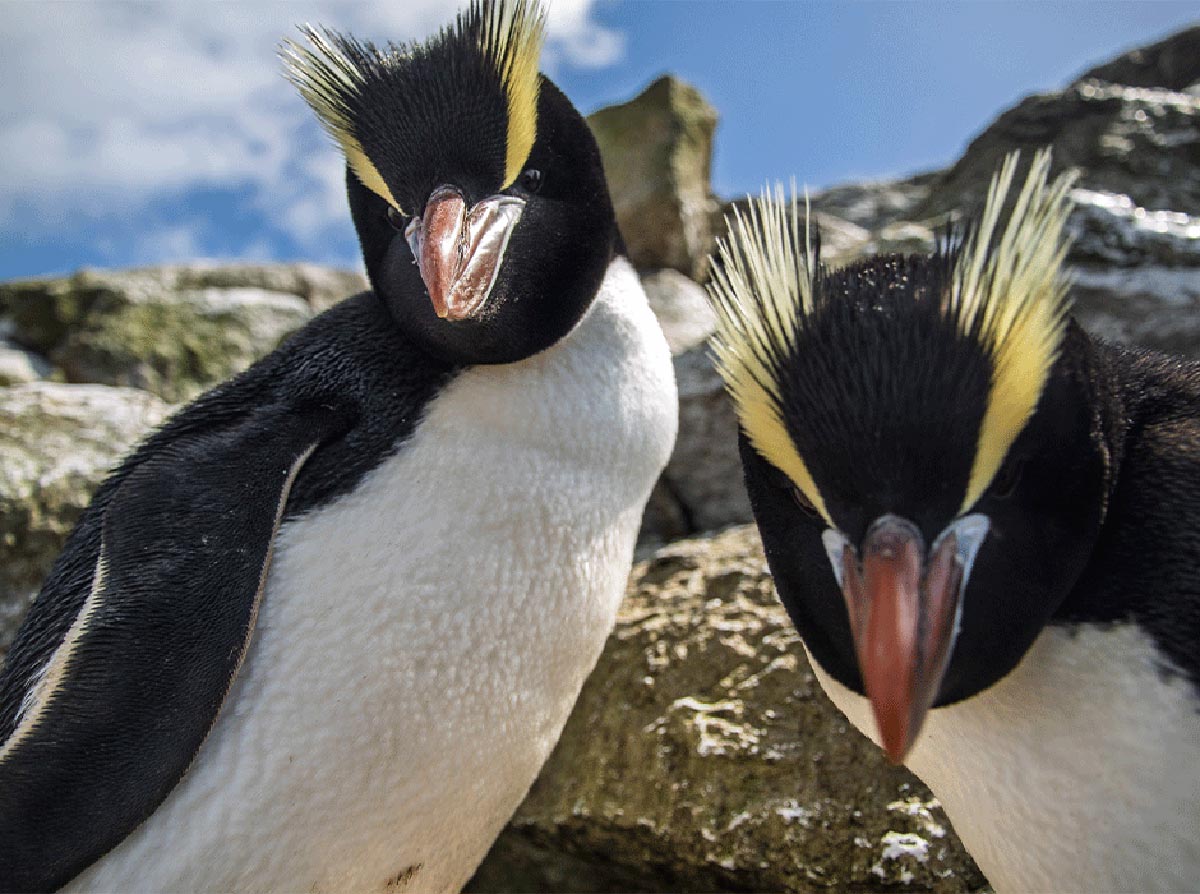
Endangered erect-crested penguins are holding steady on tiny islands while declining on a breeding ground 40 times larger, challenging assumptions about where the species’ best hope for survival lies.
An endangered penguin species could receive a less severe global risk rating even as one of its only two breeding populations suffers a steep decline. A survey of erect-crested penguins in Aotearoa New Zealand shows how a single assessment of an entire species can conceal very different conservation needs.
The erect-crested penguin is among just four penguin species worldwide listed as “Endangered” on the International Union for Conservation of Nature Red List. Another is New Zealand’s hoiho, or yellow-eyed penguin. Yet while the hoiho has attracted sustained public and conservation attention, the erect-crested penguin remains largely overlooked and is one of the country’s least-studied penguin species.
Steady on Bounty, shrinking on Antipodes
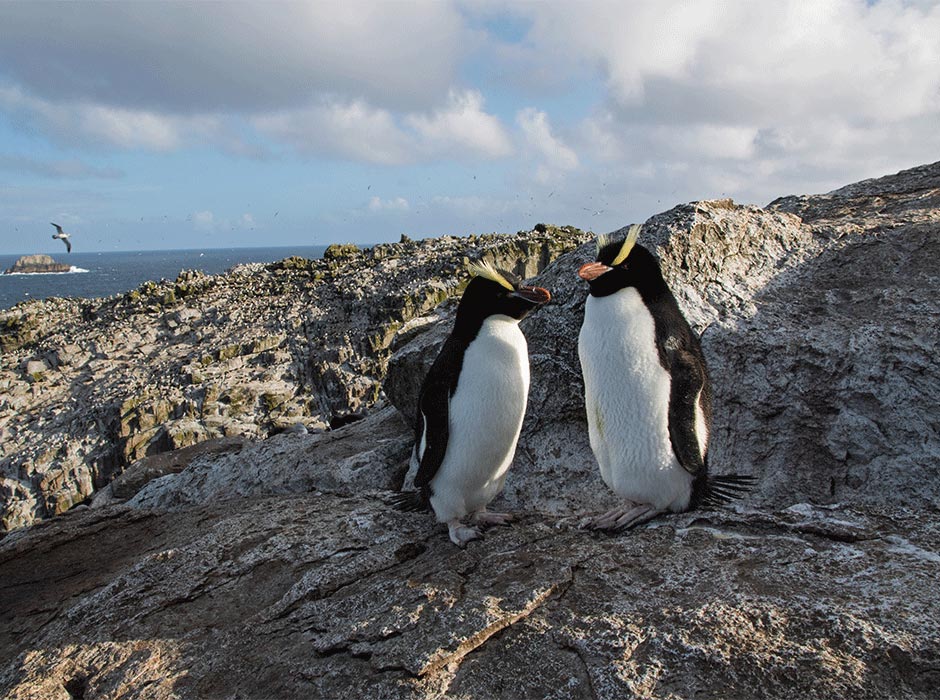
These birds breed only on the Bounty and Antipodes islands, two remote island groups about 800 kilometers (500 miles) southeast of the South Island. Between 2022 and 2024, researchers used drones to photograph and count every breeding colony across both groups, the first time this had been done for the entire species.
The study, published October 21, 2026, in PLOS ONE, was led by Dr. Thomas Mattern of the Tawaki Project, whose researchers are based in the Departments of Zoology and Marine Science at the University of Otago (Ōtākou Whakaihu Waka). The team collaborated with the Antarctic Research Trust and the Global Penguin Society.
Mattern says, “Comparing the new counts with historical records going back to the mid-1990s, the Bounty Islands population has remained essentially unchanged for at least 25 years.
“The Antipodes Islands population, by contrast, has declined by more than 40 percent since 1995.”
The counts also challenged the historical view of where most of the species breeds.
“The results overturn a long-standing assumption,” Mattern says.
“The tiny Bounty Islands, at just 50 hectares, were found to hold almost as many breeding pairs (about 27,800) as the Antipodes Islands (about 29,800), even though the latter is 40 times larger and historically considered the species’ stronghold.”
The researchers have dubbed the situation “Schrödinger’s Penguin” after the well-known thought experiment in which a cat sealed in a box is imagined to be simultaneously alive and dead until someone opens it and checks. For the penguins, Mattern says, the logic runs in reverse.
“With Schrödinger’s cat, opening the box settles the question one way or the other.
“With Erect-crested penguins, it’s the opposite. From a distance, without proper surveys, everyone assumed there was a single answer for the whole species.
“Once we actually opened the metaphorical box and looked, we found there wasn’t one state at all, but two: stable on the Bounty Islands, declining on the Antipodes Islands.”
Shrinking colonies give predators an opening
On the Antipodes Islands, a shrinking colony may become increasingly difficult for the penguins to defend. Mattern describes how that can compound the losses.
“As Antipodes colonies have shrunk over recent decades, the collective defense they once provided against native subantarctic bird, the skua, a natural predator of eggs and chicks, has weakened, allowing predation losses to increase and colonies to fragment further.”
The islands’ eastern rockhopper penguins had already experienced a population collapse. Their numbers crashed “catastrophically” during the second half of the 20th century, leaving fewer than 1,000 breeding pairs on the Antipodes Islands. The decline mirrored trends elsewhere across the species’ Southern Ocean breeding range and was likely driven by ocean warming.
Co-author Dr. Klemens Pütz of the Antarctic Research Trust suggests that this loss may have changed which penguins the predators targeted.
“As Rockhoppers disappeared, skuas may have turned to Erect-crested penguin eggs and chicks instead,” Pütz says.
Increasingly severe storms, consistent with broader climate trends in the Southern Ocean, have also triggered landslides that break colonies into smaller fragments and put them at further risk. Differences in the birds’ ocean habitats and migration routes likely add to the pressures.
Outside the breeding season, Antipodes birds travel far into the Antarctic Polar Frontal Zone, a region of the Southern Ocean, Mattern says. Bounty Islands birds stay close to their breeding sites in more sheltered waters that may also be more productive.
Bounty’s penguins remain exposed to industrial fishing
The contrasting population histories complicate how the species’ extinction risk should be assessed. According to Mattern, its current Endangered ranking rests on inflated population estimates from the 1970s. Reassessing that status against the new data broadly supports the ranking for the Antipodes population, but not for the Bounty population.
“Averaged across both populations, the global ranking would actually improve to “Vulnerable”, masking the severity of the Antipodes decline, and downplaying how exposed the Bounty Islands, likely the species’ last secure stronghold, are to industrial fishing.
“A single, ostensibly improved threat ranking is like putting the lid back on Schrödinger’s box, trading a convenient illusion for the stronger protection the Bounty Islands population actually needs,” Mattern says.
Reference: “Schrödinger’s Penguin? Divergent population trajectories and the challenge of assessing the threat status of the Erect-crested penguin” by Thomas Mattern, Klemens Pütz, Hannah Mattern, Robin Long, Dave Houston, Bianca Keys, Jeff White, Richard Seed, Myrene Otis, Ursula Ellenberg, Pablo Garcia-Borboroglu and Benno Lüthi, 21 October 2026, PLOS ONE.
DOI: 10.1371/journal.pone.0359075
The study was funded by the Vontobel Foundation (Switzerland) through the Antarctic Research Trust, the Global Penguin Society, and conducted under permits from the New Zealand Department of Conservation.
Never miss a breakthrough: Join the SciTechDaily newsletter.
Follow us on Google and Google News.