
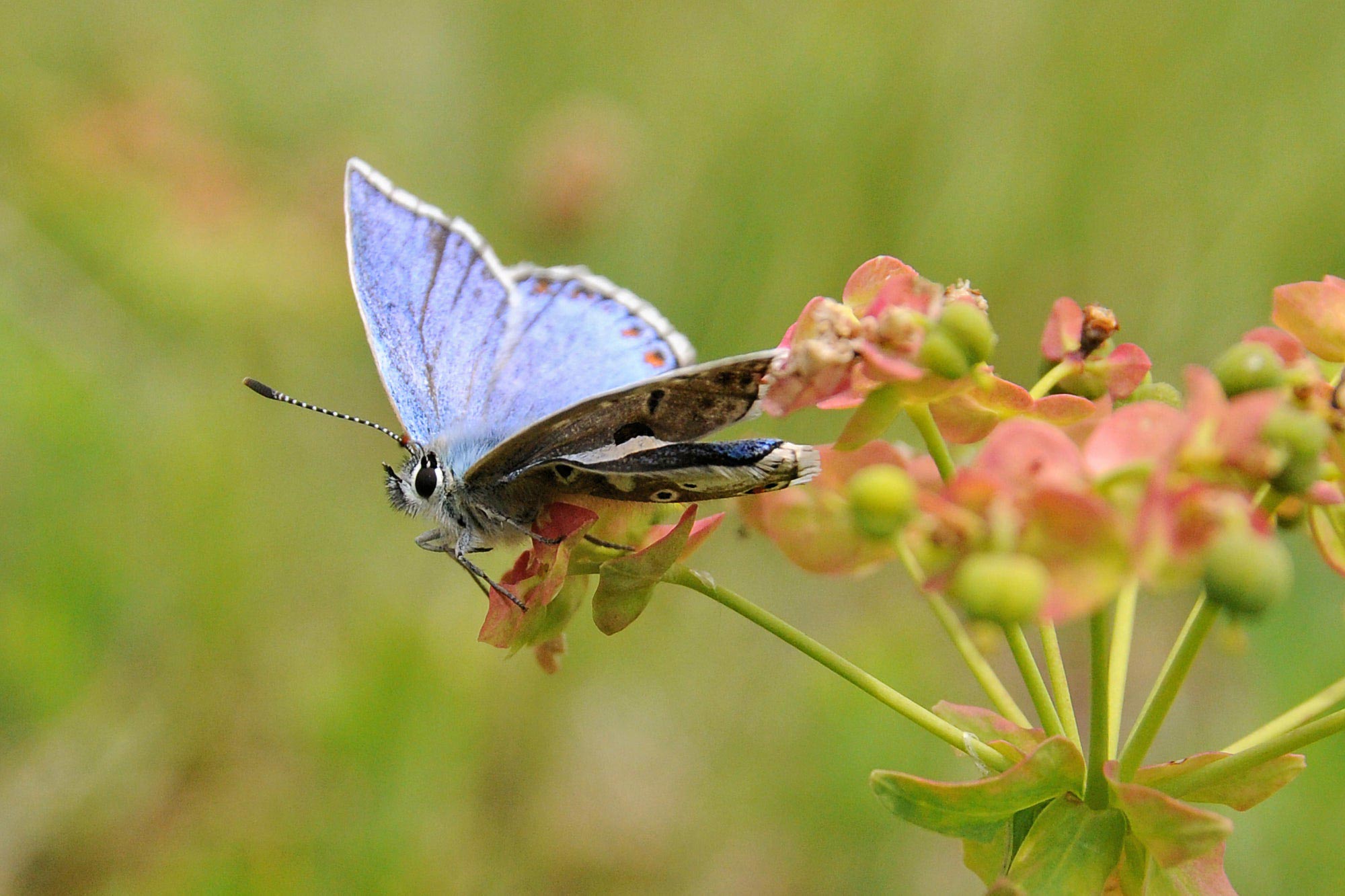
Mountaintops host some of the world’s most diverse butterfly species, but climate change could transform these habitats into ecological traps according to a new study.
A Yale-led study warns that global climate change may have a devastating impact on butterflies, transforming their species-rich mountain habitats from safe refuges into ecological traps.
Think of it as the “butterfly effect” — the idea that something as small as the flapping of a butterfly’s wings can eventually trigger a major event, such as a hurricane — but in reverse.
The new study, published in the journal Nature Ecology and Evolution, also suggests that the lack of comprehensive global data on insects may leave conservationists and policymakers ill-equipped to address biodiversity loss caused by climate change across a wide range of insect species.
For the study, a team co-led by Yale ecologist Walter Jetz analyzed phylogenetic and geographic range data for more than 12,000 butterfly species worldwide. The team was also co-led by Stefan Pinkert, an entomologist at the University of Marburg, in Germany, and former postdoctoral associate at Yale.
Mountain Diversity Under Threat
They found that butterfly diversity is highly clustered in tropical and subtropical mountain systems: two-thirds of butterfly species live primarily in the mountains, which contain 3 1/2 times more butterfly hotspots than lowlands.
Yet those mountain ecosystems — and surrounding areas — are quickly changing as a result of climate change. According to the study, 64% of the temperature niche space of butterflies in tropical areas will erode by 2070, with the geographically restricted temperature conditions of mountains constantly shrinking.
“The diversity, elegance, and sheer beauty of butterflies impassion people worldwide,” said Jetz, professor of ecology and evolutionary biology in Yale’s Faculty of Arts and Sciences and director of the Yale Center for Biodiversity and Global Change (BGC Center).

“Co-evolved with host plants, butterflies form an integral part of an ecologically functioning web of life,” he added. “Unfortunately, our first global assessment of butterfly diversity and threats finds that butterflies’ fascinating diversification into higher-elevation environments might now spell their demise, with potentially thousands of species committed to extinction from global warming this century.”
Pinkert, a former postdoctoral researcher at the BGC Center, added: “As an entomologist, I am committed to informing the public about the distribution of insect diversity and targeted ways to protect it. Our results are insightful from an ecological point of view but unfortunately also very alarming.”
Current priorities in biodiversity preservation, the researchers note, are geared to animals and plants, rather than insects. Until now, a global assessment of the geographic coincidence of diversity, rarity, and climate change threats for an insect system did not exist.
Conservation Strategies Must Expand to Insects
The new assessment reveals that patterns in butterfly diversity differ strongly from those of much better studied groups such as birds, mammals, and amphibians — challenging the relevance of existing conservation priorities, the researchers said.
“This research was made possible by many years of mobilizing various global data and newly developed integrative approaches, all aimed at filling this critical information gap for at least one insect taxon,” Pinkert said.
Jetz said he hoped the new study — and future research enabled by the Map of Life, a global database, directed by Jetz, that tracks the distribution of known species worldwide — will support conservation managers to include insects in their plans for biodiversity preservation.
“A reduction of carbon emissions, combined with proactive identification and preservation of key butterfly habitats and migratory corridors, will be key to ensuring that much of butterfly diversity survives to benefit future generations,” Jetz said.
Reference: “Global hotspots of butterfly diversity are threatened in a warming world” by Stefan Pinkert, Nina Farwig, Akito Y. Kawahara and Walter Jetz, 24 March 2025, Nature Ecology & Evolution.
DOI: 10.1038/s41559-025-02664-0
Co-authors of the study are Nina Farwig of the University of Marburg and Akito Kawahara of the University of Florida.
The research was supported, in part, by the Alexander von Humboldt Foundation, the Gordon and Betty Moore Foundation, the National Science Foundation, and the E.O. Wilson Biodiversity Foundation.
To explore more of the results of the research at the Map of Life site, visit here.
Never miss a breakthrough: Join the SciTechDaily newsletter.
Follow us on Google and Google News.