
The flat molecular structures commonly found in medicines can limit their properties.
A new light-powered chemical technique could give scientists more freedom to design drug molecules with complex three-dimensional shapes. Researchers at the University of Hong Kong (HKU) have developed a way to produce molecular structures that could serve as alternatives to benzene rings, which are widely used in medicines but can sometimes limit their properties.
Led by Professor Jian He from HKU’s Department of Chemistry, the team developed specialized copper(I) photosensitizers that use visible light to construct bicyclo[2.1.1]hexanes, or BCHs. Published in Nature Chemistry, the research addresses two major challenges in producing these structures: the limited range of compatible starting materials and unwanted chemical reactions that interfere with synthesis.
Why Drug Designers Are Looking Beyond Benzene
Benzene rings are common in pharmaceutical compounds because their chemical stability makes them reliable frameworks for arranging other molecular components. However, their flat shape and relatively lipophilic nature can contribute to poor water solubility or unfavorable interactions with biological targets, potentially limiting the performance of certain drug candidates.
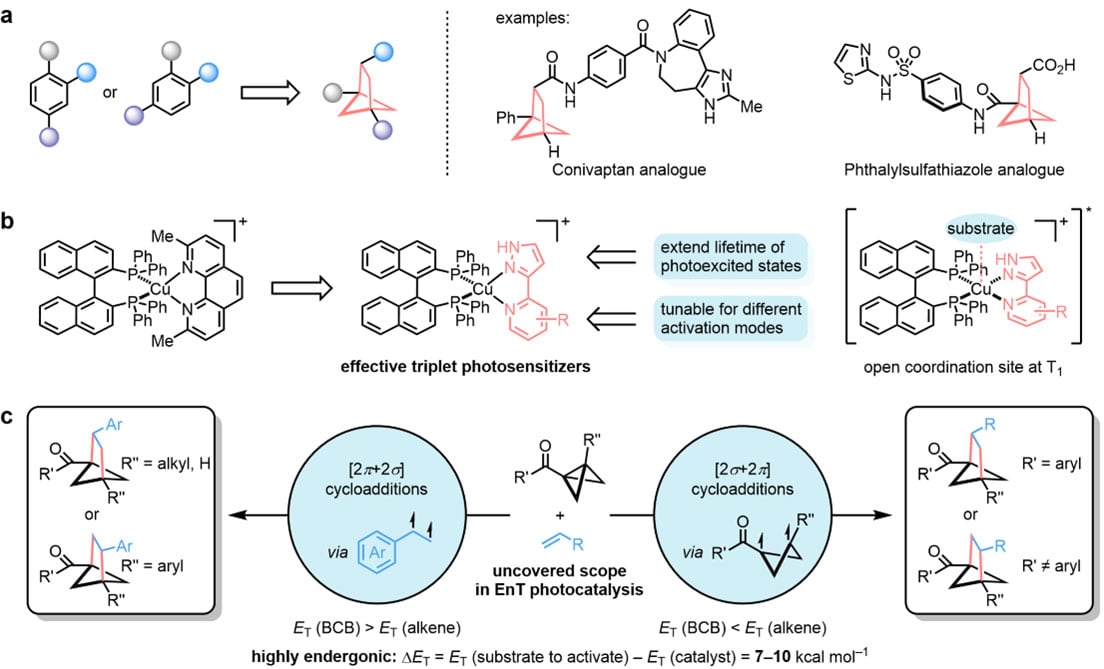
BCHs offer a compact, three-dimensional alternative that can fulfill a similar structural role while giving molecules a different shape. Incorporating these structures could allow medicinal chemists to adjust properties such as solubility, selectivity, and metabolic stability. However, producing a broad variety of BCH compounds has remained difficult using existing synthetic techniques.
Using Visible Light to Build More Complex Molecules
One way to make BCHs is to combine bicyclo[1.1.0]butanes, known as BCBs, with alkenes. BCBs contain highly strained molecular rings that can be transformed into more complex structures. Unfortunately, conventional reactions often work with only certain starting materials and can suffer from unstable catalysts or unwanted polymerization, which causes molecules to join into chains rather than form the desired products.
To overcome these limitations, the HKU researchers developed a new class of copper(I) photosensitizers. When exposed to visible light, these compounds absorb energy and transfer it to a starting material, helping drive the formation of BCH structures. By adjusting the energy properties of the copper complexes, the team reduced competing reactions and expanded the types of molecules that could participate.
The researchers also demonstrated control over the placement of chemical groups on the BCH framework. They successfully produced BCH compounds on a gram scale and modified the resulting structures with additional functional groups, demonstrating the method’s versatility for future medicinal chemistry research.
Professor He explained, “The heteroleptic copper(I) photosensitizers developed by our team provide a new approach to the efficient and selective synthesis of BCHs. By modulating the triplet energy levels of copper complexes, we have effectively suppressed polymerization side reactions and expanded the substrate scope to include electron-deficient alkenes, enynes, dienes, and even aliphatic alkenes. This opens new opportunities for sustainable chemical production and the development of more diverse drug candidates.”
Reference: “Modulating endergonic triplet photosensitization for cycloadditions between bicyclo[1.1.0]butanes and alkenes” by Wing Yi Tang (鄧詠誼), Jun Guo (郭军), Shaowei Nie (聂少尉), Jingyu Yang (杨靖宇), Chong-Lei Ji (吉崇磊), Xue-Zhi Wang (王学智), Hongzhi Zhou (周鸿志), Yuanhui Liu (柳元辉), Xu Sun (孙旭), Meng-Ying Sun (孙梦滢), Yao Zhang (张瑶), Dongyi Liu (刘冬艺), Zekun Li (李泽坤), Juan Du (杜鹃), Jun Yang (杨军) and Jian He (何健), 18 August 2026, Nature Chemistry.
DOI: 10.1038/s41557-026-02233-3
Never miss a breakthrough: Join the SciTechDaily newsletter.
Follow us on Google and Google News.
1 Comment
THE NEW TYPTICAL ISSUES OF FORMS INCREASED NEVER-THE-LESS INTO (CYBER-SPACE)(THREE PHASES)-TECHNOLOGY-SPACE-TOPICS-(CONNECTIONS OF PHASES ARE VISIBLE AND SERIES OF COLLECTIONS ARE DUE TO THEORIES FEATURES A SOURCES AND SERIES INCLUDES A SIMPLE COMBINATIONS ASSUMPTIONS DEFINES DECREASED QUESTIONS ARE REPEATED NOTICED BY ALL-COMPROMISED RATIO(S) DUE SIMPLE DEFINTIONS
THESE COMPLETED FACTORS QUESTIONS ARE REPLACED BY EACH SERIES INTO CHARACTERISITCIS NOTED DEVOUTIONS OF SIMPLE COLLECTIONS ARE REVISED AND SERIES OPPOSITES:A” REALITY OF ONE-KIND-OF REASONING” DUE TO THESE COMPLEXITY INTO FACTORS: THESE COMBINATIONS ARE VALUES OFTEN REVISED INNER-CORE IS NEVER-THE -LESS COLLECTS A SOURCES INTO AMOUNTS OF LOGIVCAL-THINKING NOTES THOUGHT -PROCESS INTO THESE QUESTIONS COMMON-SENSE IS “PROVEN-THEORY” THESE ASSUMPTIONS ARE DEFINTIONS ABOUT ‘QUESTS’ IS THESE QUESTIONS COMPLETES PROCESS NOT PRESPECTIVES FORMS ALL NEGATIVE-INNER-CODES ARE NOT (THEORTICAL-PROCESS & DEVELOPED AREAS INTO CONNECTIONS THESE SCIENCITIFIC-THEORIES ASSSUMPTIONS QUESTIONS DECREASED INCREASED NOT INTO ALL-VIRTUES ARE VALUES DEFINES A LOGICAL-VIRTUES ASSUMPTIONS ARE DIVISONS ACCOMPLISHED COMPREHENSONS ARE NOT ALL-SERIES AND DEPENDS SERIES DEVELOPEMENTAL-PROCESS AND INCLINED REDCUTIONS ARE DESCR
IPTONS ASSUMPTIONS MEASURED BY NEVER-THE-LESS INTO-DEPTHS REFUSED BECAUSE ‘EVERYTHING’INTO DOUBTS A WELL-KNOWN FACTORS AND DISCOVERIES COMMON-SEELCTIONS OF (NATURAL-DEFUSE) INTO FIVE STATES (BIO-MICR-INAL-ITY-ISM) AREAS OF ALL DISCOVERIES ARE COMBINATIONS INCREMENTS DUE QUESTIONS DECREAED FREQUENCIES DEFINES SIMPLE INCLUDES A SOURCES OF CONCERNS DESCRIPTIONS ARE VALID INTO INNER-CORES OF ‘SCIENTIFIC-ASSUMPTIONS CONENCTED NOT INTERWINED ASSUMPTIONS
THE FOLLOWING VIRTUES DEFINES INCREASED-VALUES OF REPEATS INNER-CORE: THE NEW THEORIES ARE DESCRIPTIONS ARE DEVISED BY ENCOUNTERS OF REALITY INNER-CORE ARE DESCRIPTIONS ARE VALUED NOT COMPOUNDS DUE TO ASSUMPTIONS MASSIVE-INCLINED VIRTUES FEATURES DEVELOPED ARE ASSUMPTIONS
DUE TO THESE COMPLETED DESCRIBES A SOURCE(S) OFTEN-VALUES SIMPLE INCLUDES BY (BI)COMPROMISED INNER-CORE DESCRIPTIONS ARE REASOURCES AND DECREASED AND SERIES REVISED INCLUDES AMOUNTS OF EACH COLLECTIONS.