
An enzyme found in compost broke down small amounts of polyurethane foam in laboratory tests, offering an early lead toward gentler ways to recycle a stubborn plastic.
The polyurethane used in mattress foam, shoe soles, and refrigerator insulation is notoriously difficult to recycle on an industrial scale. A very large share of the millions of metric tons produced worldwide ends up in landfills or incinerators, taking potentially reusable material with it.
Nylon presents a similar challenge. Used in clothing, bags, cars, ropes, engine components, and fishing nets, it is another plastic made from crude oil, a finite resource. Researchers want to break both materials down into their pure components so those ingredients can become new polyurethane and nylon. Chemical and biological approaches are making progress, but the solutions emerging from laboratories are not yet ready for industrial use.
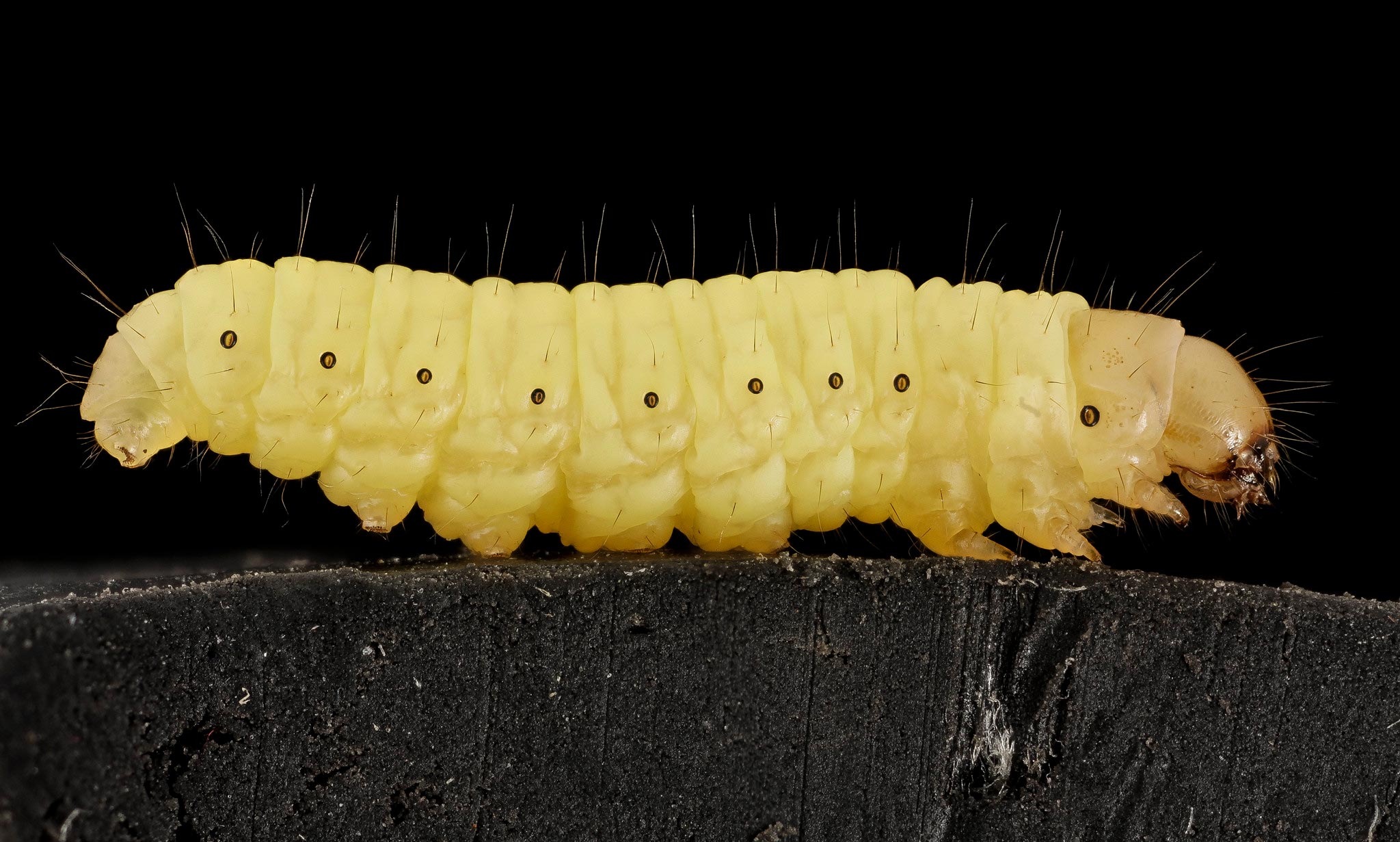
Researchers from Aarhus University and the Danish Technological Institute went looking for help among bacteria. Their search took in a Kenyan landfill, a tropical zoo, the guts of wax moth larvae, and a compost heap near Aarhus. The best candidate came from the compost, where a bacterium produced an enzyme with an ability that could prove useful far beyond the heap.
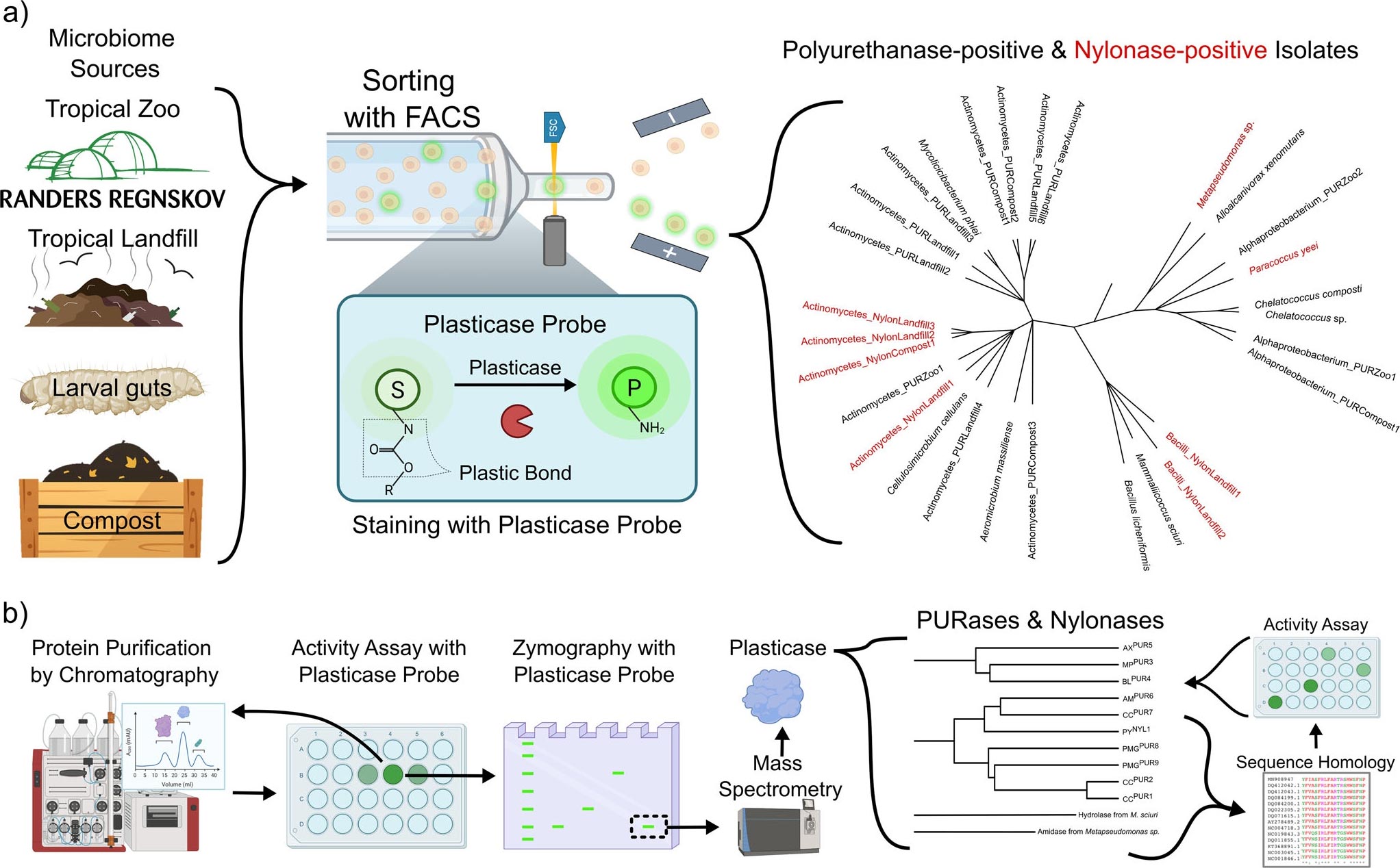
Researchers collected bacteria from plastic-contaminated environments, including a tropical zoo, a landfill in Kenya, compost and larval guts. Using fluorescent probes and fluorescence-activated cell sorting (FACS), they isolated bacteria capable of cleaving chemical bonds found in polyurethane and nylon. The active enzymes were then purified and identified using chromatography, activity assays and mass spectrometry. In total, the researchers identified 10 polyurethane-degrading enzymes and 2 nylon-degrading enzymes. Credit: Rosie Graham / Angewandte Chemie
Enzymes are proteins that speed up chemical reactions. To find ones that can break down plastic, researchers conventionally search genome databases for gene sequences resembling those of enzymes already known to do the job. That approach has yielded useful enzymes, but there are relatively few known examples to guide the search.
This team used bioprospecting, which means searching nature for organisms and genetic material that could be useful in research or industry. It was the first time researchers had searched on such a large scale and across such varied environments for enzymes capable of degrading polyurethane, also called PUR, and nylon.
From a Kenyan landfill to compost
The idea came to Andreas Møllebjerg as he prepared to begin a postdoctoral position at what was then the Interdisciplinary Nano Science Center (iNANO) at Aarhus University. He was joining a new project investigating whether natural enzymes could break down plastic. Møllebjerg, a co-author of the resulting study, recently published in Angewandte Chemie, was responsible for collecting bacteria from different environments.
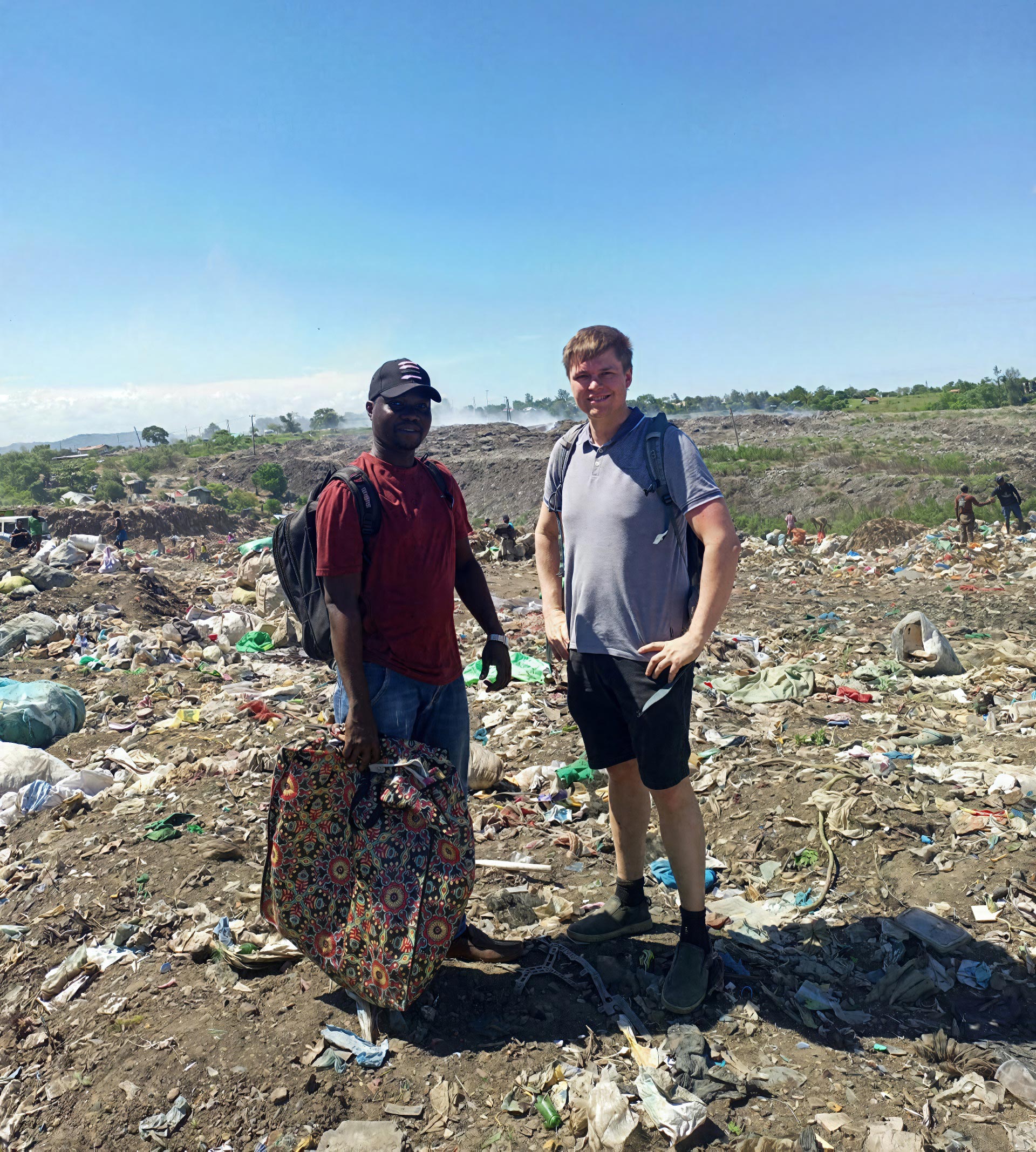
“I suggested looking for suitable enzymes in places where it is warm, because bacteria thrive and grow well there all year round. And preferably somewhere plastic has been present for a long time. A year and a half later, I was on a plane to Kenya, followed by half an hour on the back of a local student’s motorbike on the way to a huge landfill. He helped me collect samples and communicate with the hundreds of people who lived on and off the landfill,” he says.
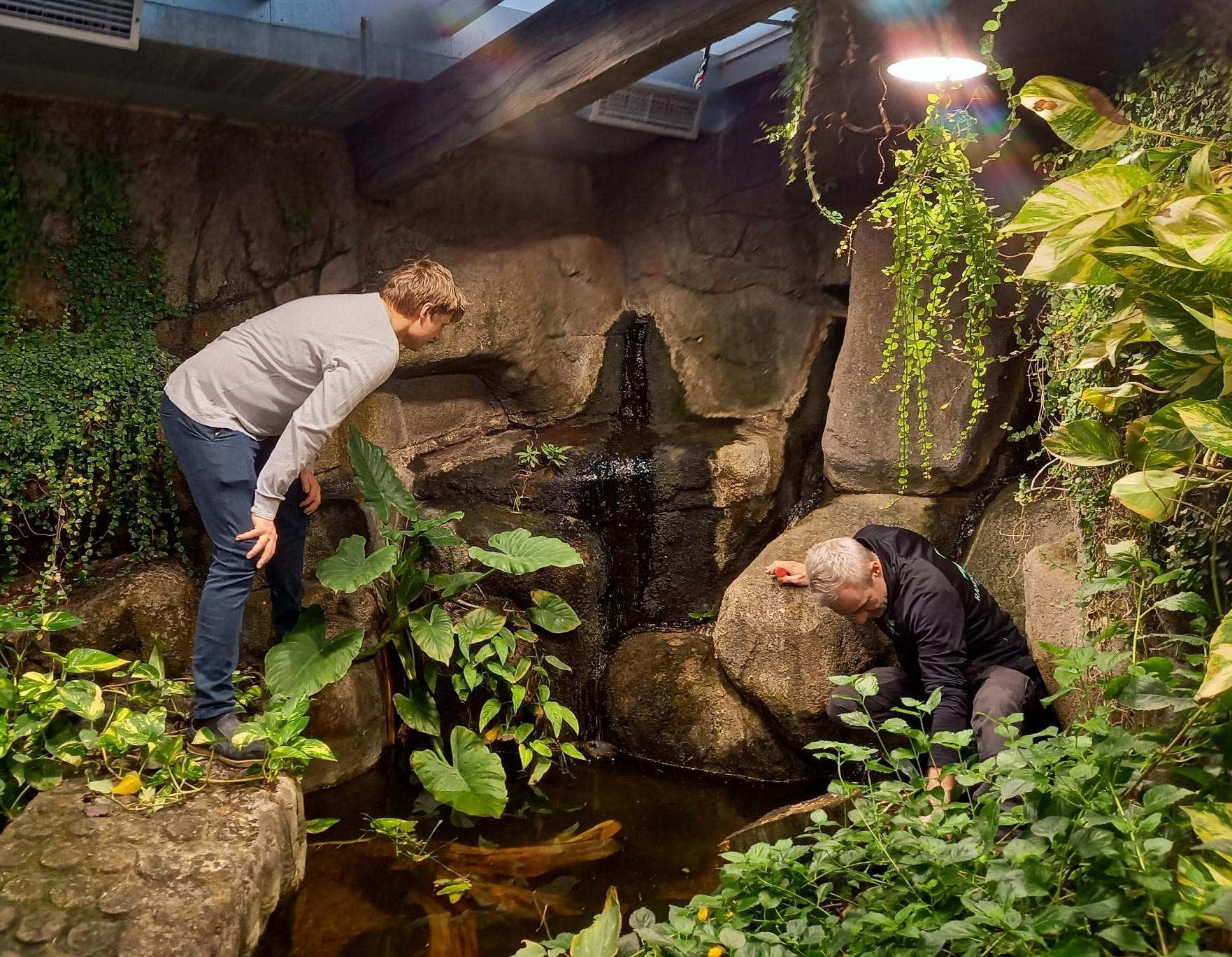
Møllebjerg and PhD student and co-author Malthe Kjær Bendtsen also traveled 34 kilometers, about 21 miles, to collect plastic waste at Randers Regnskov Tropical Zoo. Møllebjerg bought a bag of wax moth larvae from a pet food shop so the team could investigate enzymes from bacteria in their guts. At a recycling center about 10 kilometers, or 6 miles, from the university, he collected a shovelful of compost.
Glowing bacteria reveal plastic-degrading enzymes
Those samples gave the researchers millions of bacteria to examine. Finding a useful enzyme required more than showing that a bacterium could react with a convenient laboratory substitute for plastic.
“It was like a three-stage rocket, where we gradually narrowed them down. We started by finding bacteria that could break down the fluorescent model material. Then we isolated the enzymes capable of breaking down exactly that fluorescent material. And finally, we tested the enzymes on increasingly realistic materials,” Bendtsen explains.
This 90-hour time-lapse video shows enzymatic degradation of two different molecules that mimic nylon. The second and fourth vials show CCPUR1 breaking down the two molecules, while the first and third vials show an inactive enzyme. Credit: Samuel Peña Díaz, Aarhus University, and Andreas Sommerfeldt, Danish Technological Institute
For the initial screening, the researchers mixed bacteria with molecules designed to mimic chemical bonds in polyurethane and nylon. The molecules lit up when they encountered a bacterium containing a suitable enzyme. Using fluorescence-activated cell sorting, or FACS, a machine could screen the bacteria and pick out glowing cells at a rate of up to 10,000 per second.
The search identified 29 plastic-degrading bacteria and 12 enzymes with varying abilities to break down polyurethane and nylon. The most promising enzyme was CCPUR1, from the compost bacterium Chelatococcus composti. Its name takes “CC” from the bacterium and “PUR” from PURase, shorthand for polyurethane hydrolase, an enzyme capable of breaking down polyurethane.
Testing on more realistic materials showed both its potential and its limitations. Given polyurethane mattress foam in powdered form, CCPUR1 broke down just under 1% in three days. That leaves a substantial gap between detecting an enzyme’s activity and using it to recycle plastic on an industrial scale.
Compost helps explain the enzyme’s toughness
CCPUR1 nevertheless had several useful characteristics. Its unusually wide binding cleft, a groove where it accommodates the material it acts on, gives large polymer molecules room to fit. Polymers are the long molecules that make up plastics. The enzyme was also particularly stable, withstanding higher temperatures and a range of solvents better than the other candidates.
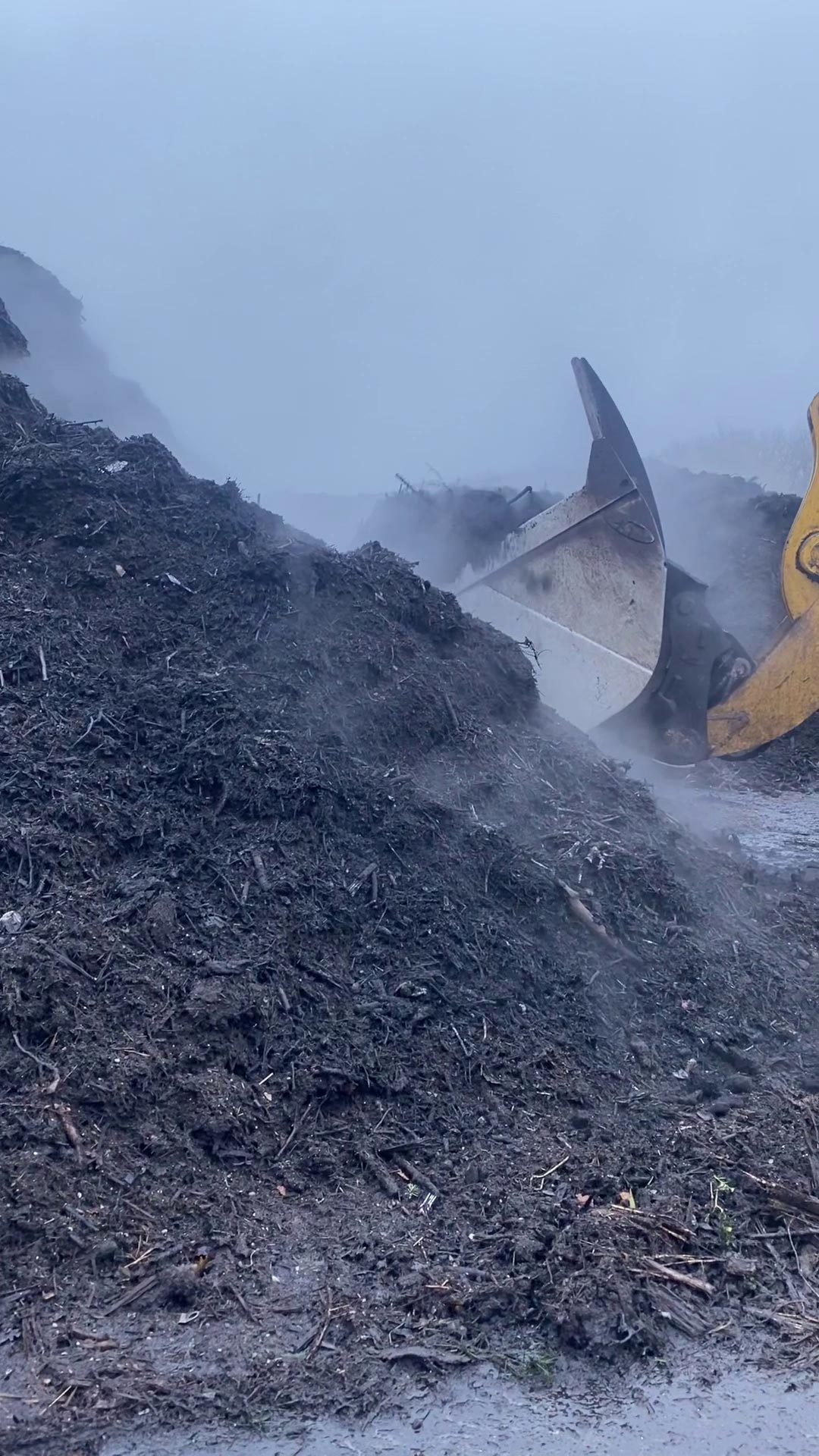
Its origins in compost offer an explanation for those abilities. Compost contains stubborn plant materials such as wax and lignin, and an enzyme that evolved to break down those substances can also happen to work on plastic. Compost heaps can reach 80°C, or 176°F, so enzymes functioning there need enough stability to withstand the heat.
The team has since worked to improve CCPUR1. In a follow-up study published September 11, 2026, in Chem Catalysis, the researchers collaborated with the University of Porto, using computer simulations and targeted edits to the DNA instructions for making the enzyme.
Within three days, the modified enzyme broke down around 1.4% of the polyurethane in foam from a real shoe sole, without any pretreatment of the plastic. That experiment used a different material from the powdered mattress foam in the original study. Postdoctoral researcher Rosie Graham, who was responsible for testing the enzymes on plastic materials in the laboratory, is the first author of the follow-up study.
Different enzymes for different plastics
The other 11 enzymes could also have a role. They work best on small pieces of plastic and may complement CCPUR1 in future combinations of processes. Because enzymes are selective about what they act on, the researchers envisage using an enzyme cocktail in stages. Polyurethane could first be broken down and washed away, followed by the addition of nylon-degrading enzymes. Chemical methods cannot separate those tasks in the same way.
Making these processes practical may require mechanical and chemical treatments that make the plastic easier for enzymes to attack. Chemical degradation of polyurethane and nylon is itself a major research field, including at Aarhus University. The scale of the remaining challenge is one reason the team compares efficient polyurethane recycling to finding the holy grail.
“But the research highlights the strength of enzymes. Their real advantage when it comes to recycling is that they work under mild conditions, meaning at lower temperatures and pressures than those used in most recycling technologies today,” Graham says.
Reference: “Environmental Identification of Novel Enzymes for Polyurethane and Polyamide Degradation” by Malthe Kjær Bendtsen, Andreas Møllebjerg, Samuel Peña-Díaz, Rosie Graham, Nicolai Claus Petersen, Bjørk Nolsøe Isaksen, Mathias Carstensen, Martin B. Johansen, Andreas Sommerfeldt, Allan R. Petersen, Iddi Khamisi Chuma, Cecilie Ryberg, Thomas Rea Wittenborn, Virginia Gichuru, Huabing Wang, Carsten Scavenius, Alexander Sandahl and Daniel E. Otzen, 26 June 2026, Angewandte Chemie International Edition.
DOI: 10.1002/anie.6159643
This work is supported by the Novo Nordisk Foundation through the Challenge Grant NNF22OC0072891 to the Center EnZync.
Never miss a breakthrough: Join the SciTechDaily newsletter.
Follow us on Google and Google News.