
Scientists have created an automated system to make unstable DNA-building blocks on demand, improving efficiency and reliability in DNA synthesis.
Chemically synthesized short DNA sequences are extremely important ingredients with countless uses in research laboratories, hospitals, and in industry, like in the method for identifying COVID-19. Phosphoramidites are necessary building blocks in the production of DNA sequences, but they are unstable, and break quickly. PhD Alexander Sandahl (Professor Kurt Gothelf’s group) has, in collaboration with a researcher in Professor Troels Skrydstrup’s group, developed a new patented way to quickly and efficiently manufacture the unstable building blocks immediately before they are to be used, and thus streamline DNA production.
The DNA sequences produced are also called oligonucleotides. These are widely used for disease identification, for the manufacture of oligonucleotide-based drugs, and for several other medical and biotechnological applications.
The high demand for oligonucleotides therefore requires an efficient automated method for their chemical production. This process relies on phosphoramidites, which are chemical compounds that have the disadvantage of being unstable unless stored at the ideal -20 degrees Celsius.
Instruments used for DNA synthesis are not able to cool down the phosphoramidites, and consequently, it is unavoidable that some of them degrade after being added to the instrument.
Avoiding unwanted degradation of important ingredients
Professor Kurt Gothelf and Professor Troels Skrydstrup are each heading a research group in organic chemistry, which have worked together to develop a relatively simple but efficient technology where the production of phosphoramidites can be automated and integrated directly into the instrument for DNA synthesis.
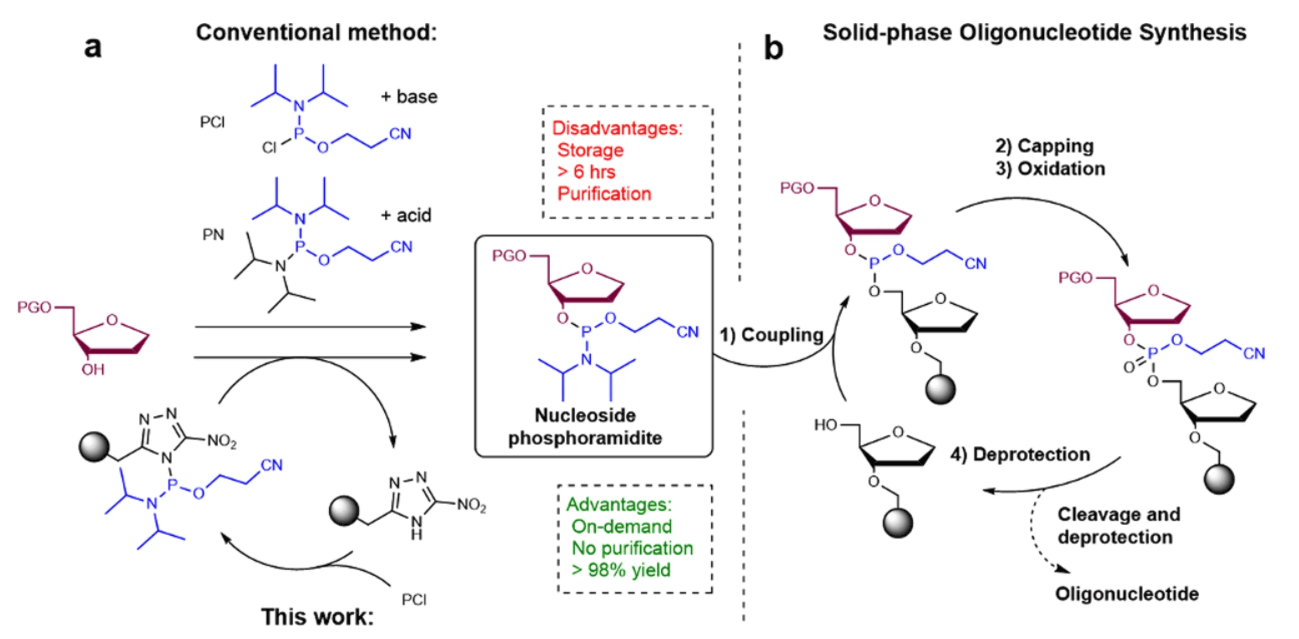
This avoids both the manual synthesis of these, which normally would take up to 12 hours, as well as the problem of storing unstable phosphoramidites. Gothelf’s group has contributed with their expertise in automated DNA synthesis and Skrydstrup’s group has contributed with their know-how with chemical reactions that take place in continuously flowing liquids (flow chemistry).
“It has been a very rewarding collaboration which is precisely one of the core values of iNANO,” says Kurt Gothelf, who adds “and I would also like to attribute to Alexander Sandahl a large part of the credit for this project being successful, as he has established the collaboration and has developed and realized a large part of the ideas for the project.”
The results have just been published in the journal, Nature Communications.
In the method of producing phosphoramidites, nucleosides (starting materials) are flushed through a solid material (resin), which can potentially be fully integrated into an automated process in the instrument for DNA synthesis. The resin ensures that the nucleosides are rapidly phosphorylated, whereby the nucleosides are converted to phosphoramidites within a few minutes. From the resin, the phosphoramidites are automatically flushed on to the part of the instrument which is responsible for the DNA synthesis.
This avoids the degradation of the phosphoramidites, as they are first produced just before they are to be used (on-demand), in a faster, more efficient flow-based way that can potentially be automated and operated by non-chemists.
Reference: “On-demand synthesis of phosphoramidite” by Alexander F. Sandahl, Thuy J. D. Nguyen, Rikke A. Hansen, Martin B. Johansen, Troels Skrydstrup and Kurt V. Gothelf, 12 May 2021, Nature Communications.
DOI: 10.1038/s41467-021-22945-z
The research is financially supported by the Lundbeck Foundation, the Novo Nordisk Foundation (CEMBID), the Independent Research Fund Denmark, and the Danish National Research Foundation (CADIAC).
Never miss a breakthrough: Join the SciTechDaily newsletter.
Follow us on Google and Google News.