
In a new study, researchers at the University of Illinois and the Missouri University of Science and Technology modeled a method to manipulate nanoparticles as an alternative mode of propulsion for tiny spacecraft that require very small levels of thrust.
The team simulated a system that uses light to generate an electromagnetic field. Neutral nanoparticles made from glass or some other material that insulates rather than conducts electric charges are used. The nanoparticles become polarized. All of the positive charges are displaced in the direction of the field and negative charges shift in the opposite direction. It creates an internal electric field that produces a force to move the particles from a reservoir, funneled through an injector, then shot out of an accelerator to produce thrust.
The study, that has been about eight years in the making, analytically showed that the technique can work, and suggested parameters for success.

“The challenge is in selecting the right permittivity of the medium, the right amount of charge, in which all of this happens,” said Joshua Rovey, associate professor in the Department of Aerospace Engineering in The Grainger College of Engineering at the U of I. “You have to choose the right materials for the nanoparticles themselves as well as the material surrounding the nanoparticles as they move through the structure.”
The technique is based on a field of physics called plasmonics that studies how optical light or optical electromagnetic waves, interact with nanoscale structures, such as a bar or prism.
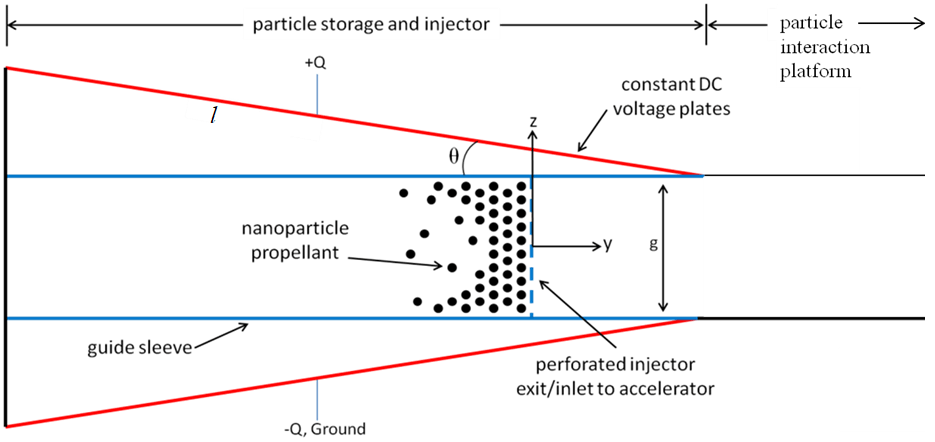
Rovey explained when the light hits the nanoscale structure, a resonant interaction occurs. It creates strong electromagnetic fields right next to that structure. And those electromagnetic fields can manipulate particles by applying forces to nanoscale particles that are near those structures. The study focused on how to feed the nanoparticles into the accelerator structure, or injector and how the angles of the plates in the injector affect the forces on these nanoparticles.
“One of the main motivating factors for the concept was the absence of or lack of a power supply in space,” Rovey said. “If we can just harness the sun directly, have the sun shine directly on the nanostructures themselves, there’s no need for an electrical power supply or solar panel to provide power.”
Rovey said this study was a numerical simulation. The next step will be to create nanoscale structures in a lab, load them into the system, apply a light source, and observe how the nanoparticles move.
Reference: “Nanoparticle injector for photonic manipulators using dielectrophoresis” by Jaykob Maser and Joshua L. Rovey, 14 June 2019, AIP Advances.
DOI: 10.1063/1.5099520
This project was supported by the Air Force Office of Scientific Research, a grant from the NASA Innovative Advanced Concepts program, and Missouri University of Science and Technology through the Chancellor’s Fellowship.
Abstract
We describe the concept of a dielectrophoretic nanoparticle injector and its use in a plasmonic/photonic-based nanoparticle manipulation system. Particle motion is achieved by generating an electrostatic, non-uniform field between two tilted plates and applying the corresponding dielectrophoretic force to net-neutral nanoparticles. We investigate the dependence the dielectrophoretic force has on the plate angle of the charged plates as well as their separation distance, dielectric filler material, and exit interface membrane. Our results indicate an increasing average and maximum dielectrophoretic force attainable in the axial direction with corresponding decreasing plate angle and gap distance. The model also predicts larger field variation and deviation from the average with smaller plate angle and gap distance. Lastly, we conclude that the nanoparticles must be suspended in a dielectric medium with permittivity greater than their own permittivity so that their net motion is outward through the exit interface membrane and into the manipulator system.
Never miss a breakthrough: Join the SciTechDaily newsletter.
Follow us on Google and Google News.