
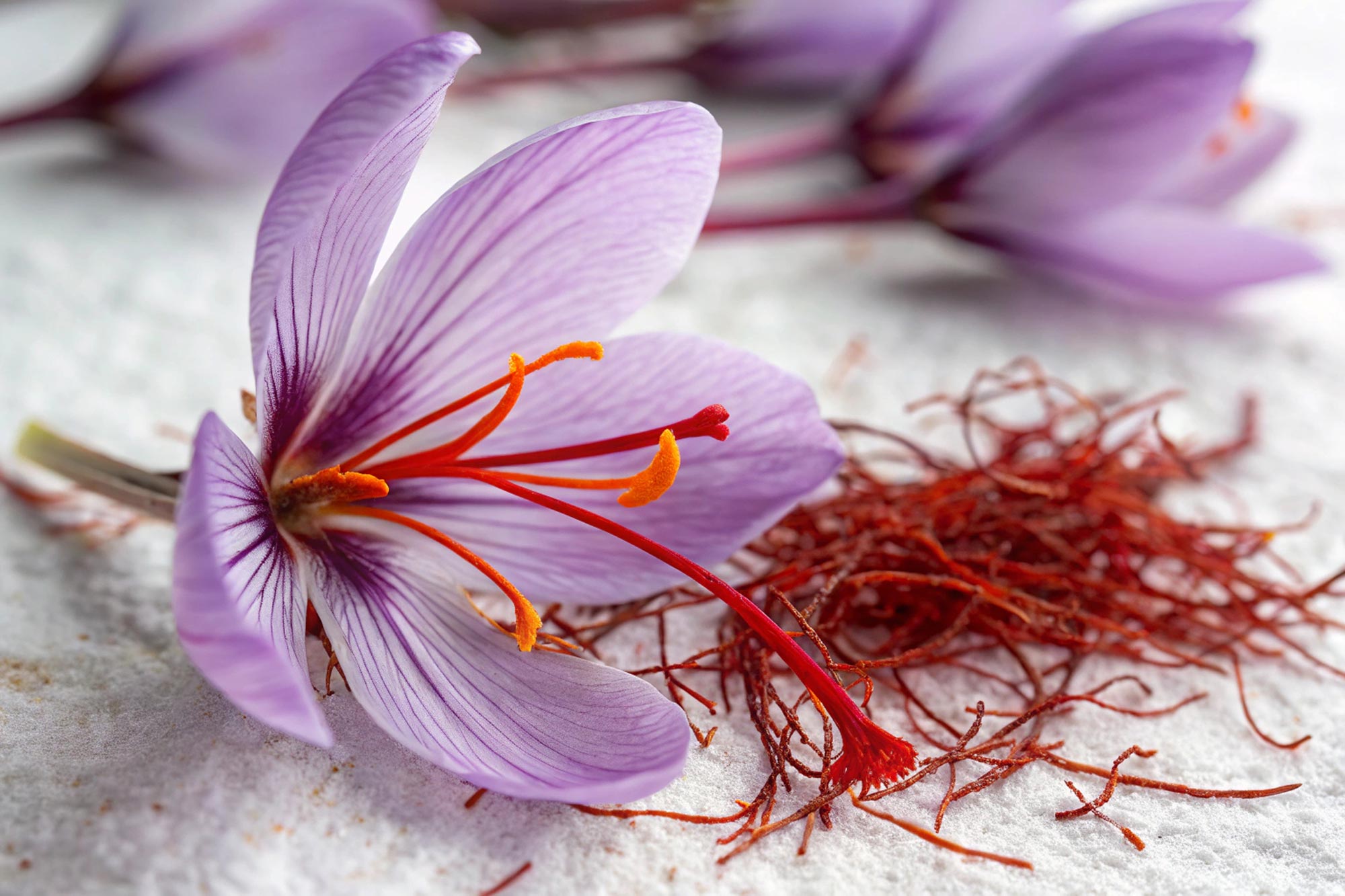
Beneath Denver’s solar panels, a spice nicknamed “red gold” is yielding a promising harvest that could help Colorado farmers earn more with less water.
At Colorado State University Spur, horticulture graduate student Reece Bailey is investigating whether saffron could become a profitable addition to the state’s farms. His experiments in the campus’s urban gardens and green roof research areas are testing how the crop handles Colorado’s climate, how much water it needs, and whether growing it beneath solar panels improves production.
The appeal starts with its extraordinary value. A pound of saffron typically costs between $600 and $5,000, with some varieties reaching $10,000. Vanilla, the second most expensive spice, sells for roughly $90 to $225 a pound. Those prices caught Bailey’s attention, but the research must establish whether the potential earnings justify the work.
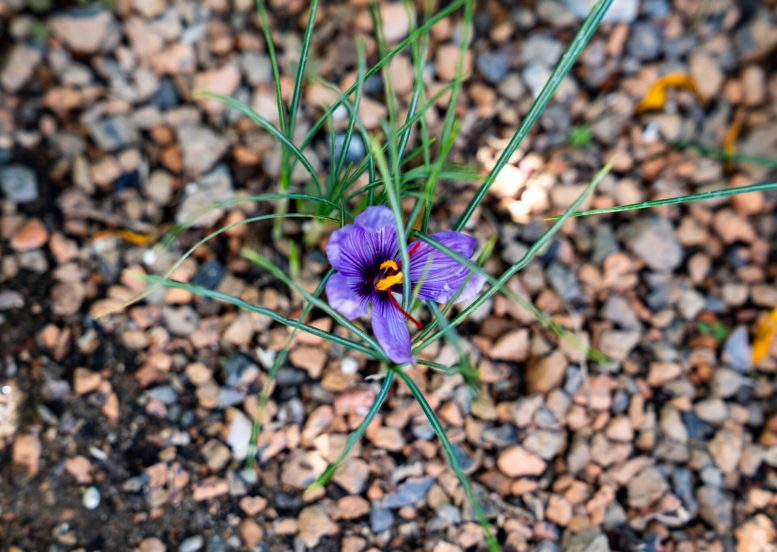
Why Saffron Could Suit Colorado
Colorado may seem an unlikely home for a spice closely associated with the Middle East. Yet Iran, which produces roughly 85% of the world’s saffron, has mountainous, semiarid conditions that resemble parts of the state. Bailey sees that overlap as a reason to investigate whether “red gold” could find a foothold on Colorado’s high plains.
The crop also offers an unusual combination of low water demand and late production. Saffron typically blooms in November, potentially bringing farmers income after other harvests have ended. Under suitable conditions, Bailey said, it could provide that additional crop without requiring extra irrigation.
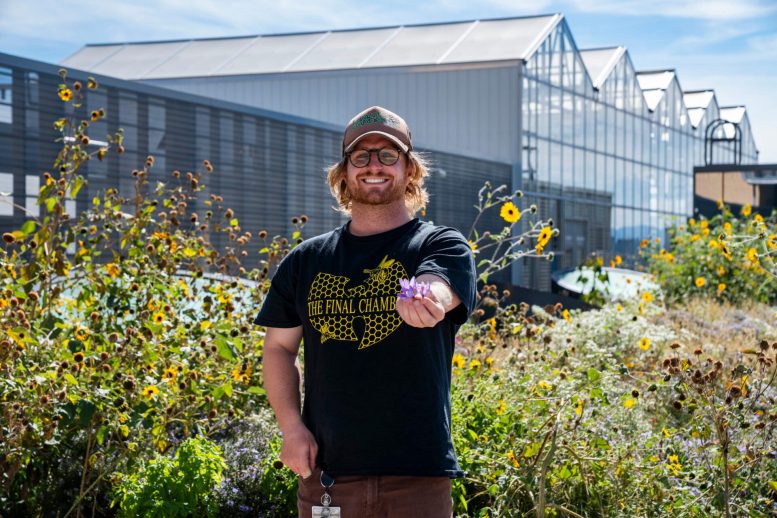
“One thing that’s always been interesting to me is new ideas and novel ways of integrating crops into our environments,” said Bailey, who grew up in Aurora and has worked on Spur’s green roof for three years.
The Work Behind “Red Gold”
The world’s most expensive spice comes from a remarkably small harvest: the three slender red stigmas inside each purple saffron flower. Collecting enough to produce a pound of dried spice requires roughly 75,000 flowers.
That harvest is painstaking. Flowers open for only a few hours each morning, and workers carefully extract the stigmas, often with tweezers. The amount of hand labor helps explain both saffron’s price and the challenge of turning it into a profitable crop.
“It’s certainly not the easiest crop to grow or the easiest crop to work with, but the investment can be well worth it,” Bailey said.
The Colorado Department of Agriculture has committed $80,000 through its Specialty Crop Block Grant Program to investigate that possibility, particularly as a source of supplemental income late in the season and during dry years.
A Potential Boost for Farm Income
“For a lot of farmers, the price for their goods isn’t keeping up with the price of inputs, so what we’re really trying to do is find new crops that will work with Colorado’s climate and for our producers’ bottom line,” said Sam Hahn, the department’s next generation and specialty crops program manager. “Saffron has a high labor input, but it could really be a boon for our farmers.”
Successfully growing the flowers would answer only part of the business question. Farmers would still need to assess startup costs, bulb suppliers, equipment, labor availability, and buyers. A valuable spice does not automatically translate into a profitable harvest.
Its labor demands could nevertheless create another benefit. Hahn said the November bloom might provide agricultural jobs during a period when many farmworkers are typically unemployed, while helping farms adapt to a changing climate.
“It’s so important that we experiment with these high-value crops to see if it can supplement the market in our state and keep us competitive,” Hahn said.
Saffron Thrives Beneath Solar Panels
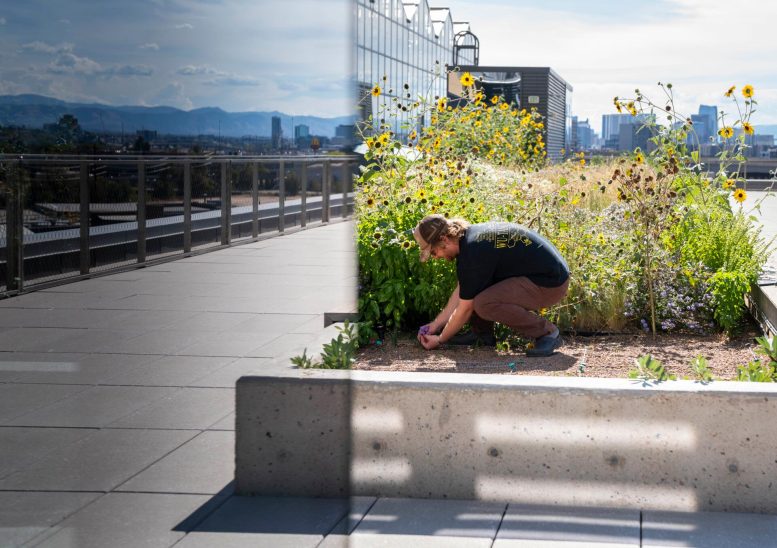
Some of the most promising results are emerging 75 feet (23 meters) above the ground. Bailey’s plots occupy the roofs of two CSU Spur buildings, with Denver’s skyline and the Rocky Mountains in view. One grows among native Colorado plants, including sunflowers. Another sits beneath solar panels in an agrivoltaic system, where the same space supports crops and electricity production.
“I’m always curious about how different plants evolve and how they adapt to green roofs, and lately, I’ve come to realize that saffron is almost the ideal plant for these environments,” said Jennifer Bousselot, Bailey’s faculty adviser and an associate professor of horticulture and landscape architecture at CSU.
Spur’s rooftop gardens have carefully selected soil characteristics and are designed to use water efficiently. Saffron also tolerates some shade, and Bailey’s research so far has found that yields nearly double beneath the partial shade of solar arrays.
“This could provide cash flow value for farmers who want to use solar as an energy source, or who happen to be in an urban agriculture setting,” Bailey said.
Testing a Crop for Dry Years
Water use offers another reason to keep testing. Bailey said saffron requires roughly half as much water as corn and could potentially survive on rainfall alone, making it an appealing candidate for a region where irrigation water is under pressure.
“This crop is incredibly drought resistant,” Bailey said.
The experiments extend beyond Spur’s rooftops to CSU’s Foothills Campus and Denver Botanic Gardens Chatfield Farms, at the base of the mountains south of Denver. At Chatfield Farms, Lauren Hazlett, one of the head growers working at the solar array, has welcomed the sight of flowers appearing as other plants fade.
“I never thought I’d ever be able to see saffron growing, especially in Colorado—it’s something I always associated with the other side of the world,” she said.
From Rooftop Trials to Working Farms
Bousselot and Bailey have also sent bulbs to farmers in Paonia, Pueblo, and Montrose. Their reports will help show how saffron performs in working farm operations and whether its potential benefits carry beyond the research plots.
There is already a long history of finding uses for the spice. Alexander the Great, king of the ancient Greek kingdom of Macedon, reportedly bathed in saffron to help heal battle wounds. Doctors once prescribed it for bubonic plague, and Cleopatra used its fragrance to attract potential suitors. Today, it flavors dishes such as paella and risotto and is increasingly sought after in perfumes.
Modern research is also exploring its medicinal properties. Some studies suggest saffron may support mental health and help alleviate depression, while others have investigated its possible anti-inflammatory effects. Those research areas could add to its commercial appeal, although Colorado’s trials are focused on whether farmers can grow and sell it successfully.
“Up until now, we haven’t really been able to study saffron in Colorado at a deeper level, but the demand is there, and I only think we’ll be talking about it more and more,” Bailey said.
Never miss a breakthrough: Join the SciTechDaily newsletter.
Follow us on Google and Google News.