
Some of Earth’s best-known oxygen milestones may belong to the oceans, not the atmosphere, reshaping our understanding of the conditions that allowed complex life to evolve.
For billions of years, Earth had almost no oxygen in its atmosphere, making it a vastly different world from the one that supports complex life today. New research suggests oxygen accumulated in three major stages, with the deep ocean taking hundreds of millions of years to catch up.
Two geochemists at Chengdu University of Technology argue in The Innovation that scientists may have misjudged the timing of Earth’s oxygenation by using ancient ocean chemistry to estimate atmospheric conditions. Ocean chemistry is also influenced by nutrients, biological activity, circulation, and basin shape, making it an imperfect record of the air.
Instead, the researchers examined an oxygen isotope signature preserved in sedimentary sulfate. Reactions involving oxygen, ozone, and carbon dioxide produce a distinctive shortage of oxygen-17 in the atmosphere. This signature enters sulfate when sulfide minerals weather, providing a record of atmospheric oxygen.
Earth’s three major oxygen transitions
The first major increase, the Great Oxidation Event, occurred between 2.4 billion and 2.1 billion years ago, raising oxygen from less than one-millionth of today’s level to between 0.1% and 10%.
The next increases occurred between 1.3 billion and 1.0 billion years ago and between 440 million and 410 million years ago, earlier than traditionally thought. The better-known Neoproterozoic and Paleozoic oxygenation events, dated to 800 million to 500 million and 420 million to 360 million years ago, may instead reflect ocean responses that lagged behind atmospheric changes by roughly 200 million and 30 million years.
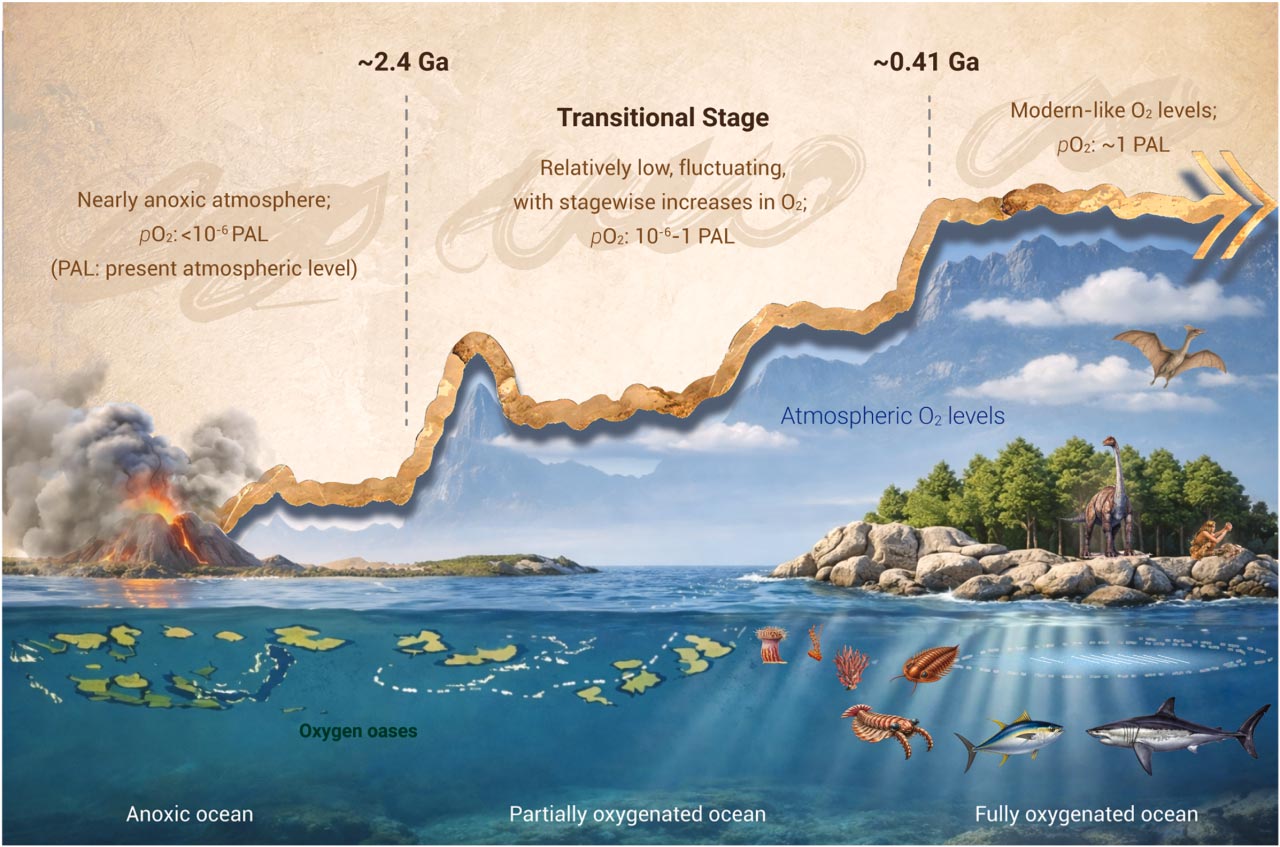
Oxygen nevertheless remained scarce. Models based on the isotope evidence place mid-Proterozoic atmospheric oxygen at just 0.1% to 1% of modern levels. Charcoal, which requires roughly three-quarters of today’s oxygen concentration to form during burning, first appears around 420 million years ago.
The oceans could drain atmospheric oxygen
Atmospheric and ocean oxygen generally increased together over billion-year timescales, although they could move in opposite directions over millions of years. When oxygen entered seawater containing accumulated organic carbon and sulfide, chemical reactions consumed the gas and could lower atmospheric levels. Some geological signals previously interpreted as oxygen increases may therefore indicate declines.
Oxygen also spread unevenly through the oceans. Photosynthetic microbes created localized oxygen-rich environments as early as 3 billion years ago, or earlier. These dominated during the Archean, before oxygen supplied from the atmosphere became increasingly important. The ocean interior did not become fully oxygenated until approximately 410 million years ago.
Rising oxygen opened new possibilities for life
For life, the transition was gradual. An oxygen-free atmosphere severely limited organisms dependent on the gas, while fluctuating levels during the Proterozoic opened new habitats as animals evolved. After the third atmospheric increase, greater oxygen availability helped support larger bodies, active predation, and expansion into deeper waters.
The researchers caution that the isotope record has limited time resolution, oxygen concentrations after 1 billion years ago remain poorly constrained, and additional increases may have gone undetected. Their findings suggest that Earth’s transformation into an oxygen-rich world was shaped not only by rising atmospheric levels, but also by the long delay before oxygen reached the ocean depths.
Reference: “Stagewise oxygenation of the Earth’s atmosphere and oceans” by Haiyang Wang and Chao Li, 17 March 2026, The Innovation.
DOI: 10.1016/j.xinn.2026.101353
Financial support was supported by the National Key Research and Development Program of China (grant no. 2022YFF0800100 to C.L.) and the National Natural Science Foundation of China (grant nos. 42425002 to C L. and 42572129 and 42103072 to H.W.).
Never miss a breakthrough: Join the SciTechDaily newsletter.
Follow us on Google and Google News.